
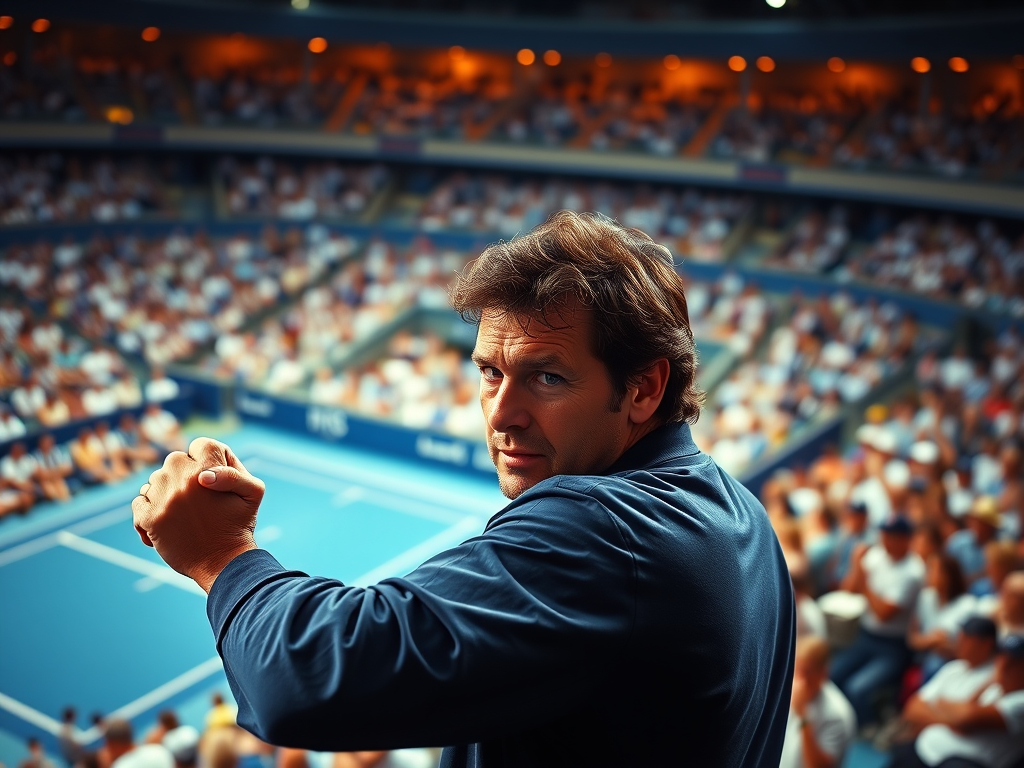

When people look back on the golden age of professional tennis, names like Björn Borg, John McEnroe, and Ivan Lendl immediately come to mind. Yet for many fans, it was Jimmy Connors—the fierce competitor from Belleville, Illinois—who embodied the raw, untamed spirit of the sport. Across a remarkable 24-year career, Connors captured eight Grand Slam titles, including five U.S. Opens and two Wimbledons, and built a reputation not only as a champion but also as a relentless showman who never bowed to tradition.
Now 72, Connors lives far from the corporate suites and broadcast booths where many of his contemporaries have found comfortable second careers. His memoir, tellingly titled The Outsider, sums up his approach. He prefers to keep his distance from the tennis “legends’ circuit,” where retired stars make paid appearances at Grand Slam events. Instead, Connors spends his time with his wife Patti near Santa Barbara, playing golf with friends, swinging a racket several times a week, and hosting a podcast with his son Brett that blends tennis talk with discussions about sports betting. Financially secure thanks to smart investments, he chooses freedom over fame, privacy over publicity.
The Iconic 1991 U.S. Open Match
For all his victories, Connors’ career is often distilled into one unforgettable match: the 1991 U.S. Open fourth-round battle against Aaron Krickstein. It was Labor Day, Connors’ 39th birthday, and he entered the tournament as a wild card ranked 174 in the world, fresh off wrist surgery. Facing Krickstein, a 24-year-old in his athletic prime, Connors seemed an unlikely contender. Yet what unfolded on Louis Armstrong Stadium became one of the most memorable contests in tennis history.

Krickstein had every reason to expect victory. He had youth on his side, a strong record, and the New York summer heat had been wearing down even younger competitors. But Connors was no ordinary opponent. Famous for defying expectations and energizing crowds with his brash, emotional style, he thrived on adversity. The first set went to Krickstein 6-3, but Connors clawed back with fire and theatrics. Disputed line calls, heated exchanges with chair umpire David Littlefield, and the roars of a New York crowd hungry for drama transformed the match into theater as much as sport.
At one point, Connors berated Littlefield with a barrage of taunts, turning the umpire into a villain in the drama he orchestrated. The crowd erupted, and Connors fed off their energy, winning points with fist pumps and exaggerated gestures. Even as Krickstein regained control to dominate the third set, Connors refused to quit. Down 5-2 in the fifth, he summoned a final burst of energy, chasing balls that seemed impossible for someone his age to reach. Four hours and 41 minutes after the first serve, Connors sealed victory with a backhand volley, arms raised in triumph as the stadium thundered.
Though his run ended in the semifinals against Jim Courier, that comeback became Connors’ signature moment, a final act of defiance that crystallized his legacy. For Krickstein, the loss lingered painfully for years, replayed endlessly during rain delays when broadcasters filled time with classic matches. Over time, however, he accepted it as part of tennis history, even calling it “iconic” despite the personal disappointment.
Life Beyond the Spotlight
Unlike other legends who embraced television roles or sponsorship appearances, Connors never softened his image to fit into tennis’ establishment. He dabbled in commentary and even coached Andy Roddick for a time, along with brief stints mentoring Maria Sharapova and Eugenie Bouchard. Still, he avoided the glad-handing world of tennis politics. According to his son Brett, Connors felt misrepresented in recent coverage and simply chose silence over interviews. That decision has frustrated Brett, who believes his father deserves more recognition in the sport’s history books.
Connors’ refusal to conform extended to his friendships on tour. While he remained close to players like Vitas Gerulaitis and Eddie Dibbs, he deliberately kept emotional distance from rivals he needed to beat, such as McEnroe, Borg, and Lendl. That competitive isolation, Brett explains, was the key to his father’s edge. To Connors, camaraderie risked dulling his hunger to win.
Even his trophies reflect this philosophy. When his family retrieved boxes of memorabilia from storage years after his mother’s death, Connors discarded many of them—especially runner-up prizes. To him, second place was meaningless.
Reconciliation and Reflection
Time has a way of reshaping perspectives. In 2015, Connors and Krickstein reunited for an exhibition at Krickstein’s Florida club. Though Connors had two artificial hips, he played gamely in front of 750 fans, losing 8-4 but delighting the crowd by staying late, posing for photos, and chatting with attendees. For Krickstein, who had once turned away from television whenever their infamous match aired, it was an opportunity for closure.

Today, Connors remains passionate about the sport that defined his life but does so on his terms. He avoids the spotlight yet continues to play and talk about tennis with a sharp perspective that hasn’t dulled with age. He plans occasional visits to New York during the U.S. Open, though not for the limelight—mostly to spend time with Brett and enjoy the city. Asked whether he might step back onto the grounds of the Billie Jean King National Tennis Center, Brett hesitates. “Truth be told, I wish he would,” he says. “I’d like him to get his due.”
Legacy of an Outsider
Jimmy Connors’ legacy lies not only in the numbers—109 tour titles, eight Grand Slams, and a record of consistency that stretched across three decades—but in the way he challenged the establishment. He was loud, confrontational, often vulgar, and unapologetically himself. Fans adored him because he wasn’t polished. He wasn’t polite. He was raw, authentic, and willing to put his emotions on full display. In an era before tennis was softened into global corporate entertainment, Connors gave it edge and electricity.
The 1991 Labor Day thriller against Krickstein exemplifies why Connors remains unforgettable. It wasn’t the final of a major, nor was it technically the highest-quality match. But it had everything that makes sport compelling: youth versus age, discipline versus defiance, calm versus chaos, and ultimately, a legend refusing to bow out quietly. Even today, fans who witnessed it remember the atmosphere, the noise, and the sheer willpower that carried Connors across the finish line.
For a man who still calls himself The Outsider, perhaps avoiding the celebrity carousel of tennis’ old guard is fitting. While others bask in nostalgia under bright lights, Jimmy Connors has chosen a quieter life, defined not by appearances but by independence. His story is not about settling into a comfortable role—it is about continuing to live on his own terms, just as he played the game.
And that may be the truest legacy of all.




Leave a Reply