
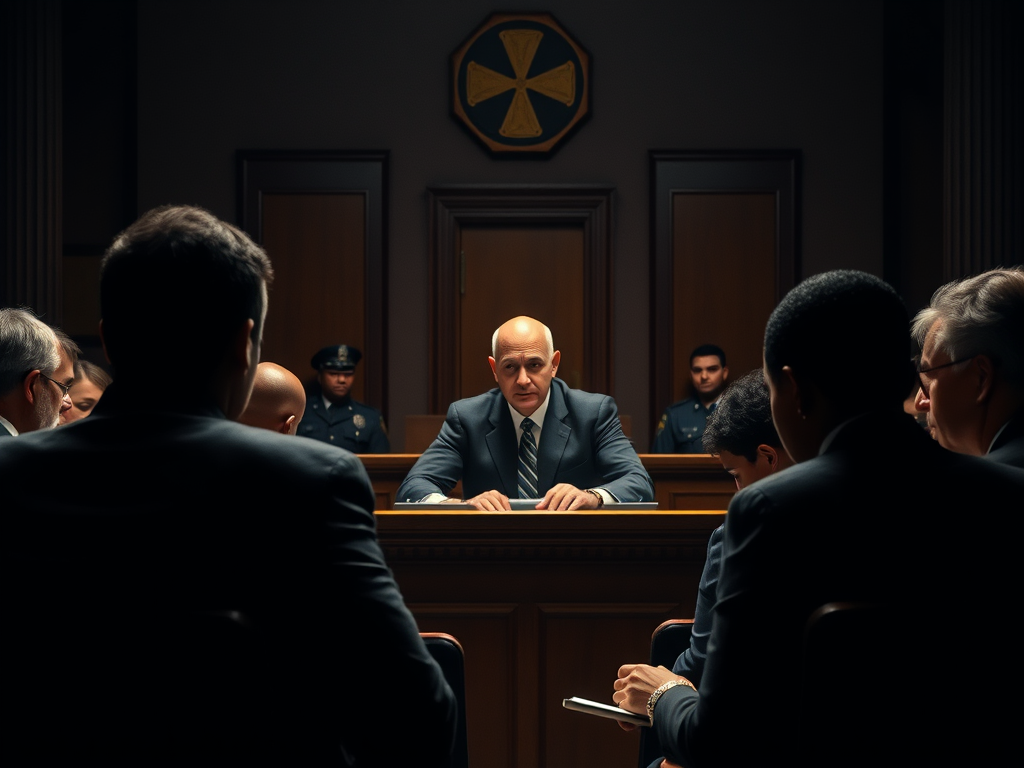

In the nation’s capital last week, as President Trump proudly posed for photographs with police officers, National Guard members, and federal agents in Southeast Washington, a very different scene was unfolding across town inside a federal courthouse. There, defense lawyers and judges were dealing with the consequences of a new era of policing—one that many legal experts believe reflects a dramatic expansion of federal power into local law enforcement. The steady stream of defendants appearing before a magistrate judge that Thursday afternoon offered a striking picture of how ordinary cases are now being treated under the president’s newly imposed order. Many of the charges being processed were the kinds of infractions that, until recently, might have been dismissed entirely or handled quietly in local courts. Instead, they were elevated into the federal system, sometimes with unusually severe charges. The result, according to critics, is a legal landscape where even minor incidents are transformed into test cases for a sweeping crackdown that the president has declared a model for other cities, including Chicago.
Among the defendants was a man arrested for nothing more than possessing an open container of alcohol in public. Another case involved a suspect accused of threatening the president, although the remarks had been made in the middle of a drunken rant following an arrest for vandalism. One weapons case even became so contentious that prosecutors eventually chose to drop it, fearing it could undermine long-term crime enforcement if pursued. To supporters of the administration, these arrests demonstrated resolve and effectiveness. To defense attorneys and even some federal prosecutors, however, the strategy raised alarm bells, suggesting that the administration was more concerned with producing headline-grabbing statistics than with ensuring justice.

One individual swept up in the effort was Mark Bigelow, a 28-year-old part-time delivery driver for Amazon. According to court filings, shortly after midnight on August 19, Bigelow was seated in the middle row of a van parked on a street in Northeast Washington. Two other men occupied the front seats when a large group of law enforcement officers approached, representing not just the Metropolitan Police Department but also federal agencies including the FBI, DEA, ICE, and even the State Department’s Diplomatic Security Service. Officers noticed what appeared to be an open alcoholic beverage in the front seat. While officers questioned and searched the men in the front, Bigelow attempted to quietly exit the van and walk away. He was stopped almost immediately by other agents, and when officers looked more closely inside the vehicle, they claimed to have found another cup containing alcohol near his seat. That discovery led to his arrest on misdemeanor charges for an open container violation.
What followed escalated the case far beyond its original scope. Once handcuffed, Bigelow grew agitated, twisting against the officers and shouting at them, including taunts aimed at an ICE agent. According to prosecutors, he kicked one officer in the hand and struck another in the leg. What would ordinarily have remained a minor alcohol-related offense quickly transformed into a federal felony: assaulting or impeding a federal officer, a crime carrying a potential sentence of up to eight years in prison. This outcome, critics argue, exemplifies how the president’s directive is reshaping law enforcement. Under instructions from U.S. Attorney Jeanine Pirro, prosecutors are being told to file the most severe federal charges possible in each case. Elizabeth Mullin, Bigelow’s federal public defender, told Magistrate Judge Moxila A. Upadhyaya that her client would likely never have faced such charges if not for the president’s new policy. In her words, he was “caught up in this federal occupation of D.C.,” a case manufactured not by his actions but by the unprecedented presence of federal law enforcement.
Another example was the case of 37-year-old Torez Riley, arrested at a Trader Joe’s grocery store after police claimed to discover two handguns in his bag. This case quickly became a flashpoint within the U.S. attorney’s office itself. Several prosecutors reviewing the incident concluded that the search which uncovered the weapons may have been unlawful, potentially violating Riley’s Fourth Amendment rights. Before the crackdown, they argued, such a case might never have advanced beyond an initial review. Despite these concerns, according to insiders, Ms. Pirro initially pushed to pursue charges aggressively. Only after she reviewed body camera footage did she reportedly order the gun charges to be dropped. While her public statement emphasized integrity and the importance of removing firearms from city streets, legal observers noted that pressing such cases could risk adverse appellate rulings. If higher courts determined that Riley’s rights had been violated, they could set precedents making it harder for law enforcement to conduct searches in the future, potentially hindering crime prevention efforts across Washington for years.
While Pirro defended her office’s aggressive stance by declaring that she would always act with integrity and consistency with the law, critics warned that the long-term consequences of forcing shaky cases into federal court could backfire. For many prosecutors, the greater danger was not appearing soft on crime, but that overzealous enforcement might erode constitutional protections and, in doing so, weaken law enforcement’s overall effectiveness.

The crackdown also extended to cases involving threats against the president himself. On August 17, 30-year-old Edward Dana, a man with a history of mental illness, was arrested after police responded to complaints that he had damaged a light fixture outside a restaurant in Northwest Washington. Initially charged with property destruction, Dana reportedly told officers that he was intoxicated after consuming seven drinks. Once placed in the back of a police car, he became increasingly erratic, making verbal threats not only against law enforcement officers but also against the president, declaring that he would use “any means necessary” to protect the Constitution, including violence. His outburst, captured on body camera footage, was reviewed by the Secret Service, which filed a formal affidavit leading to federal charges for threatening the president’s life—a crime carrying up to five years in prison.
At his court appearance, Dana’s defense attorney argued that he posed no real danger and that the true risk came from unleashing federal agents onto city streets in search of cases to justify the crackdown. Judge Upadhyaya pressed both sides to negotiate reasonable conditions for Dana’s release, but she also grew visibly frustrated with the prosecutor’s insistence that Dana’s erratic behavior justified his continued detention. At one point, she snapped, emphasizing that “there has to be a common-sense application of the law,” a remark that underscored the growing tension between strict enforcement directives and judicial pragmatism.
By the end of the week, the judge herself highlighted how strained the system had become. In one final case involving a man arrested on a warrant from Virginia, she could not find any federal agents available to transfer him across state lines. In an unusual move, she persuaded the defense attorney to transport the man instead, citing the extraordinary demands being placed on the court’s time and resources. Her comment—“It’s been like this all week”—was a reminder of how the federal takeover was overwhelming not only defendants and lawyers, but also the very judicial system responsible for adjudicating these cases.
What emerges from these accounts is a portrait of Washington caught in a legal experiment with national implications. For the president and his supporters, the approach demonstrates strength, order, and a commitment to backing law enforcement to the fullest extent. For critics, however, it represents a troubling overreach that risks turning minor offenses into major federal cases, stretching resources thin, and potentially eroding constitutional safeguards in the process. Whether this model will be replicated in other cities, as the president has suggested, remains uncertain. But for those caught in its grip in Washington, the consequences are immediate, personal, and in many cases, life-altering.




Leave a Reply