
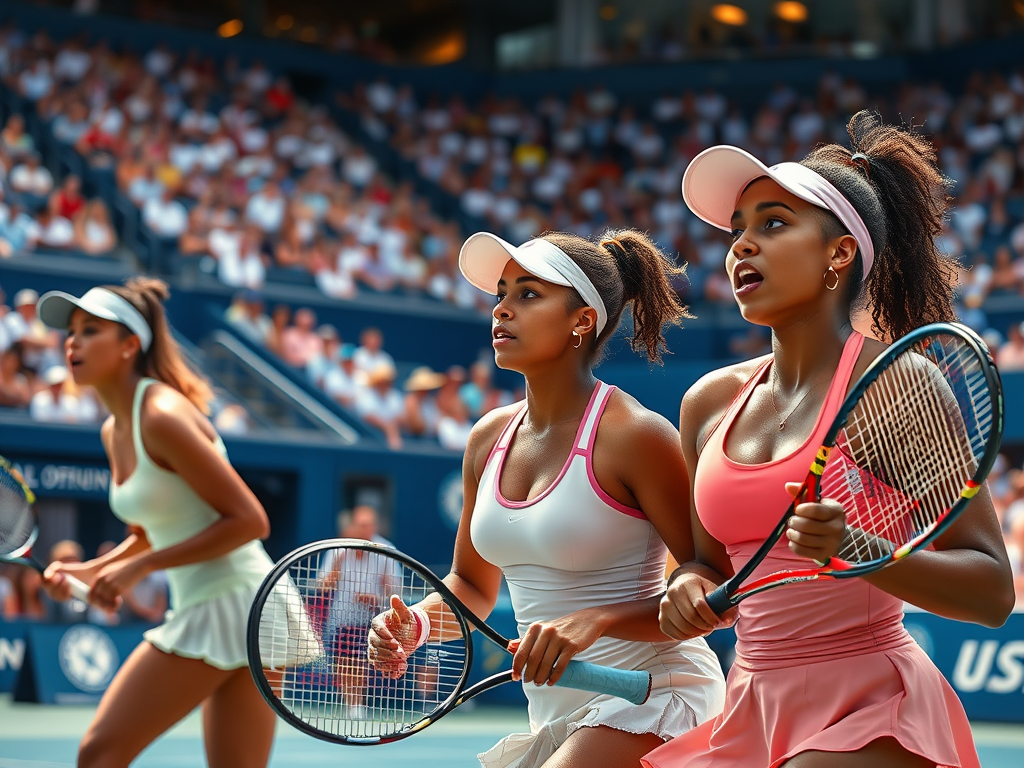

When tennis fans look toward this year’s U.S. Open, the big question is clear: which American woman will rise to the occasion and capture the trophy on home soil? The possibilities seem endless. Coco Gauff, who last lifted a Grand Slam title at the French Open in June, remains a strong contender, even if her shaky summer forced her to bring in a biomechanics expert to fix her serve. Madison Keys, this year’s Australian Open champion, could just as easily make a run, while Jessica Pegula, a U.S. Open finalist last year, and Wimbledon finalist Amanda Anisimova are equally dangerous threats.
One thing is undeniable—American women’s tennis has entered a golden period. For four straight Grand Slam tournaments, at least one American has appeared in the singles final. Two of those finals ended with Gauff and Keys hoisting the trophy. Today, two American women sit inside the world’s top four, three in the top six, and four in the top nine. Emma Navarro, a semifinalist at last year’s U.S. Open, ranks just outside at No. 11, while McCartney Kessler, once outside the top 100, has surged to No. 34 thanks to late-career momentum. Like Navarro, Peyton Stearns, and Danielle Collins—all of whom have claimed WTA titles recently—Kessler sharpened her game in college tennis, a pathway that has become one of the United States’ most effective development pipelines.
Beyond the top 10, the depth is remarkable. Sofia Kenin, the 2020 Australian Open champion, holds steady at No. 28. Ashlyn Krueger has powered her way into the top 40. Taylor Townsend dominates the doubles circuit as the current world No. 1. Rising teenagers such as Iva Jović signal that the next generation is already preparing to step into the spotlight. By contrast, the American men’s side is only just beginning to reassert itself after a decade-long drought. For years now, women have carried the U.S. banner at the sport’s highest level, continuing a legacy built by Serena and Venus Williams.
Gauff summed it up best when she joked at the Cincinnati Open: “The men have to catch up.”

Why American Women Keep Thriving
This dominance is no coincidence. It is the outcome of decades of cultural support, structural investment, and a legal framework that opened doors for generations of female athletes. Title IX, passed more than 50 years ago, mandated gender equality in scholastic sports, ensuring girls had access to facilities, training, and opportunities once denied to them. Over time, this legal guarantee evolved into a cultural expectation: in the U.S., it is normal for girls to play sports, compete fiercely, and aspire to be champions.
Marc Lucero, a veteran WTA and ATP coach who has trained numerous players—including Anisimova—believes social attitudes are crucial. “In the U.S., girls are encouraged to stand out, to compete ruthlessly,” he explained. “In some other countries, the emphasis or resources lean heavily toward boys. That makes a real difference in long-term development.”
The Aspen Institute’s Project Play reports that while boys still participate in sports at a higher overall rate, around 35 percent of American girls ages 6 to 17 engage regularly. That number is enough to create a “critical mass” unmatched by most other nations. In soccer, this same foundation powered the U.S. Women’s National Team to four World Cups and five Olympic gold medals, despite the fact that many countries possess deeper soccer traditions.
Tennis benefits particularly from this culture. Gabriel Echevarria, an Argentine strength coach who has worked with the USTA for more than a decade, explains that many American girls grow up playing catch or throwing balls—movements closely aligned with a tennis serve. “It makes the teaching process easier,” he says.
Lulu Sun, a New Zealander who reached last year’s Wimbledon quarterfinals and later studied in the U.S., noted how unique the system is. “Sports are so much bigger here—it’s almost cultural,” she reflected. “In Europe, you don’t have universities structured around combining academics with athletics. That’s special about the U.S.”

Challenges Remain
Of course, not everything is perfect. Despite the U.S. Open’s long history of equal prize money, most women’s tournaments in America still offer less compensation than their men’s equivalents. Even outside tennis, female athletes struggle with pay disparity. WNBA star Caitlin Clark’s base salary for 2025 is just $78,000—roughly equivalent to the prize for a single first-round win at the U.S. Open.
And while America dominates in depth, smaller nations sometimes outperform in efficiency. The Czech Republic, with a population just three percent the size of the United States, has produced six players in the WTA top 100, including Wimbledon champions Markéta Vondroušová and Barbora Krejčíková. Their secret? An extensive network of clubs emphasizing match play over drills, backed by accessible coaching.
Still, the U.S. holds clear advantages. Its size, wealth, immigration policies, and tennis-friendly states like Florida create an ecosystem that fosters talent from all backgrounds. From country-club prodigies like Pegula and Navarro to players like Gauff and Keys, who rose from modest beginnings, diversity remains one of America’s greatest strengths.

A Rich History, A Diverse Future
The Williams sisters remain the touchstone for today’s players. Their dominance inspired a generation, particularly Gauff, whose father initially coached her much like Richard Williams coached Serena and Venus. Keys trained at the prestigious Evert Academy in Florida, while others like Kenin and Anisimova followed pathways blazed by Maria Sharapova—arriving at Florida academies as children and securing scholarships.
Anisimova’s story highlights the opportunities available. Born in the U.S. after her family emigrated from Russia, she was identified by the USTA as a prodigy by age eight. With steady coaching, resources, and travel support, she flourished. She still credits early mentor Richard Ashby, describing him as “like a second father” and praising both his technical coaching and his lessons in respect and character. Her father’s sudden death in 2019 forced her into a period of reflection, but now she has returned stronger, recently capturing her first WTA 1000 title and a Grand Slam final appearance.
For Kathy Rinaldi, head of USTA player development, such stories show how far the U.S. system has come. When she joined in 2008, she felt the culture lacked cohesion. “Players were on their own,” she recalls. Now, collaboration and mentorship are central. Younger players train alongside seasoned pros at the USTA campus in Orlando, absorbing lessons and building belief. Keys may share a court with Jović, or a 12-year-old may see Ben Shelton lifting weights nearby. The message is clear: greatness is achievable.
The Present and Future of American Women’s Tennis
Tracy Austin, who won two U.S. Open titles before turning 19, sees echoes of her era in today’s resurgence. “They’re complete athletes with well-rounded games,” she said. “Different strengths, but all capable of winning.”
From Gauff’s athleticism to Keys’ power, Pegula’s steadiness, and Anisimova’s shot-making, the U.S. boasts not just one star but an entire lineup of them. Their unity and depth suggest that American women’s tennis will continue dominating not only the U.S. Open but also the broader global stage.
As Gauff put it: “It’s great to see so much representation of our country in the sport.”
And for tennis fans, it is even greater to witness a moment when nearly every Grand Slam final feels incomplete without an American woman in contention. Winning has become more than a goal—it is now the shared identity of U.S. women’s tennis.




Leave a Reply