
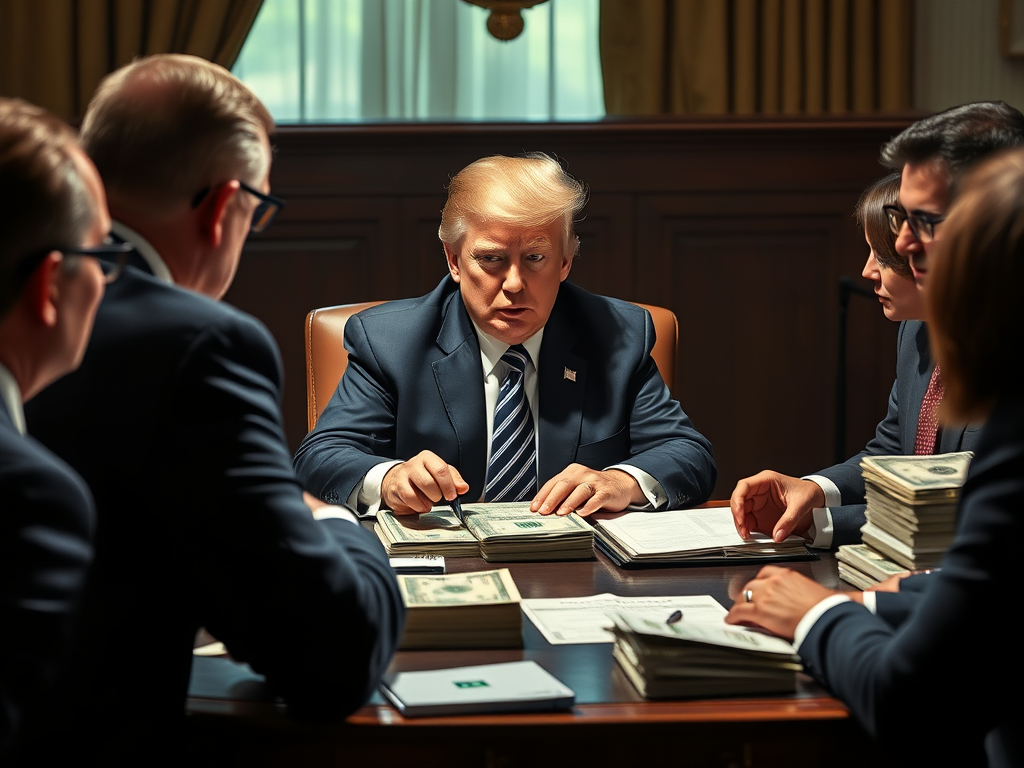

In May, President Donald Trump was presented with what seemed like a straightforward resolution between his administration and Columbia University. Senior officials had worked on an agreement designed to address antisemitism concerns on campus while preserving the school’s access to federal funding. Instead of approving the deal, however, Trump raised the stakes dramatically. According to six individuals familiar with the negotiations, he added an unexpected requirement: Columbia would need to pay $200 million.
This sudden escalation transformed what had originally been a compliance-based negotiation into a financial settlement worth nine figures. University leaders were caught off guard. Columbia had already spent weeks adjusting policies in line with the administration’s demands, believing this would be enough to secure continued federal support. Now, they were faced with an ultimatum: pay hundreds of millions or risk jeopardizing the $1.3 billion in federal grants the institution relied on annually.
Ultimately, Columbia agreed to the unprecedented payment. Officials later admitted they felt they had no choice given the federal government’s financial leverage.
A Strategy Beyond Policy Compliance

Since the beginning of Trump’s second term, his administration has pursued a defined agenda toward higher education. The White House signaled three primary goals: eliminate antisemitism on campuses, reassert traditional gender classifications in athletics and student activities, and diminish what it viewed as liberal dominance within academia.
But the execution of this agenda went far beyond cultural or policy changes. Federal agencies under Trump’s control began using financial leverage to pressure elite universities. Civil rights investigations were launched, billions in federal research grants were frozen, and threats were made to restrict international student enrollment.
What emerged was a broader strategy: settlements that required universities to pay massive sums. Critics quickly compared the approach to extortion, while the White House maintained that the money was intended to fund apprenticeships, trade schools, and vocational training programs—initiatives the administration argued were more aligned with “real-world” career preparation.
Harvard: The Administration’s Biggest Target
While Columbia faced a $200 million settlement, Harvard University became the administration’s ultimate prize. With the largest university endowment in the nation and billions in annual federal grants, Harvard’s refusal to comply voluntarily only intensified tensions.
After Harvard sued the government in April over the administration’s demands, negotiations grew hostile. Trump reportedly expressed personal frustration, stating that “every time they fight, they lose another $250 million.” By the spring, Harvard was facing a $500 million settlement—more than double Columbia’s.
The administration justified the higher figure by pointing to Harvard’s wealth and resistance. Officials conveyed the message that compliance reduced penalties, while defiance multiplied them. Harvard, seeking to avoid the appearance of directly funding Trump’s political projects, pushed for the settlement money to be allocated to vocational and educational initiatives rather than as a direct transfer to the Treasury.
UCLA Faces a Billion-Dollar Demand

Perhaps the most staggering demand so far has been directed at the University of California, Los Angeles (UCLA). With an endowment of roughly $10 billion, far smaller than Harvard’s $53 billion, UCLA might have expected a lighter financial burden. Instead, a draft agreement revealed that the administration wanted the school to pay $1 billion to the federal government and an additional $172 million into a victims’ compensation fund for alleged civil rights violations.
This figure shocked California officials. James B. Milliken, president of the University of California system, warned that such a settlement would devastate the nation’s premier public university system and harm students statewide. Governor Gavin Newsom was even more forceful, denouncing the demand as “a billion-dollar political shakedown” and vowing to take legal action.
The White House, however, dismissed the criticism. Press Secretary Karoline Leavitt responded bluntly when asked about Newsom’s threats: “Bring it on, Gavin.”
Universities Between Compliance and Resistance
The administration’s pressure tactics have created an environment in which universities feel cornered. On one hand, refusing the White House risks billions in lost funding for research in medicine, national security, and technology. On the other hand, compliance requires committing vast financial resources that could otherwise be used for academic development, scholarships, or faculty support.
Columbia’s leaders, for example, debated whether the money should be directed to trade schools, as Trump suggested, or paid directly to the government. Ultimately, paying the Treasury seemed less politically fraught and administratively burdensome than funneling money into programs associated with Trump’s brand.
Other universities, such as Brown, sought alternative arrangements. Brown reportedly agreed to spend $50 million on workforce development initiatives rather than write a check to Washington. Still, White House officials consistently conveyed that the final price tag was nonnegotiable.
Trump’s Broader Pattern of Leverage

Observers note that Trump’s approach to higher education reflects strategies he has employed in other areas, including trade negotiations and legal settlements with corporations. Rather than relying solely on regulatory or legal authority, he introduces financial penalties that are large enough to force institutions into compliance but flexible enough to allow him to claim credit for funding broader policy initiatives.
This method blurs the line between governance and dealmaking. Supporters argue that it holds powerful institutions accountable and redirects elite resources to working-class training. Critics counter that it undermines academic independence and resembles coercion more than reform.
The Future of Higher Education Under Financial Pressure
The standoffs with Columbia, Harvard, and UCLA raise questions about the future relationship between the federal government and American universities. Elite schools depend heavily on federal research grants, but Trump’s administration has demonstrated a willingness to weaponize that dependency.
University leaders worry that compliance may set a dangerous precedent. If financial penalties become the standard tool of federal negotiations, schools could find themselves repeatedly forced to pay massive settlements whenever political disputes arise. This could not only drain resources but also erode the autonomy that universities view as essential to their mission.
Meanwhile, state governments and advocacy groups are preparing legal challenges, arguing that the administration’s tactics amount to unconstitutional overreach and political extortion.
Conclusion
The Trump administration’s financial settlements with elite universities represent a seismic shift in the relationship between government and higher education. What began as policy disputes over antisemitism and campus culture has evolved into billion-dollar negotiations that leave universities scrambling to preserve both their funding and their independence.
Columbia’s $200 million payment, Harvard’s looming $500 million settlement, and UCLA’s unprecedented $1 billion demand highlight how dramatically the administration has raised the stakes. Whether these settlements will ultimately reshape higher education, redirect resources to vocational training, or simply leave universities financially battered remains uncertain.
What is clear is that the balance of power between Washington and academia has been fundamentally altered, and the nation’s most prestigious universities are grappling with a new reality: in Trump’s America, compliance increasingly carries a billion-dollar price tag.




Leave a Reply