
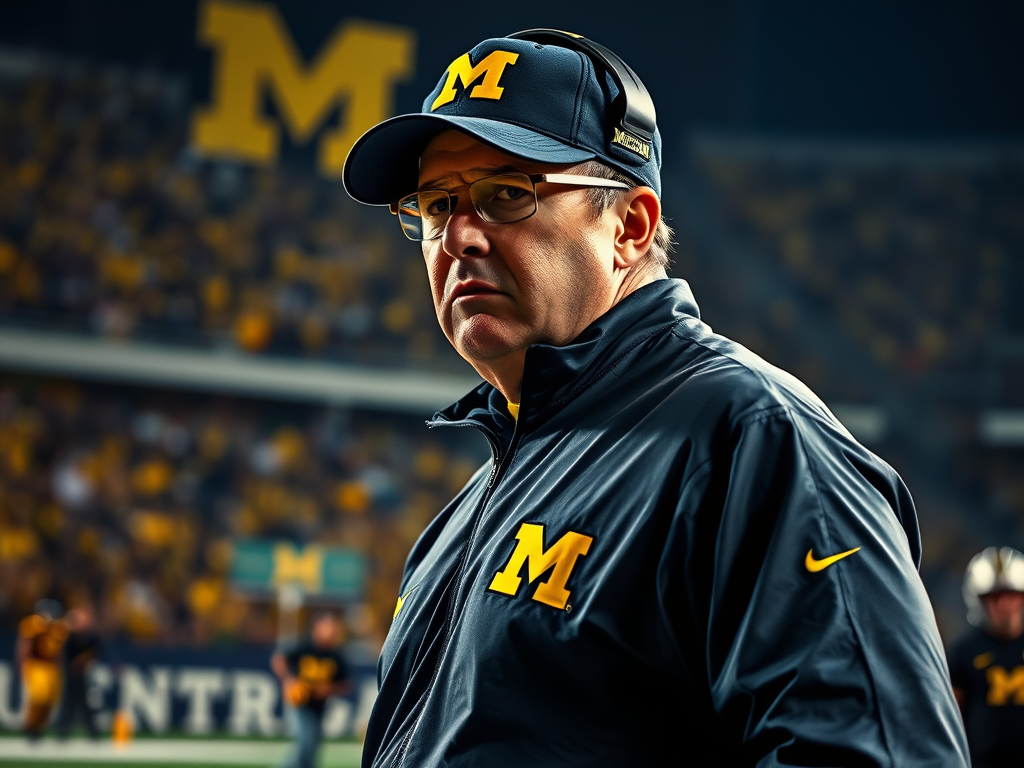

Jim Harbaugh has always been more than just a football coach. He is a figure who embodies intensity, competition, and the relentless pursuit of victory. Yet, as the National Collegiate Athletic Association (NCAA) continues its slow decline into irrelevance, the governing body has chosen to make Harbaugh the centerpiece of one of its final high-profile enforcement actions. In its latest ruling, the NCAA declared that Harbaugh oversaw a program “largely dismissive of rules compliance,” a phrase that carries the sting of an accusation designed to tarnish his reputation.
This finding was tied to the sign-stealing scandal that dominated college football headlines and seemed to become more absurd with each passing day. As punishment, the NCAA imposed a 10-year show-cause penalty on top of an existing four-year penalty, effectively banning Harbaugh from the college sidelines until 2038. By that point, the current Los Angeles Chargers head coach will be 74 years old — ironically, just a year older than legendary NFL coach Bill Belichick is today.
For many fans, the news was startling. But the truth is, perceptions of Harbaugh should not change dramatically because of this development. Over decades of covering both college and professional football, one pattern has remained consistent: elite coaches will do almost anything to win. Whether consciously or by turning a blind eye, they often allow rule-bending by supporters or staff members in pursuit of championships.

The Rise and Struggles at Michigan
To understand Harbaugh’s current situation, it is important to recall his journey at the University of Michigan. When he first arrived, expectations were sky-high. Harbaugh was the program’s golden son, a former star quarterback brought home to restore the Wolverines to glory. Yet his tenure began with struggles, particularly against Ohio State, and a disappointing 16 losses across his first four seasons. The low point came in the pandemic-shortened 2020 campaign, where Michigan stumbled to a 2-4 record.
That year, the university insisted Harbaugh accept a 50 percent cut in his base salary. Publicly, Harbaugh claimed the move didn’t bother him. Privately, however, those close to the coach suggested it stung deeply. Having previously led the San Francisco 49ers to a Super Bowl and boasting a near 70 percent winning record in the NFL, Harbaugh reportedly longed for a return to professional football. Michigan’s message was clear: success was not optional. Winning big was the only currency that mattered.
Harbaugh eventually silenced critics by delivering Michigan’s first national championship since 1997, even as he served multiple suspensions during the 2023 season for unrelated infractions. He mocked the entire process by triumphing in the face of adversity, proving once again that controversy could not overshadow his results.
The NCAA’s Final Blitz
When Harbaugh accepted the Chargers job, many assumed his battles with the NCAA were behind him. Yet the association unleashed what felt like one of its final major strikes, almost reveling in the symbolic punishment of a coach who had become a national champion. Michigan itself is now facing millions of dollars in fines linked to an improper scouting network allegedly operated by former staffer Connor Stalions. His crew, jokingly nicknamed “the KGB,” was accused of attending rival games and filming coaches’ play signals — a blatant violation of NCAA rules.
Harbaugh’s successor, Sherrone Moore, also faced disciplinary measures, with his suspension extended into future seasons. Still, Michigan retained its championship and avoided a postseason ban, ensuring the program’s recent success would remain intact. But despite these side stories, the narrative has always revolved around Jim Harbaugh. His presence, his legacy, and his clash with the NCAA dominate the conversation.
Harbaugh’s Defense and Philosophy
Publicly, Harbaugh has stood firm against the allegations. Speaking as the Chargers’ rookie head coach, he declared:
“Never lie. Never cheat. Never steal. I was raised on that lesson. I’ve raised my family on that lesson. I have preached it to my teams. No one is perfect, and if you stumble, you apologize and make it right. But today, I do not apologize. I did not participate, was not aware, nor complicit in these allegations.”
This defense encapsulates Harbaugh’s larger persona — someone who fiercely rejects any suggestion that his integrity as a leader is compromised, even while critics highlight his relentless, win-at-all-costs mentality.
A Family of Competitors
To fully understand Harbaugh, one must also look at his family. His brother John Harbaugh, head coach of the Baltimore Ravens, once famously reminded a reporter of his 3-0 record against Jim — counting even a preseason game. The Harbaugh family competes in everything, not just football. Those who know them insist that faith and family are genuine priorities. But when inside the walls of a football facility, the focus narrows entirely to victory.
That competitive drive has sometimes erupted in dramatic ways. In his playing days, after Buffalo Bills quarterback Jim Kelly questioned his toughness, Harbaugh literally broke his hand punching Kelly in the face. Nothing, not even accusations of dishonesty, infuriates him more than questioning his will to win.
The Broader Context of College Football
Some defenders of Harbaugh argue that the NCAA itself is hopelessly outdated. In a world where college athletes sign multimillion-dollar NIL (Name, Image, and Likeness) deals, critics question why rules around scouting and sign-stealing remain so rigid. After all, tens of thousands of fans in stadiums can see the same signals being flashed from the sidelines. Coaches like Belichick in the NFL faced similar scrutiny during “Spygate,” yet many argued the fault lay in not protecting signals rather than in filming them.
This debate is hardly new. Even revered figures like John Wooden, often celebrated as paragons of virtue, benefited from booster activity that skirted NCAA rules. His players received improper perks from a well-known UCLA supporter, yet Wooden maintained plausible deniability. History suggests that college sports have always operated in gray areas, with compliance often seen as a burden rather than a moral compass.

The Price of Greatness
At the end of the day, Jim Harbaugh’s story is not one of innocence or guilt alone. It is the story of a coach who, like many before him, prioritized winning above all else. Michigan cut his salary when he failed to deliver victories. He responded by winning it all. The NCAA has now punished him severely, but it cannot strip away the championship he earned or the adoration he enjoys in Ann Arbor.
What this saga reveals is the enduring tension between regulation and ambition in college sports. The NCAA, increasingly viewed as a relic of a bygone era, sought to make an example of Harbaugh. But to many fans, his legacy remains untarnished. He is still remembered as the coach who brought Michigan back to the top, and now as the man leading an NFL franchise with the same relentless energy.
Harbaugh’s career may ultimately be judged not by compliance hearings but by wins, losses, and the culture he created around his teams. Like countless legendary coaches before him, he was not hired to be a moral example. He was hired to win. And on that front, Jim Harbaugh has already secured his place in football history.




Leave a Reply