
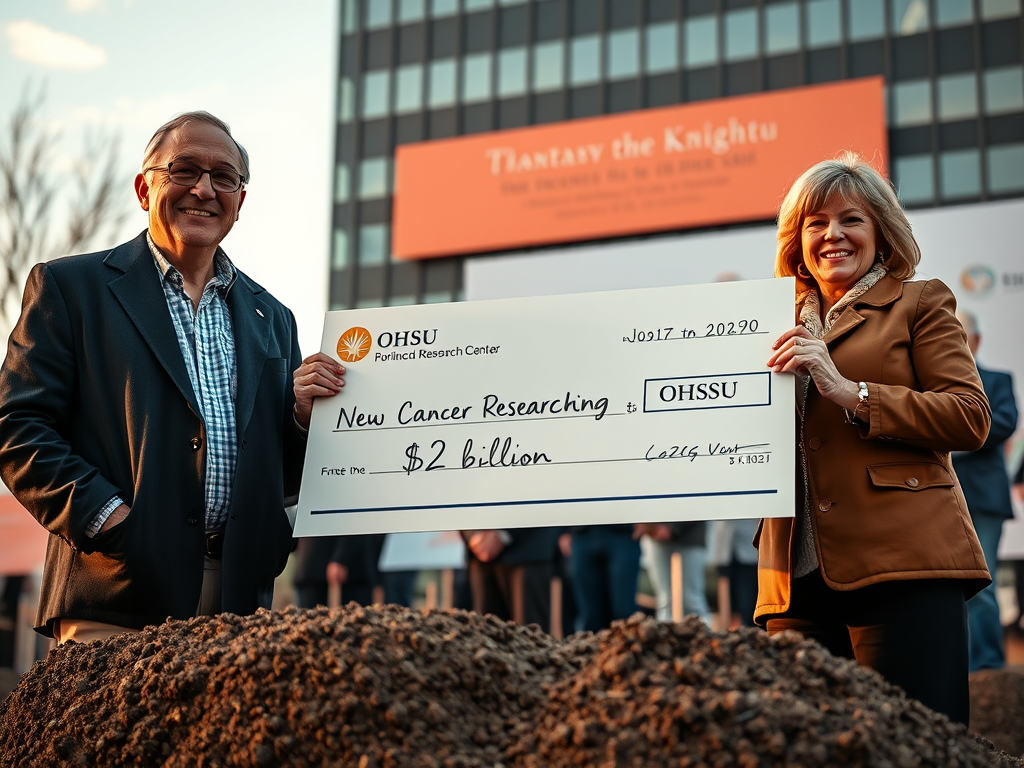

Phil Knight, Ex-Nike Chief, and His Wife Pledge $2 Billion to Oregon Cancer Center

In an unprecedented act of philanthropy, Nike co-founder Phil Knight and his wife, Penny Knight, have pledged an extraordinary $2 billion to the Oregon Health & Science University (OHSU) cancer research center. The institution has described the gift as the largest single donation ever made to a university in the United States, a contribution that promises to redefine the future of cancer diagnosis, treatment, and patient care.
This historic donation is set to supercharge OHSU’s ability to detect cancer earlier, broaden access to groundbreaking clinical trials, and streamline the care experience for patients and their families. Located in Portland, Oregon, OHSU is already recognized as a leader in medical research, but the Knight family’s contribution will give the institution resources on a scale rarely seen in academic medicine.
A Long-Standing Partnership Between the Knights and OHSU
The Knights’ philanthropic relationship with OHSU began more than a decade ago. In 2008, the couple donated $100 million to the university, leading to the cancer institute being renamed in their honor. Their commitment deepened in 2013 with a bold challenge: they pledged $500 million if the university could match the amount within two years. The challenge was met ahead of schedule, raising an astonishing $1 billion in total and catalyzing a wave of innovation in cancer research.
In their joint statement released through OHSU, Phil and Penny Knight expressed their belief in the power of medical innovation to change lives:
“We couldn’t be more excited about the transformational potential of this work for humanity.”
Driving Innovation in Early Detection and Precision Medicine
According to Dr. Brian Druker, chairman of leukemia research at OHSU’s Knight Cancer Institute, the Knights’ previous gifts have already delivered groundbreaking results. The funding helped establish one of the most ambitious early cancer detection programs in the world, spurring the creation of advanced blood tests designed to identify cancer in its earliest, most treatable stages.
The institute has also emerged as a leader in targeted therapies and precision medicine, tailoring treatments to the unique genetic makeup of each patient’s cancer. This approach has revolutionized outcomes for many patients, offering new hope where few options previously existed.
Dr. Druker emphasized that the $2 billion pledge will amplify these efforts:
“Penny and Phil Knight have always challenged us to do what no one else is doing. Navigating the health care system after a cancer diagnosis can feel overwhelming—we’re going to change that. We’ve already transformed how cancer is detected and treated, and this gift will take us even further.”
Phil Knight’s Legacy of Giving
Phil Knight, 87, is best known as the visionary who built Nike into a global sportswear powerhouse, forever associated with the iconic “swoosh” logo. He stepped down as Nike’s president and CEO in 2004, and retired as chairman in 2016. But beyond his business achievements, Knight has earned a reputation as one of America’s most generous philanthropists.
With a net worth estimated at $35.4 billion by Forbes, Knight has consistently directed his wealth toward causes close to his heart, particularly education and health. His alma maters—the University of Oregon and Stanford University—have been major beneficiaries of his generosity.
At the University of Oregon, where Knight competed as a track athlete, his influence is visible across campus. The Knight Library and the university’s basketball arena—named the Matthew Knight Arena in memory of the couple’s late son—are lasting symbols of his commitment to the school. In 2016, he pledged $400 million to Stanford University to launch the Knight-Hennessy Scholars program, attracting graduate students worldwide to tackle urgent global challenges such as climate change and poverty.
Philanthropy at an Unprecedented Scale
While billion-dollar donations to higher education and medical research are rare, they are not without precedent. In 2018, billionaire businessman and former New York City mayor Michael Bloomberg pledged $1.8 billion to his alma mater, Johns Hopkins University. That gift created a financial aid fund to help low- and middle-income students graduate debt-free.
More recently, in 2024, the 93-year-old widow of a Wall Street financier stunned the medical community by donating $1 billion to the Albert Einstein College of Medicine in the Bronx. The donation covered tuition for all students indefinitely, removing financial barriers for future doctors.
Yet the Knights’ $2 billion pledge stands out—not just for its size, but for its focus on accelerating medical innovation in the fight against one of humanity’s deadliest diseases. This donation is more than a record-breaker; it is a commitment to rewriting the playbook for how cancer is detected, treated, and ultimately defeated.
A Future Where Cancer Care Is Seamless and Accessible
Cancer remains one of the leading causes of death worldwide, claiming millions of lives every year. Detecting the disease early is critical, as survival rates are significantly higher when treatment begins in the earliest stages. However, access to cutting-edge diagnostic tools and clinical trials is often limited to patients at major research centers, leaving many without potentially life-saving options.
OHSU’s expanded resources will aim to close this gap. The plan includes:
- Scaling early detection programs to identify cancer before symptoms appear.
- Expanding clinical trials so more patients, regardless of geography, can access the newest treatments.
- Simplifying the patient journey by integrating diagnosis, treatment, and support services into a more cohesive and less stressful process.
If successful, OHSU could set a global standard for patient-centered cancer care.
The Broader Impact of Mega-Gifts on Research
Large-scale philanthropic donations can transform institutions in ways that government grants and traditional funding sources often cannot. They provide immediate capital to invest in ambitious projects, attract top researchers, and accelerate the pace of scientific discovery.
In the case of the Knights’ gift, the impact will ripple beyond Oregon. Breakthroughs in early detection and precision treatment developed at OHSU will likely influence cancer care protocols worldwide. Moreover, the visibility of such a high-profile gift may inspire other ultra-wealthy donors to consider similar commitments to medical research.
From the Track to Transforming Healthcare
Phil Knight’s journey from a University of Oregon track runner to co-founder of one of the world’s most iconic brands is already the stuff of business legend. But his growing legacy in philanthropy—particularly in healthcare—may prove even more enduring.
For the Knights, this is not just about writing a check; it is about reshaping what is possible in medicine. Their $2 billion donation is a statement of belief in human ingenuity, in the power of science to conquer disease, and in the capacity of dedicated institutions like OHSU to lead the charge.
As Dr. Druker noted, the couple’s vision challenges conventional limits:
“They’ve asked us to imagine a future where cancer is no longer a death sentence. With this gift, we can move closer to making that vision a reality.”
A Landmark Moment for Cancer Research
This record-setting pledge is a defining moment for OHSU and for the broader medical community. It reinforces the idea that private philanthropy can be a catalyst for scientific revolutions—especially in areas where the stakes are nothing less than life and death.
The $2 billion from Phil and Penny Knight is more than the largest single university donation in U.S. history. It is a bold bet on the future—a future where earlier diagnoses, more personalized treatments, and greater patient support could turn cancer from a devastating diagnosis into a manageable, and perhaps even curable, condition.




Leave a Reply