
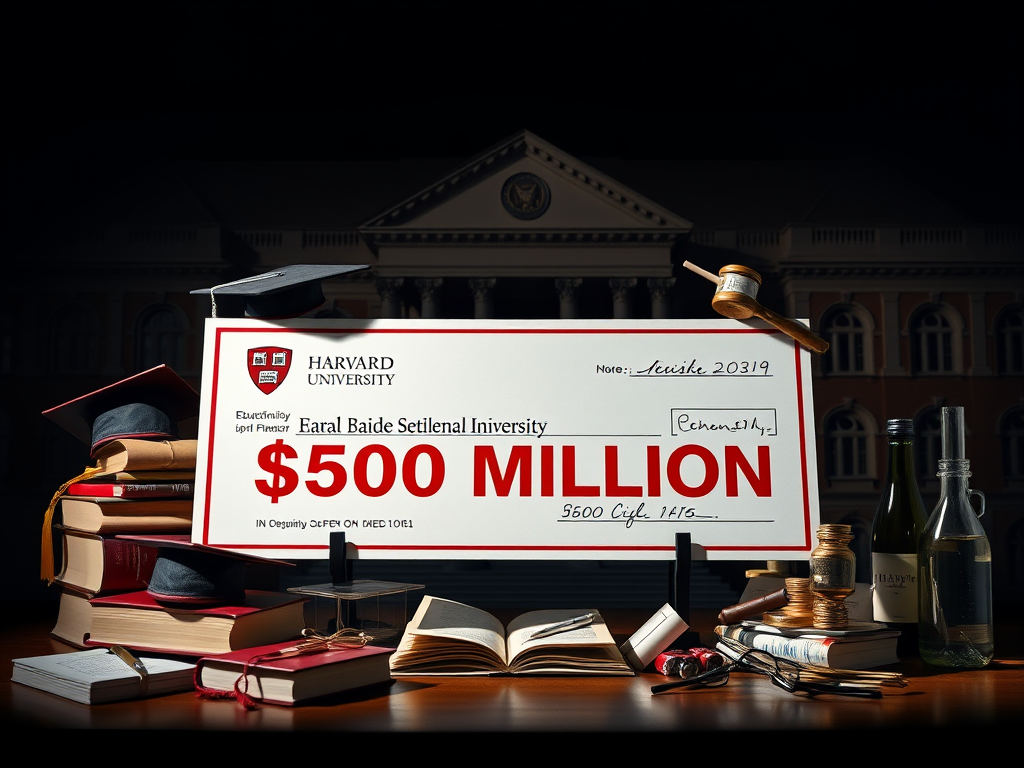

Harvard University and the Trump administration appear to be on the verge of reaching a historic legal settlement that could reshape the relationship between elite universities and the federal government. According to four people familiar with ongoing talks, the tentative agreement would require Harvard to invest $500 million into vocational training, education initiatives, and research in exchange for the restoration of billions of dollars in frozen federal research funds.
Sources say the closed-door negotiations between senior White House officials and Harvard representatives have accelerated in recent weeks, with both sides sketching out the framework of a deal that could bring an end to months of legal and political conflict. However, the agreement is not yet finalized. Final approval is still needed from President Trump and Harvard’s top leadership, and negotiators are reportedly still working through sensitive language in the contract.
The Core of the Proposed Agreement

Under the emerging deal, Harvard would commit to spending $500 million over several years on educational and vocational programs, as well as on research projects. The amount would be more than double the $200 million settlement that Columbia University agreed to last month, a figure President Trump has publicly used as a benchmark in his negotiations with Harvard.
Importantly for the university, the settlement would not involve direct payments to the U.S. government — a major difference from Columbia’s arrangement. Harvard has long insisted that any agreement avoid the appearance of paying the federal government directly, viewing such a move as a threat to institutional independence.
The proposed settlement also includes commitments from Harvard to strengthen its efforts to combat antisemitism on campus. This point has been a central concern for the administration and a recurring theme in public statements from the White House.
In return, Harvard — one of the nation’s largest recipients of federal research grants — would have its research funding fully restored. The agreement would also ensure that no government-appointed monitor would be installed at the university, a condition Harvard has fought for to protect its academic autonomy.
The Trump administration would, in turn, halt a series of investigations targeting Harvard. These include probes by the Justice Department and a newly announced Commerce Department inquiry, as well as moves to restrict the enrollment of thousands of international students at the university.
High Stakes for Both Sides
For President Trump, such a deal would be politically valuable, allowing him to claim that Harvard yielded to his demands and committed substantial resources under his pressure. For Harvard, the agreement would safeguard critical research funding and prevent prolonged federal oversight — ensuring the university maintains its status as a global leader in higher education.
Harvard has been at the forefront of resisting the Trump administration’s pressure campaign on higher education. It remains the only institution to sue the government over punitive funding freezes. This legal confrontation began after the administration issued a series of demands — including political ideology surveys, curriculum audits, and restrictions on the influence of untenured faculty — that Harvard rejected outright.
Following the refusal, the White House moved swiftly to freeze billions in research grants, sparking a legal and political standoff.
Precedents and Parallels
The Harvard settlement, if finalized, could set a precedent for other institutions under similar scrutiny. The administration has been pushing large settlements with other universities, including a reported $1 billion proposal for the University of California, Los Angeles.
Negotiations have been influenced by terms agreed upon in other settlements, such as the one between Brown University and the White House in late July. Brown’s agreement included protections for academic independence, explicit prohibitions against government interference in curriculum decisions, and policies related to the inclusion of transgender athletes and the treatment of Jewish students.
While Harvard agrees with many of these non-financial provisions, it has faced significantly higher financial demands than Brown, which agreed to pay only $50 million over a decade.
The Data Access Dispute
One unresolved issue could derail the negotiations: the administration’s push for greater access to Harvard’s admissions data. The White House has sought detailed statistics on applicants’ race, gender, GPA, and standardized test scores — part of a broader push following a Supreme Court ruling that banned affirmative action.
Columbia and Brown both agreed to share such data under their settlements, but Harvard has been hesitant, calling the demand overly intrusive and a potential threat to privacy and academic discretion. This point remains one of the most delicate in the talks.
Legal and Financial Pressures
Harvard’s lawsuit against the administration, filed in April, argues that the funding cuts violated constitutional protections and procedural rules. A federal judge in Boston has yet to rule, but during July hearings, the court appeared skeptical of the government’s position.
Behind the scenes, Harvard leaders have been pragmatic about the risks of a prolonged fight. Even if the university wins in court, the administration could continue to pressure the institution with investigations and procedural funding delays. With much of Harvard’s $53 billion endowment restricted to specific uses, the loss of federal research funding has already strained its budget. University officials warn that new federal actions, including an excise tax on endowments, could leave Harvard facing a $1 billion annual shortfall.
Resistance on Campus
Despite the urgency from administrators, faculty and students at Harvard have voiced strong opposition to any agreement they see as capitulating to political pressure. Many argue that President Trump could renege on the deal at any time. To address these fears, Harvard negotiators have insisted on structuring any agreement as a binding legal settlement — making it harder for future administrations to alter its terms.
Prominent faculty, such as Nobel Prize–winning economist Oliver Hart, have publicly emphasized the need for clear dispute-resolution mechanisms. “If a party feels the agreement isn’t honored, there should be a defined process,” Hart noted, warning that the government might still find ways to apply pressure even after signing.
What Happens Next
Negotiations between Harvard and the Trump administration began in June, following months of escalating confrontation. While both sides have strong incentives to reach a resolution before the new academic year, the remaining disputes — especially over admissions data — could still sink the deal.
If the settlement goes through, it will mark one of the largest financial commitments ever made by a U.S. university in response to federal demands. It would also send a strong signal to other institutions navigating the political and legal challenges of higher education in the Trump era.
Whether this moment becomes a turning point in the relationship between elite universities and Washington, or merely a temporary truce in a broader conflict, will depend on how faithfully both parties uphold the final agreement.
For now, the higher education community — and indeed much of the political world — is watching closely. A $500 million settlement between the world’s most prestigious university and the U.S. government is more than just a legal deal. It’s a high-stakes negotiation over the very boundaries of academic freedom, institutional independence, and the role of politics in American education.




Leave a Reply