
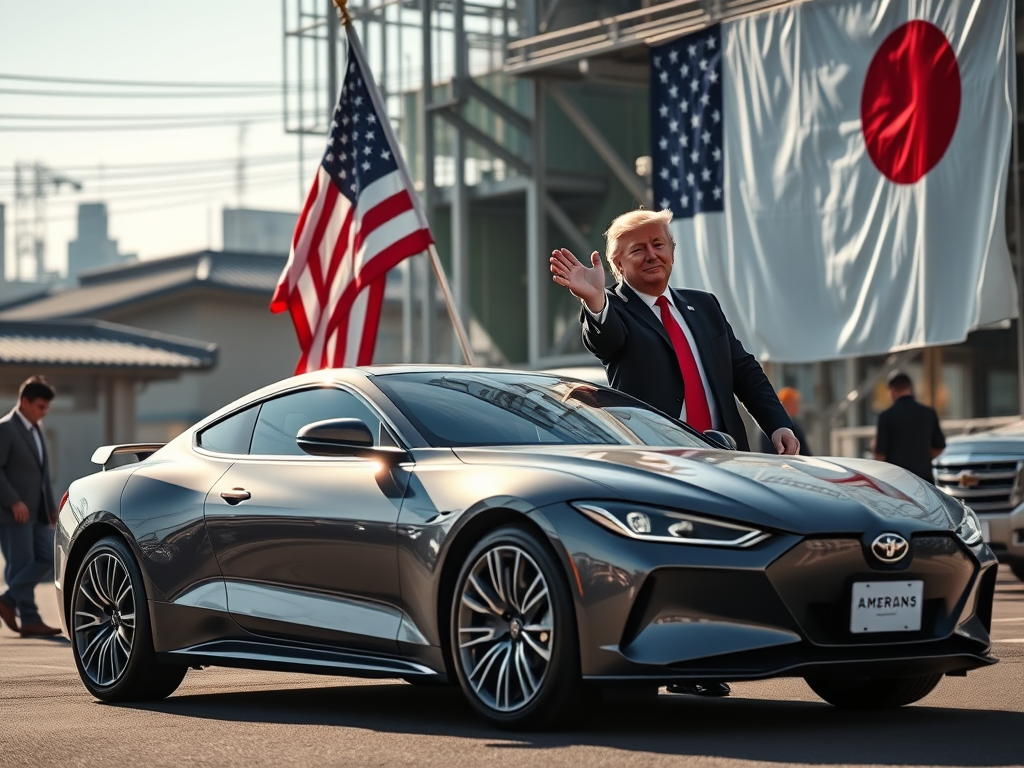

Does Japan Want American Cars? Trump’s Push to Open Foreign Markets Faces Test.

In a significant move last month, former President Donald Trump announced a long-awaited breakthrough in his campaign to open Japan’s auto market to more American-made vehicles. Japan has agreed to ease longstanding restrictions on U.S. car imports — a shift the Trump administration considers a major win after years of lopsided trade dynamics.
For decades, Trump has voiced frustration over the dominance of Japanese car brands on American roads, while American automakers continue to struggle to gain a foothold in Japan. The imbalance has been symbolic of what Trump sees as a broader pattern of unfair trade: the United States maintains open markets, while other countries, in his view, hide behind regulatory walls.
Now in his second term, Trump has intensified efforts to rebalance trade by raising tariffs and pressuring key partners — including Japan, South Korea, and the European Union — to dismantle trade barriers, especially in sectors like agriculture and automotive.
A Pledge, But Not a Breakthrough?
Japan’s recent agreement was part of a larger negotiation in which the U.S. settled on a 15% blanket tariff for Japanese imports, down from the 25% that had previously been threatened. In exchange, Japan agreed to invest heavily in U.S.-based industries and open its domestic auto market to American vehicles. According to Japan’s chief trade negotiator, the country will now allow American cars to be imported without being subject to its unique safety certification process, which differs from U.S. standards.
Trump celebrated the development on social media, calling it “a historic victory for American workers and manufacturers,” and emphasized that “Japan will open their country to trade, including cars and trucks.”

He made similar declarations when concluding a trade deal with South Korea, highlighting that both countries would reduce tariffs and open their markets to more U.S. auto exports.
Why U.S. Cars Don’t Sell in Japan
Despite the public announcement, automotive experts and trade analysts remain skeptical. They point out that the structural challenges American carmakers face in Japan go far beyond regulatory restrictions.
Japan hasn’t imposed tariffs on foreign vehicles since the late 1970s. Nevertheless, American brands like Ford and General Motors have historically failed to gain market share in the country. Ford exited Japan entirely in 2016, citing a lack of profitability and limited growth prospects. In 2024, U.S. car brands represented less than 1% of total sales in Japan.

The obstacles go beyond safety standards. The Japanese consumer market tends to prefer compact, fuel-efficient vehicles tailored for narrow urban roads. Most American car companies, however, focus on larger SUVs and trucks — products that are ill-suited to the local landscape and consumer preferences.
“Trade barriers have never really been the main issue,” said Tsuyoshi Kimura, a professor at Chuo University in Tokyo and a former GM executive. “The truth is, American cars don’t meet the basic demands of the Japanese market. Even if the market is open, the cars still won’t sell.”
According to analysts, altering Japan’s safety testing requirements — which previously added thousands of dollars to the cost of importing American cars — is unlikely to reverse consumer preferences overnight.
Political Messaging vs. Market Reality
From a policy perspective, Trump’s insistence on prying open the Japanese auto market reflects a broader pattern in his trade strategy. During negotiations for the United States-Mexico-Canada Agreement (USMCA), Trump similarly pushed for greater access for U.S. dairy products, which had limited potential impact but carried strong symbolic value for key domestic constituencies.
Alan Wolff, a senior fellow at the Peterson Institute for International Economics, noted that while Trump could have pursued broader and more strategic trade reforms — such as currency alignment — he tends to focus on high-visibility wins. “Targeting specific sectors like autos or agriculture plays well politically, even if the economic impact is modest,” Wolff said.
Former Commerce Secretary Wilbur Ross, a longtime Trump ally, echoed that sentiment. While he acknowledged that regulatory changes alone wouldn’t drive Japanese consumers to buy more American cars, he argued that removing such barriers is a matter of fairness and principle.
“We’ve been locked out of foreign markets by design,” Ross said. “It’s time we push back more aggressively than past administrations ever did.”
Ross recounted past negotiations with the European Union over food safety rules — specifically, the ban on American chicken treated with chlorinated washes. He proposed letting consumers decide: put the products on grocery store shelves, clearly label them, and let the market dictate the outcome. The EU has since agreed, in a recent deal, to begin addressing agricultural trade barriers, though the details remain vague.

History Repeats Itself?
For many in Japan, the current trade tensions evoke memories of the 1980s and 1990s, when the U.S. and Japan engaged in heated disputes over automotive and electronics exports. In 1995, Japan agreed to reforms aimed at easing dealership access for foreign cars, but American auto sales in Japan remained stagnant.
Ironically, Japanese automakers responded to U.S. pressure not by increasing imports, but by building more factories on American soil — a move that created jobs in the U.S. but didn’t change the trade deficit significantly.
Glen S. Fukushima, a former executive at AT&T and vice president of the American Chamber of Commerce in Japan during that era, remembers the symbolic importance the U.S. placed on driving American cars in Tokyo. After one meeting with then-U.S. Ambassador Walter Mondale, Fukushima was encouraged to switch from his Nissan to a Cadillac Fleetwood.
“I gave it a try,” he recalled. “But the car was way too big for Tokyo streets. I had to go back to my Nissan.”
His story illustrates the deeper disconnect between U.S. trade goals and Japanese market realities — a problem that can’t be solved by a policy memo or tariff reduction alone.
Looking Ahead
While Trump’s trade team continues to celebrate the agreement with Japan as a milestone, the road ahead for American carmakers remains uncertain. Opening regulatory doors doesn’t automatically translate into consumer demand, especially in a market as unique and saturated as Japan’s.
Nonetheless, the move signals a renewed commitment by the U.S. to confront what it sees as systemic unfairness in global trade. Whether that will produce meaningful change — or simply repeat the patterns of past decades — remains to be seen.
What is clear is that Trump’s approach has revived old debates, forced foreign partners to the negotiating table, and ensured that trade, once again, is a central issue on the global stage.” Mr. Fukushima said. “He understood.”




Leave a Reply