
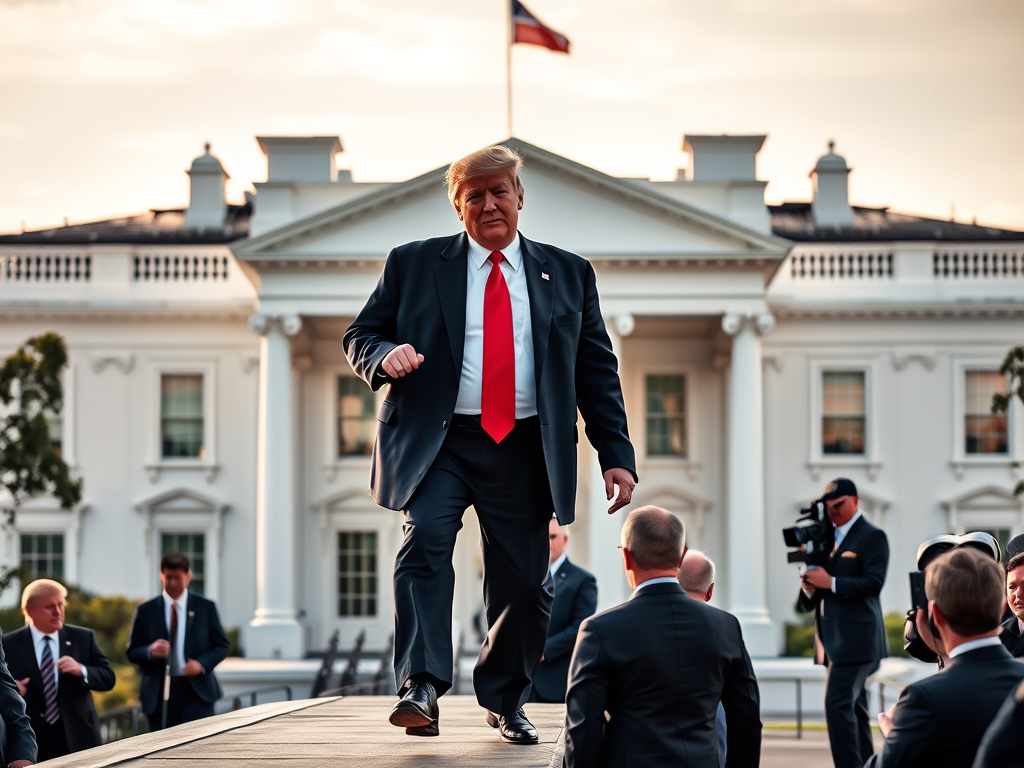

In an unexpected spectacle that left reporters scratching their heads, former President Donald Trump took an unusual morning stroll—on the roof of the White House. The brief yet theatrical appearance was not part of any official announcement, but rather Trump’s personal inspection tour for a grand project he’s proposing: a $200 million White House ballroom.
Standing high above the James S. Brady Press Briefing Room, the former president addressed the gathered press below with little more than a vague explanation: “Just taking a little walk,” he said, while gesturing broadly. The real purpose, it turns out, was to visualize where his opulent ballroom would be constructed—an addition he described as a patriotic act of personal spending.
“I’m spending my money for the country,” Trump shouted to the press corps, his voice echoing down from above.

A Walk That Was Anything But Casual
While the president’s walkabout appeared spontaneous, it was anything but. The Secret Service had locked down the surrounding area, with counter-sniper units stationed discreetly on the rooftop. Trump’s presence near the Oval Office and the newly paved Rose Garden suggested that this “walk” was as strategic as it was symbolic.
He declined to answer any detailed questions—especially when reporters attempted to clarify his cryptic remarks about “something beautiful,” likely referencing the ballroom project. The gesture seemed more about optics than transparency, as Trump continued walking, unfazed.
A Grand Ballroom Amid Serious Policy Turmoil
At a time when many Republican lawmakers are facing angry constituents over polarizing economic legislation, Trump’s ballroom idea has become a welcome diversion—at least for his inner circle. While not an urgent matter of national concern, the project captures attention and shifts the narrative, which is often a strategic goal of the former president.
Though political tempests rage around him—many of his own making—Trump seems content to shape the White House in his own image. If approved and completed, the ballroom would transform the executive mansion into something resembling one of Trump’s own gilded properties, echoing the lavish aesthetic of his Mar-a-Lago estate.
Trump’s “Fun Projects” and the Business of Appearances
On social media, Trump referred to his home improvement efforts as “‘fun’ projects I do while contemplating global affairs—China, Russia, the U.S., and more.” But these efforts also serve as powerful visual reminders of Trump’s branding strategy: turn every space he inhabits into a reflection of his personality.
Inside the Oval Office, he has installed gold-accented decor, baskets, urns, and even drink coasters emblazoned with his name. American flags have been placed prominently across the lawn in theatrical fashion. It’s all part of a growing effort to transform the people’s house into a stage for Trump’s persona.

The White House as a Social Hub
During his first term, Trump frequently used the Trump International Hotel in Washington, D.C., as a gathering place for family, conservative allies, and journalists. With the hotel now closed, it seems the White House itself is being repurposed in a similar vein.
Rather than focusing on campaign rallies or policy events, Trump appears more interested in shaping the White House’s physical and symbolic footprint. Tours continue, but there’s no mistaking who calls the shots upstairs. The aesthetic changes aren’t subtle.
The Rose Garden Makeover Revisited
One of the most notable changes to the White House under Trump’s eye has been the Rose Garden. First Lady Melania Trump had once undertaken a historical redesign of the garden, guided by historians and professional landscape architects. The renovation included the removal of problematic crab apple trees, newly planted roses, and the addition of a refined limestone walkway.
However, the upgraded garden has since been paved over—partially undoing months of design and planning. Additionally, the first-ever piece of artwork by an Asian American artist included in the White House collection, installed in the Rose Garden in 2020, has been quietly removed. An anonymous White House official stated it was “being polished,” but offered no timeline for its return.
As of Tuesday, there was no official comment from the East Wing about the ongoing changes or whether Melania Trump supports the alteration of her original project. When asked about the fate of East Wing offices that may be displaced by the proposed ballroom, the press was referred to the West Wing.

Gilded Taste and Personal Preference
Trump’s control over the White House aesthetic isn’t new. Back in 2017, he overruled the First Lady’s decor preferences, favoring instead the installation of several extravagant, gold-embellished furnishings pulled from the permanent White House collection.
The new ballroom—at 90,000 square feet—would dwarf the size of the current White House residence. Renderings show an event space nearly identical to the one at Mar-a-Lago, often used for high-dollar fundraisers, political dinners, and lavish weddings. At such events, Trump plays both host and star attraction, often stepping out to enthusiastic applause.
Who’s Paying the Bill?
The project’s cost has raised pressing questions about financing. Trump claimed the ballroom would be “funded by me, and other patriot donors,” but the White House has not released specific details.
“I contribute to everything I do. Just like my salary—no one mentions that,” Trump told the media. While this might sound generous, a deeper look tells a different story.

According to official records, Trump did donate portions of his presidential salary during his first term to agencies like the Department of Education. However, those donations declined over time, and no charitable contributions were reported in 2020. The White House has not clarified whether Trump plans to make any donations this year.
Noah Bookbinder, president of Citizens for Responsibility and Ethics in Washington (CREW), expressed concern over the funding strategy. “This approach is highly unusual,” he said. “There’s a real risk that donors may view this as a chance to curry favor with Trump and his circle.”
A Private Residence Turned Presidential Portfolio
Ultimately, Trump’s efforts to reshape the White House reflect more than personal taste—they signal a shift in how he views the presidency itself. For him, the executive mansion has become an extension of his business empire and personal brand, more akin to a luxury resort than a public institution.
As Americans contend with economic challenges, domestic policy shifts, and international crises, the president’s attention appears fixated on gold fixtures and ballroom blueprints. For Trump, it seems, the appearance of power remains as important as its execution.




Leave a Reply