
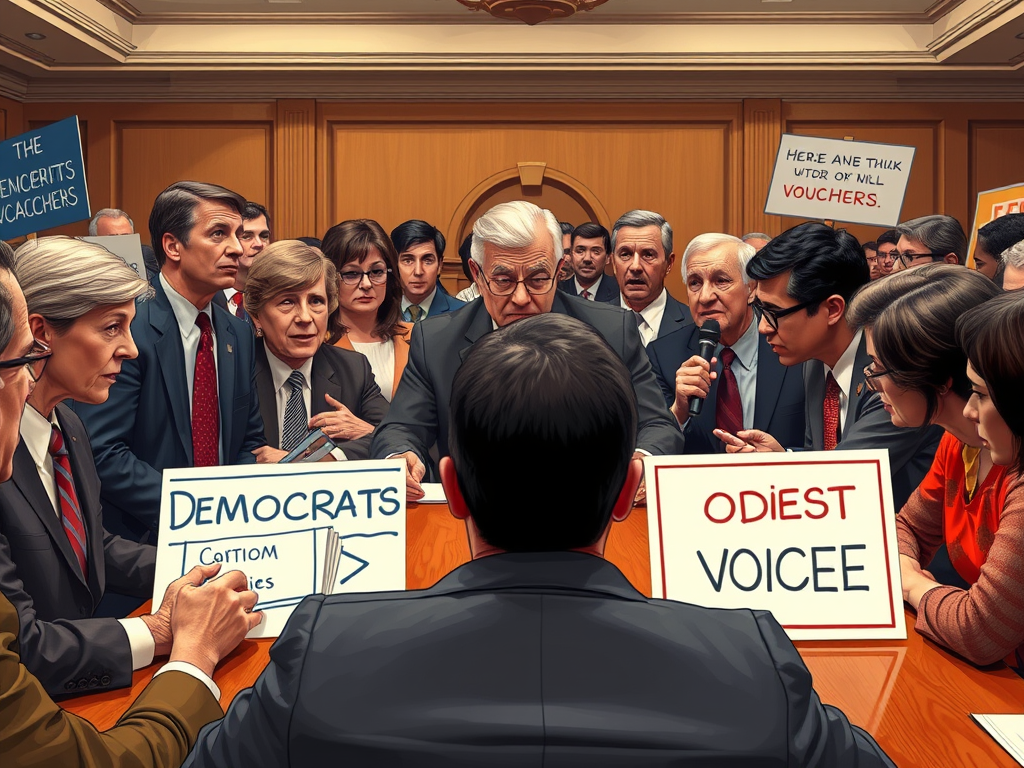

Democratic Group Pushes Party to Embrace G.O.P. School Voucher Plan

As tensions continue to mount within the Democratic Party, key issues such as transgender rights, immigration, the Israel-Palestine conflict, and housing affordability are already stoking internal divisions. Now, the battleground has expanded to include education policy, particularly around the controversial topic of private-school vouchers.
The latest flashpoint is a provision in former President Donald Trump’s recent federal budget proposal. The bill outlines the first-ever national private-school choice program, a significant move that gives states the option to participate or opt out. The decision will place Democratic governors in a politically sensitive position, one that advocacy groups on both sides of the issue are working feverishly to influence.
A Divisive Proposal Gains National Attention
The proposed federal program, funded through a tax credit initiative, aims to provide education scholarships to families across a range of income levels. These funds could be used not only for private-school tuition, but also for tutoring, exam fees, or other educational services — even by students who remain in traditional public schools.
Supporters describe the program as a lifeline for underserved communities, while critics argue it will divert crucial resources from public schools. With the 2024 election still fresh in voters’ minds, education policy has once again become a central ideological fault line in American politics.
Among those championing the voucher program is Democrats for Education Reform (D.F.E.R.), a group with deep roots in the Obama-era education movement. The organization is pushing Democrats to cross a traditional party line and reconsider their opposition to private-school choice, a stance that many progressive leaders view as an affront to public education principles.
Former Obama Officials Embrace Change
Jorge Elorza, CEO of D.F.E.R. and former mayor of Providence, Rhode Island, has become the public face of this pivot. Elorza argues that vouchers have growing appeal among working-class Black and Latino voters, many of whom supported Trump in the last election. Winning back these constituencies, he insists, will require Democrats to move beyond old ideologies and embrace a more pragmatic, choice-based approach to education.
Speaking at the recent Democratic Governors Association meeting in Madison, Wisconsin, Elorza made the case that opting into the federal voucher program is simply “common sense.” He emphasized that the program doesn’t just support private school tuition, but also public-school students seeking tutoring or exam support.
“This is literally free money,” Elorza told attendees. “And it’s supported by voters who are increasingly drifting away from the Democratic Party. Ignoring it isn’t a political option anymore.”
Opposition Remains Fierce Within the Party

However, not everyone within D.F.E.R. agrees. The group’s shift in position has caused internal ruptures, with two of its former leaders publicly breaking away. These dissenters are now forming a new organization that rejects private-school vouchers while still advocating for other forms of school choice, such as public charter schools and expanded intra-district enrollment options.
The emerging group plans to launch both a political action committee (PAC) and a think tank, focusing on promoting accountability, choice within the public school system, and resisting privatization. Their new initiative, named the Center for Strong Public Schools Action Fund, will endorse candidates — particularly in the South — who champion public education reforms without resorting to vouchers.
One of the group’s founders, Alisha Thomas Searcy, is a former charter school executive, Georgia state legislator, and past D.F.E.R. regional president. Her co-founder, Garry Jones, previously led political strategy for D.F.E.R. in Texas. Both experienced fierce legislative battles in their respective states over the rise of Education Savings Accounts (ESAs) — flexible voucher-like tools that allow taxpayer funds to be used for private schooling, online learning, homeschooling, and even for-profit education services.
“These programs,” Searcy says, “undermine public education at its core. Our vision is to build a clear, progressive, Democratic path forward — one that protects public schools from being hollowed out by privatization efforts.”

Teachers’ Unions Draw the Line
One of the most formidable obstacles to Democratic support for vouchers is the enduring influence of teachers’ unions. Organizations such as the American Federation of Teachers (AFT), led by Randi Weingarten, have long held sway over party leaders and continue to oppose any policy that redirects funds from public schools to private institutions.
“Vouchers are a vehicle to abandon public education,” Weingarten said bluntly in a recent interview. “They strip resources from already underfunded schools and threaten the foundation of equitable learning for all students.”
Many Democratic governors, particularly those with strong union alliances, are hesitant to endorse policies that could erode traditional public school systems. These leaders have instead focused on combating Trump’s broader efforts to weaken the Department of Education and dismantle federal programs designed to promote racial and economic equity in education.
A New Centrist Coalition Emerges
Interestingly, the Democratic divide is not purely binary. Some party leaders are exploring middle-ground solutions that embrace school choice without fully endorsing vouchers. These policymakers are backing charter school expansion, inter-district enrollment flexibility, and student performance accountability — reforms that aim to provide families with more options while keeping public schools at the center of the system.
This centrist stance appears to resonate with younger, moderate Democratic governors, many of whom are being floated as potential 2028 presidential contenders. Names like Governor Wes Moore of Maryland and Governor Josh Shapiro of Pennsylvania are at the center of this debate.
Moore’s office recently stated that the governor is still evaluating the federal voucher proposal, while Shapiro’s spokesperson confirmed that the Pennsylvania administration is also reviewing the plan, noting that it won’t take effect until 2027.
These governors are walking a tightrope: on one side, there’s the political pressure to modernize education policy in line with shifting voter sentiments; on the other, the risk of alienating powerful union supporters and progressive advocates.

Conclusion: A Defining Issue for the Party’s Future
As the Democratic Party grapples with its identity in a post-Trump, post-pandemic America, education may become one of the most defining policy arenas. With multiple factions forming — pro-voucher reformers, traditional union-aligned defenders of public schools, and centrist innovators — the debate is far from over.
The stakes are high. Millions of families across the country are struggling to access quality education, particularly in low-income and minority communities. Whether Democrats can craft a unified response — or at least one that resonates with their increasingly diverse voter base — will shape not only education policy but the party’s political future in elections to come.
In the coming months, as the federal program edges closer to implementation and more states weigh their options, the Democratic Party will be forced to answer a critical question: Can it evolve its stance on school choice without compromising its core commitment to public education?




Leave a Reply