

Arab States Call for Hamas to Disarm Amid Push for a Palestinian State

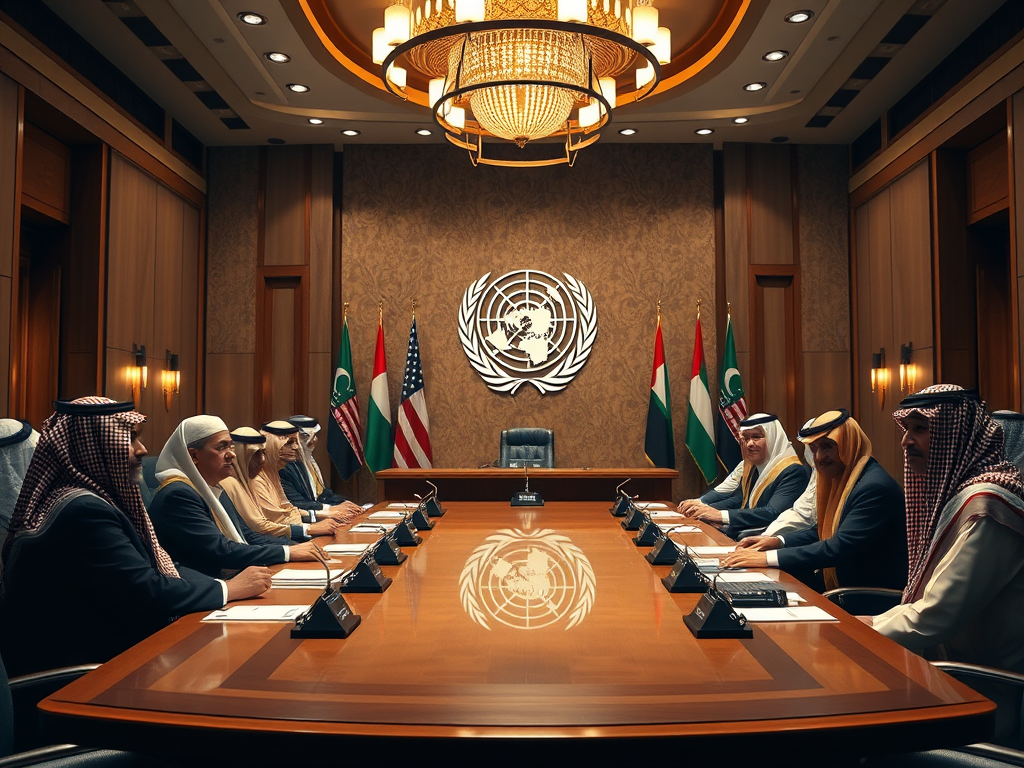
In a historic and unexpected move, the 22 member nations of the Arab League have jointly called on Hamas to relinquish its weapons, release all hostages, and relinquish its control over Gaza. This coordinated appeal marks the first time the Arab world has collectively taken such a definitive stance against Hamas. The declaration, announced at a United Nations conference in New York focused on reviving the two-state solution, was also endorsed by all 27 European Union nations and 17 additional countries, signaling broad international support for a peaceful resolution to the Israeli-Palestinian conflict.
The statement outlines a vision for ending the war in Gaza and establishing a sovereign Palestinian state, beginning with the disarmament of Hamas and the transfer of authority in Gaza to the Palestinian Authority (PA). The Arab League emphasized that this process should take place with international support and under the supervision of the United Nations.
“To achieve peace and an independent Palestinian state, Hamas must relinquish its weapons and control in Gaza to the Palestinian Authority,” the declaration reads. It also proposed deploying a temporary international stabilization force, coordinated by the UN and invited by the PA, to help facilitate the transition.
A Shift in Arab Positioning
This joint declaration represents a significant shift in Arab diplomacy. Despite long-standing solidarity with the Palestinian cause, many Arab governments have hesitated to publicly distance themselves from Hamas due to domestic political sensitivities and their populations’ strong support for Palestinian resistance. Countries like Qatar, which hosts Hamas’s political leadership, have historically served as mediators and refrained from issuing such explicit criticisms.
John V. Whitbeck, an international lawyer with decades of experience advising Palestinian negotiators, remarked on the extraordinary nature of the statement. He noted that while Arab regimes generally oppose political Islam, this declaration reflects a broader concern about Hamas’s armed resistance as a barrier to peace.
“Even among Arab governments that may sympathize with resistance, there’s growing recognition that Hamas’s political and military role is untenable if meaningful progress toward Palestinian statehood is to be achieved,” Whitbeck said.
Hamas’s Tepid Response
Hamas responded cautiously to the Arab League’s demands. While the group expressed appreciation for international support of Palestinian rights, it did not address the core demands of disarmament or relinquishing control over Gaza. Instead, the organization reiterated its call for the unconditional international recognition of an independent Palestinian state.

“Hamas continues to view Palestinian affairs as an internal matter and resists external impositions,” the group said in its statement. It also renewed its call for internal Palestinian reforms, including new presidential and legislative elections, and restructuring of the Palestine Liberation Organization (PLO).
While Hamas’s response suggested openness to political reform, it did not signal any willingness to step aside or disarm—raising doubts about the feasibility of the Arab League’s proposed pathway to peace.
A Conference Amid Crisis
The declaration emerged during a high-level UN conference on the two-state solution, co-hosted by France and Saudi Arabia. Taking place from Monday to Wednesday, the conference coincided with mounting global concern over the humanitarian catastrophe unfolding in Gaza. Shocking images of malnourished children and starving civilians have sparked international outrage over Israel’s restrictions on humanitarian aid deliveries to the war-torn enclave.
More than 125 UN member states participated in the conference, many voicing their support for Palestinian statehood and urging Israel to re-engage with the two-state framework. While the tone was hopeful, most observers acknowledged the immense challenges ahead—not least the continued reluctance of the United States to fully endorse these efforts and the entrenched resistance from the Israeli government.

Max Rodenbeck, the Israel-Palestine director at the International Crisis Group, acknowledged the symbolic power of the renewed focus on the two-state solution. “After years of bloodshed, refocusing international attention on a peaceful solution is commendable. But rhetoric alone will not suffice—concrete actions are needed to restore credibility to the idea of a Palestinian state,” he warned.
Western Resistance
Despite broad international support, the United States and Israel criticized the conference, calling it ill-timed and disconnected from the reality on the ground. Israeli officials argued that the ongoing conflict, the presence of hostages, and the continued activity of militant groups make any discussions of permanent peace or Palestinian sovereignty premature.
Danny Danon, Israel’s ambassador to the United Nations, issued a stark rebuttal, accusing participants of enabling terrorism by discussing statehood while violence continues. “Symbolic recognitions and UN resolutions cannot obscure the reality—some nations fight terrorism, others ignore it,” he said.
Israeli Prime Minister Benjamin Netanyahu has repeatedly warned that moves to recognize Palestinian statehood would reward Hamas’s violence and undercut Israeli security. Israeli officials argue that any initiative that does not address Israel’s security concerns is fundamentally flawed and could prolong the conflict.
Hamas also took issue with any calls for normalizing ties with Israel. In its statement, the group condemned the idea of integrating Israel into the region, branding it a “reward to the enemy for its crimes.”

A Growing Recognition Movement
Despite the criticism, momentum is building behind the recognition of a Palestinian state. French President Emmanuel Macron recently declared that France would officially recognize Palestine in September. The United Kingdom made a similar pledge, tying recognition to the failure of reaching a cease-fire in Gaza by then.
Other countries—including Australia, Canada, Finland, Malta, Portugal, and New Zealand—have signaled their willingness to follow suit. Their support is expected to culminate in the presentation of the “New York Declaration” during the upcoming UN General Assembly.
This document outlines a step-by-step roadmap for resolving the decades-long conflict and formally establishing a Palestinian state. UN member states have until September to endorse the declaration, making the coming months critical for the future of the region.
Conclusion
The Arab League’s historic decision to collectively demand that Hamas disarm and relinquish control over Gaza could represent a turning point in the Israeli-Palestinian conflict. While it remains uncertain whether Hamas will comply, the unified Arab stance underscores growing frustration with the status quo and a recognition that militant governance in Gaza is incompatible with peace and statehood.
With growing global support for a Palestinian state, but also fierce opposition from Israel and a cautious United States, the path forward is fraught with complexity. Still, the “New York Declaration” and the widespread participation in the UN conference suggest that international resolve to revisit the two-state solution may be stronger than it has been in years. Whether this will lead to lasting change, however, will depend on political courage, practical action, and a willingness from all parties to compromise in pursuit of peace.工具




Leave a Reply