
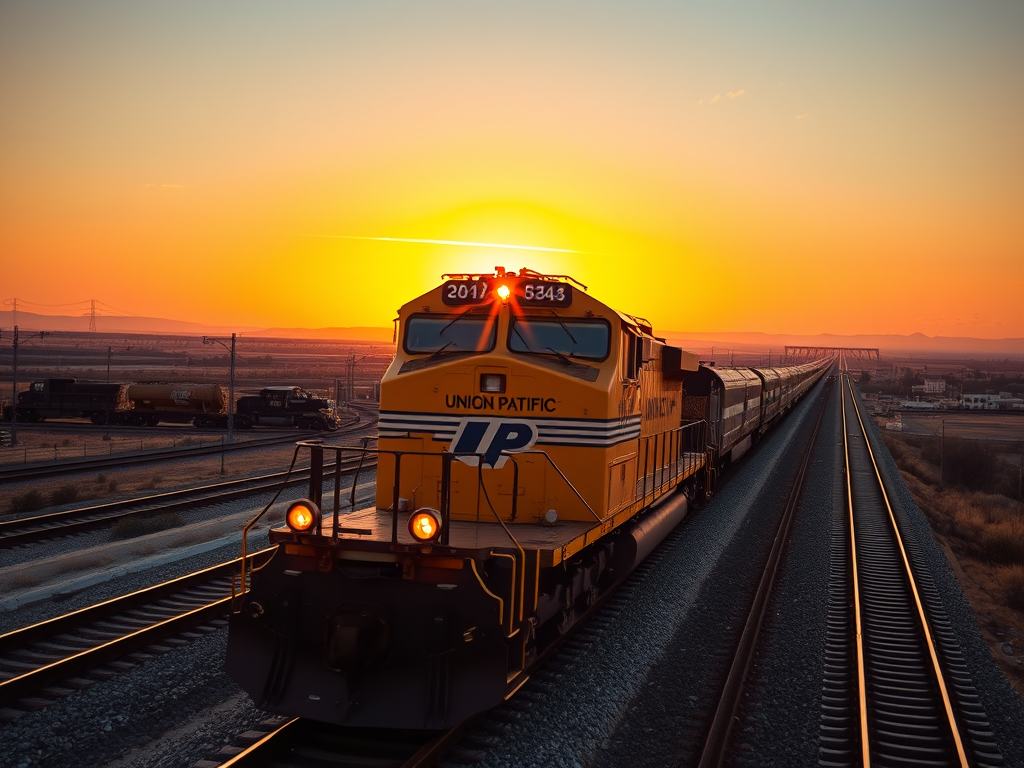

Union Pacific to Buy Norfolk Southern in $85 Billion Railroad Deal

Union Pacific, one of the country’s largest freight rail companies, revealed on Tuesday that it has reached a definitive agreement to acquire Norfolk Southern in a transaction valued at $85 billion. This landmark deal would result in the creation of the first coast-to-coast freight rail network in the United States, spanning approximately 50,000 miles and covering 43 states.
The combined company would represent a significant portion of the U.S. rail freight market—around 40%—raising substantial concerns about a potential reduction in industry competition. Analysts and lawmakers worry that the merger could limit choices for freight customers and increase shipping rates.
Currently, Union Pacific operates its rail lines primarily in the western half of the country, west of the Mississippi River, while Norfolk Southern manages tracks predominantly in the eastern United States. The merger, the companies argue, would eliminate the need to transfer freight between railroads and introduce new, more efficient routes for shippers.
“This merger is a win for American logistics. It gives shipping companies more flexibility and greater speed,” said Union Pacific CEO Jim Vena during an interview. He emphasized the operational benefits the unified company would bring to freight customers.
To complete the acquisition, Union Pacific is offering a mix of cash and stock totaling $72 billion for Norfolk Southern. With the inclusion of Norfolk Southern’s outstanding debt, the full enterprise value of the deal reaches over $85 billion.

Industry experts have already weighed in on the potential benefits. Tony Hatch, a veteran railway analyst at ABH Consulting, described the merger as a move that would streamline operations and improve consistency. “Railroads have long been plagued by delays and inefficiencies. A combined network like this could finally change that,” he said.
The newly formed company will retain the Union Pacific name and will employ more than 50,000 people, the vast majority of whom—about 80%—are union members. However, labor unions have responded to the news with caution. On Tuesday, several unions expressed concerns over safety standards and the security of workers’ jobs.
“This might look like a strategic move on paper, but consolidation has repeatedly led to downsizing and safety compromises in the past,” said Mike Baldwin, president of the Brotherhood of Railroad Signalmen, in a public statement.
In response, Union Pacific’s CEO defended the safety records of both companies, saying that the merger would not result in reduced safety standards. Norfolk Southern CEO Mark George echoed that sentiment and suggested that the union members would eventually support the deal once they saw the job growth it could create. “We’re aligning for growth,” George said. “This is not about cutting jobs—it’s about scaling up, which ultimately means more employment opportunities.”
This acquisition comes roughly two and a half years after a major Norfolk Southern train derailment in East Palestine, Ohio, which involved hazardous materials and disrupted the local community. George confirmed that any remaining liabilities related to that incident would be absorbed by the newly formed company.
The merger must now pass regulatory review by the Surface Transportation Board (STB), the federal body responsible for overseeing railroad mergers and competition issues in the freight industry. The STB will assess whether the deal would negatively impact the competitive landscape of an already concentrated market.
Skepticism is already surfacing on Capitol Hill. In a joint letter sent to the STB on Tuesday, Senators Tammy Baldwin (D-Wisconsin) and Roger Marshall (R-Kansas) raised concerns that the merger could lead to increased shipping costs, less reliable service, and further diminish competition in a sector that has seen a steady decline in the number of major carriers since the 1950s.
While Union Pacific and Norfolk Southern do not directly compete in the same regional markets, the merger would still consolidate a large portion of total U.S. rail freight under one operator. According to an analysis of freight carload data by Jason Miller, a supply chain professor at Michigan State University, the two companies combined accounted for 43% of all rail freight movements last year.
It’s widely believed that Union Pacific and Norfolk Southern are relying on the Trump administration’s broader deregulatory stance toward the rail industry for a favorable outcome. Both companies indicated that they are aiming to finalize the merger by early 2027.
In recent decades, the freight rail industry has been losing ground to trucking services. Despite higher costs, many companies have chosen to ship by truck due to better speed and reliability. A significant issue with rail freight is that cross-country shipments typically need to be transferred between different rail operators—especially in congested cities like Chicago—causing bottlenecks and delays. Vena said that the merger would allow freight to be moved from origin to destination without the need for such stops, increasing efficiency dramatically.
Still, freight customers—including businesses that transport coal, automobiles, chemicals, and consumer goods—may worry that the merged company could use its dominance to raise rates. The number of major freight rail carriers in the United States would fall from six to five following the merger. However, the reality is that most rail freight is already carried by four large operators: Union Pacific, Norfolk Southern, CSX, and BNSF, the latter of which is owned by Warren Buffett’s Berkshire Hathaway.

Speculation is mounting that BNSF and CSX may also consider a merger in response. Such a move would leave just two dominant players controlling nearly 90% of all rail freight traffic in the U.S. When asked about the possibility of a BNSF-CSX deal, a spokeswoman for BNSF pointed reporters to Buffett’s recent statement denying that the company had retained Goldman Sachs to explore such an option. CSX CEO Joseph Hinrichs declined to comment when asked about potential merger talks during a recent earnings call.
If the STB decides to allow the Union Pacific-Norfolk Southern merger to proceed, it may impose conditions to prevent market abuse. For instance, regulators could require the merged entity to grant other carriers access to certain tracks to maintain competitive pressure. Union Pacific’s CEO noted that such sharing arrangements already exist, such as the company’s current agreement with BNSF in the Pacific Northwest.
The STB uses a stringent review standard for major mergers: not only must a deal avoid harming competition, but it must also actively enhance it. Currently, the board consists of an even split—two Democrats and two Republicans—with a fifth seat awaiting a nominee from President Trump, a process that could take several months.
Vena said he was confident the STB would greenlight the merger, believing that the board would ultimately prioritize customer benefits. “We wouldn’t have moved forward if we weren’t sure this deal made sense for shippers,” he said.

Some experts in logistics argue that concerns about reduced competition may be overstated. Professor Jason Miller noted that, even if the four leading railroads eventually consolidate into two, they would still face stiff competition from trucking companies, especially for containerized freight. “They wouldn’t have the power to dictate prices without consequences,” he said.
This merger marks a historic moment for U.S. rail transportation. More than a century ago, financier George Jay Gould attempted to build a coast-to-coast railroad, but his plans collapsed during the financial panic of 1907. Today, Amtrak offers cross-country service, but it does so without owning all of the track it uses. The newly merged freight company would be the first to operate a unified coast-to-coast rail network under a single corporate structure.
Despite the long-term vision, investor reaction was cautious. Norfolk Southern shares fell by 3% on Tuesday, while Union Pacific’s stock declined by 2.4%, reflecting market uncertainty over the merger’s eventual approval and implementation.ay, and Union Pacific’s was down 2.4 percent.




Leave a Reply