
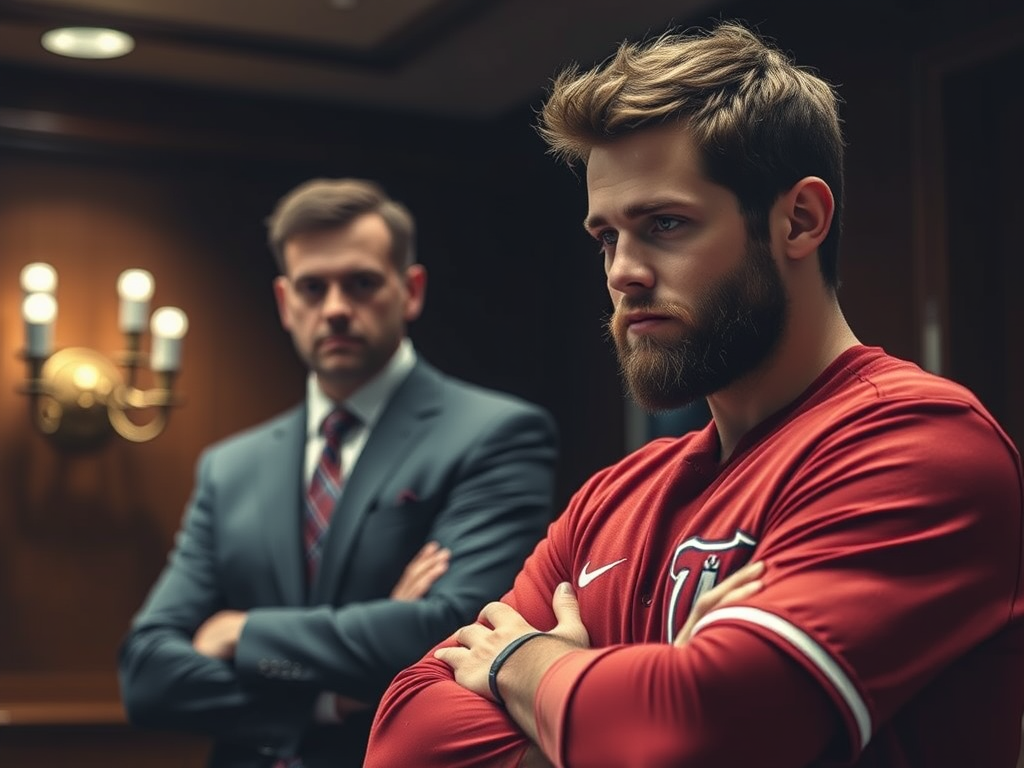

Tensions Rise in MLB as Bryce Harper Confronts Commissioner Manfred Over Potential Salary Cap

Major League Baseball (MLB) has found itself at the center of controversy following a heated meeting between Philadelphia Phillies star Bryce Harper and Commissioner Rob Manfred. The confrontation, which took place during the commissioner’s annual visit with the team, shed light on deepening labor tensions and has sparked concern among players over the league’s future direction—particularly the potential implementation of a salary cap.
A Confrontation That Shook the Room
According to multiple sources familiar with the situation, the incident occurred during a private session where Manfred discussed a range of economic issues with Phillies players. The atmosphere reportedly turned tense when Harper, a vocal leader in the clubhouse and one of MLB’s top earners, reacted strongly to the idea of a salary cap.
“If you’re talking about a salary cap, you can get the f— out,” Harper reportedly told the commissioner. This blunt statement set the tone for the rest of the meeting, signaling deep resistance from the players’ side.
After Manfred concluded his portion of the discussion, MLB Network broadcaster and former player Mark DeRosa—who now works closely with Manfred—stayed behind to engage further with the players. However, his comments would only inflame tensions further.
DeRosa’s Comment: A Joke or a Veiled Threat?
Four sources present at or briefed on the meeting stated that DeRosa made a remark that some players interpreted as a threat. The comment, reportedly delivered in a half-joking manner, implied that Commissioner Manfred held significant power:
“The commissioner’s a powerful guy. Don’t f— around with him.”
While DeRosa later told The Athletic that the comment was made entirely in jest, some players in the room didn’t see it that way. One veteran even raised concerns that the league could use the drug-testing program as a retaliatory tool—a suggestion that reveals a deep-seated mistrust between players and league leadership.
DeRosa, a 16-year MLB veteran and current Team USA manager for the World Baseball Classic, expressed regret that his comment had been taken seriously. “I was just kidding around with a group of guys I thought I had a good relationship with,” he said. “Some of them I’ve managed, some I’ve played with. We were all laughing—it was a joke, nothing more.”
Why Harper Took a Stand

Bryce Harper’s reaction to the idea of a salary cap isn’t just about protecting his own earnings. According to his agent, Scott Boras, Harper’s personal history with MLB’s compensation system makes him particularly sensitive to the issue.
In a statement, Boras explained that Harper signed for a total of $10.9 million in 2010 after being drafted. Just two years later, in 2012, MLB implemented a cap on draft bonuses. The highest bonus awarded that year was $6 million to Byron Buxton—a significant drop from what Harper had received.
“Bryce knows firsthand how salary restrictions can hurt young players,” Boras said. “He’s seen how a cap can erode player rights from the very beginning of their careers.”
Harper, who is in the middle of a 13-year, $330 million contract, is well aware that a salary cap would likely reduce the earnings potential of elite players like himself. Still, he insists his concern is broader than that.
“I’m not going to go into more detail,” Harper said before a recent Phillies game. “Everyone saw what was said. I just want to focus on my team, our union, and winning games.”
The Bigger Picture: Labor Relations in MLB
This confrontation is just one piece of a growing labor dispute within Major League Baseball. Commissioner Manfred has been visiting each team individually this season, attempting to engage players directly on financial topics—especially those related to payroll structure and competitive balance.
Although MLB does not currently operate under a salary cap, team owners have long pushed for one. Players, however, have resisted fiercely, believing that such a system would suppress wages across the board—not just for stars.
These meetings are happening in the lead-up to the next round of collective bargaining negotiations, which are expected to begin in early 2026. With the current agreement set to expire in December of that year, fears of another lockout are already circulating.
The meeting with the Phillies was the longest of Manfred’s visits so far, lasting over an hour. Yet according to attendees, it only widened the divide. “He should have just said the words out loud,” one player said, referring to the salary cap discussion that was hinted at but never explicitly acknowledged.
Deeper Distrust and a Divided Strategy
The MLB Players Association (MLBPA) has expressed growing concern over Manfred’s strategy of bypassing union leadership to speak directly with players. In June, Manfred explained that he felt a disconnect between union leaders and the player base.
“There’s a mismatch between what we’re hearing from the union leadership and what players seem to believe,” Manfred said. “So we’re going straight to the players. We want to give them the information and let them decide if change is necessary.”
But critics argue that this approach undermines collective bargaining norms and may pressure players into accepting terms that benefit ownership. Bruce Meyer, the MLBPA’s deputy director, publicly criticized the practice earlier in July during an appearance on Foul Territory.
“There are players being paid by MLB who are going into locker rooms with the commissioner to promote ideas this union has historically opposed,” Meyer said. “And many of those players never had to live under such systems themselves.”
The Role of Former Players
To support his outreach efforts, Manfred has enlisted the help of several retired stars, including newly inducted Hall of Famer CC Sabathia. These players, part of the Commissioner Ambassador Program, attend team meetings and promote league initiatives. While DeRosa is not formally part of the program, he fulfills a similar role through his media work and past relationships with current players.
This blurred line between advocacy and leadership has drawn criticism from union representatives. Tony Clark, the head of the MLBPA, advised players affiliated with the program to avoid speaking on labor issues altogether.
Manfred, however, denies using ambassadors to influence labor discussions. “They’re not out there carrying my water,” he told The Athletic. “They’re not representing my views on labor or anything else.”
What’s Next?
While Harper has typically avoided the spotlight when it comes to labor politics, this recent incident signals a shift—at least in his willingness to voice opposition when stakes are high.
“I’ve talked about labor before, just not publicly,” Harper said. “It’s not about making headlines. It’s about working with teammates and the union to make baseball better.”
As the league inches closer to its next major negotiation cycle, the clash between players and management appears far from resolved. With emotions running high and both sides bracing for a fight, this moment may be remembered as a turning point in MLB’s ongoing struggle over player compensation and control.




Leave a Reply