

Trump’s Secret $934M Plane Upgrade Exposed

President Donald Trump has never been shy about voicing his outrage over costly government spending — especially when it comes to projects he doesn’t favor. One such example is the $2.5 billion price tag associated with renovations to the Federal Reserve’s headquarters, which he has frequently criticized. Yet when it comes to another high-priced venture involving government funds — one far more personal — the administration remains notably silent.
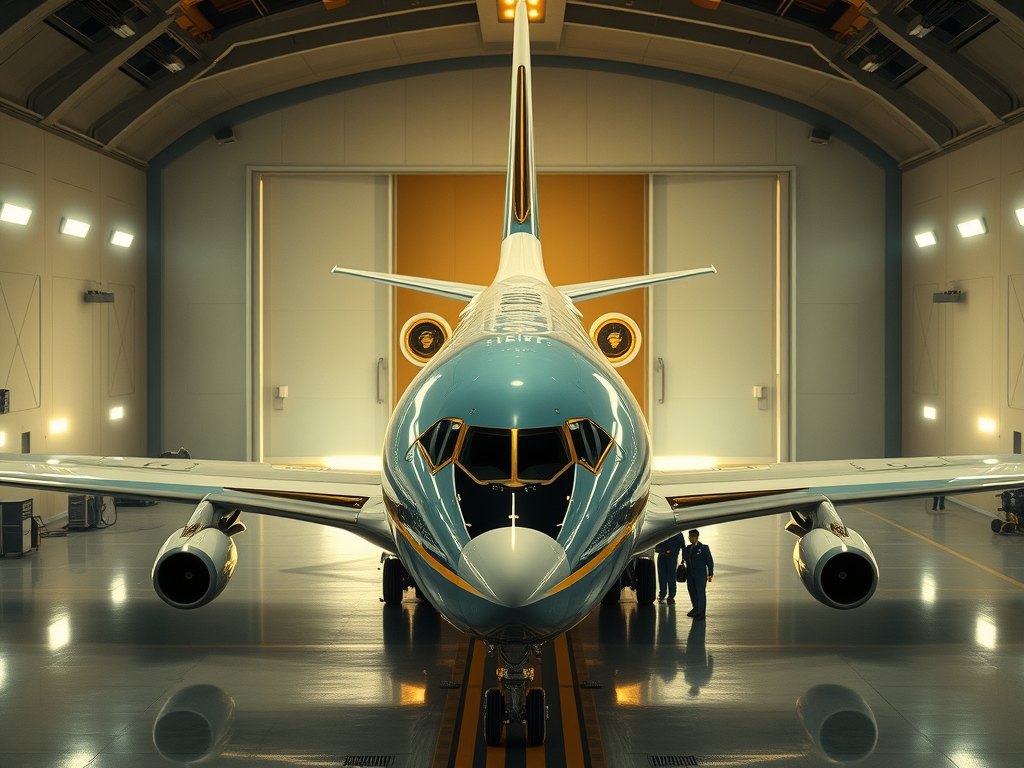
At the heart of this secrecy is a plane: an Air Force One, gifted by Qatar, now undergoing a lavish transformation to become Trump’s custom presidential aircraft. The estimated cost of this refurbishment is officially undisclosed — classified, in fact. But what has drawn scrutiny is not just the luxury makeover itself, but the lengths to which the administration has gone to obscure its true cost from the public and even from Congress.
According to recent reports and whispers from Pentagon insiders, a mysterious $934 million transfer of funds — labeled vaguely as a reallocation to a “classified project” — appears to be linked to this very initiative. This sum was redirected from one of the Defense Department’s most bloated and troubled programs: the modernization of America’s ground-based nuclear missile system.
This so-called “transfer” was hidden deep within an unassuming Pentagon document sent to Capitol Hill, devoid of any detail that might reveal its true purpose. But investigative analysts working for Congress have pieced together enough to strongly suspect that a portion — if not the entirety — of that nearly $1 billion was redirected to pay for the Qatar plane’s extensive upgrades, including advanced communication systems, missile defense, and customized interior finishes reminiscent of Trump’s signature taste in gold and extravagance.

Privately, Air Force officials have conceded that nuclear modernization funds were indeed tapped for the jet’s upgrades, which are being handled at a secretive Texas facility that specializes in classified defense projects. This arrangement was solidified a few weeks ago when the Qatari defense minister and U.S. Secretary of Defense Pete Hegseth signed a memorandum of understanding, authorizing the project to begin.
The aircraft in question is not expected to serve long in an official capacity. According to the president, the goal is to have it airborne before the end of his term. After that, it will reportedly be transferred to the Trump presidential library — an institution that doesn’t yet exist — once he leaves office in 2029.
The optics of such a deal have raised widespread concern. Critics have questioned the ethics of accepting a “gift” aircraft from a foreign government, particularly one with which Trump has had both diplomatic and business interactions. Still, Trump himself brushed off those worries when speaking to reporters this past spring.
“I wouldn’t turn down a plane like that,” he said in May. “Only a fool would say no to a free aircraft worth hundreds of millions.”

But this “free” plane is free only in the way a neighbor might gift you a beat-up car parked on their lawn — the cost of making it usable again is staggering. Among the necessary upgrades: state-of-the-art communication systems designed to remain operational during a nuclear attack, anti-missile defenses, and possibly even scans to ensure that no Qatari surveillance equipment was left onboard. Removing potential eavesdropping devices is a priority for U.S. intelligence officials.
Beyond the technical necessities, the plane is being retrofitted to reflect Trump’s distinct taste. The interior will reportedly include plush seating, luxurious furnishings, gold trim, and a presidential bedroom that can double as a medical bay in emergencies. The top deck will house a lounge area and secure communication center — essentially a flying command post.
All of this adds up quickly, leading many to speculate that the final cost could vastly exceed the unofficial estimates. While Trump administration officials have floated the idea that the refurbishment might come in under $1 billion, others aren’t so optimistic. Experts familiar with similar defense aviation projects argue that even the low-end estimates — around $400 million — are likely unrealistic, especially if the aircraft is expected to match or exceed the capabilities of the current Air Force One.
Adding further intrigue, this new plane enters the picture at a time when Boeing has failed to deliver the two new Air Force One aircraft that were originally scheduled for completion last year. The delays in that project — which has ballooned to over $4 billion — reportedly pushed Trump to seek an alternative, ultimately resulting in the acceptance of the Qatari gift.

Still, questions remain about how the funding for the Qatar jet was obtained, and why the Department of Defense chose to reallocate nearly a billion dollars from a critical nuclear program called the Sentinel. This initiative, originally presented to Congress as a $77.7 billion effort to replace 400 aging Minuteman III missiles, has already soared to $140 billion, a near doubling of its cost in just a few years. The upgrades include building hardened silos and communication networks capable of withstanding both nuclear and cyber attacks — infrastructure considered vital to national security.
The Sentinel project was meant to update a Cold War-era leg of America’s nuclear triad, which also includes submarine-launched missiles and air-delivered weapons. However, some nuclear policy experts argue that land-based systems are now obsolete — easier to detect, slower to deploy, and more vulnerable than submarine or bomber-based deterrents. Yet, due to their strategic symbolism and the political value they bring to rural states like Montana, Wyoming, and North Dakota (where missile silos provide thousands of jobs), the Pentagon has been reluctant to cut this leg of the triad.
But it is this very project — deeply over budget and perpetually delayed — that the Trump administration has reportedly used as a financial smokescreen. By embedding the Air Force One renovation costs within the Sentinel program’s massive ledger, the administration effectively shielded those expenditures from scrutiny.
At a congressional hearing in June, Air Force Secretary Troy E. Meink tried to allay concerns. “We think the actual retrofit cost will be significantly lower than $1 billion,” he stated. “Many of those expenses would have occurred anyway; we’re just advancing the timeline.” He estimated the true cost might be “less than $400 million.”

However, many in Congress remain skeptical. Some lawmakers fear that rushing the refurbishment process could lead to compromised security or technological shortcomings. When asked directly about the project’s financial details, Air Force representatives declined to comment, citing national security classifications.
This level of secrecy has drawn criticism from lawmakers across party lines. Senator Jeanne Shaheen of New Hampshire, a senior member of the Senate Armed Services Committee, expressed grave concerns: “It’s troubling enough that we’re accepting a lavish gift from a foreign power, but even worse is the fact that the administration is quietly pulling money from the nuclear modernization fund to pay for it.”
She continued, “This sends the wrong message about our national priorities. It’s a disservice to national defense to bankroll a vanity project under the guise of classified budgeting.”
The Pentagon, meanwhile, has remained tight-lipped. Budget officials confirmed that the $934 million diverted to the classified project was effectively reimbursed with the passage of a recent reconciliation bill. But whether that money truly replenishes the nuclear missile program or merely masks new expenditures is anyone’s guess.
In Washington, where black budgets and classified programs are often used to obscure inconvenient truths, Trump’s golden plane is becoming the latest symbol of unchecked executive spending cloaked in secrecy. And as its wings are fitted with armor and opulence, it soars not just through the skies, but through one of the capital’s murkiest fiscal clouds.id, “we’re weakening our credibility to fund a vanity project for President Trump.”




Leave a Reply