

Trump Escalates Attacks on Obama and Clinton as Questions Swirl About Epstein
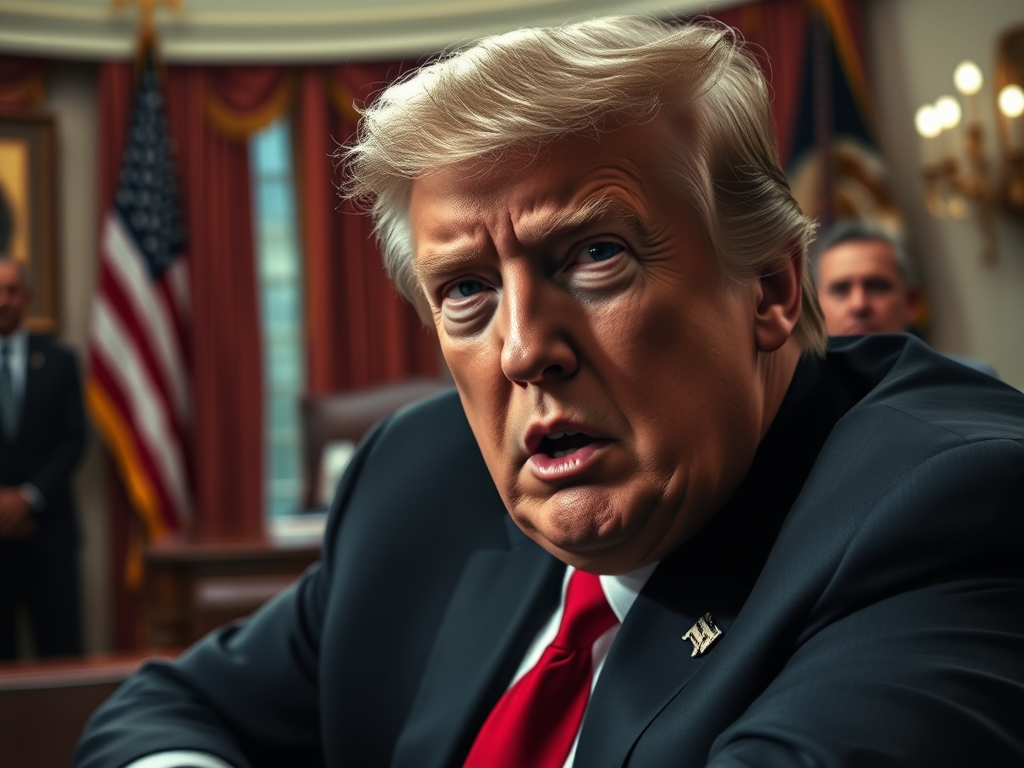
Under intensifying scrutiny over how his administration has handled revelations related to Jeffrey Epstein, former President Donald Trump on Tuesday escalated his tactic of diversion by making sensational accusations against former President Barack Obama. During a press event in the Oval Office, Trump alleged that Obama committed treason, stating bluntly, “It’s time to go after people.”
The remarks were made as Trump faced renewed questions about his past connections with Epstein, the disgraced financier who was facing federal sex trafficking charges before his death. Rather than addressing those questions directly, Trump dismissed them as part of a broader political attack, referring to the Epstein-related inquiries as “sort of a witch hunt.” He then quickly shifted focus, launching into a tirade targeting long-time political adversaries and members of the media.
“The real witch hunt is the one you’re not talking about,” Trump said, referencing a controversial report issued by Tulsi Gabbard, currently serving as Director of National Intelligence. The report seeks to challenge the U.S. intelligence community’s widely accepted conclusion from 2016 that Russia had interfered in that year’s presidential election in an attempt to benefit Trump’s candidacy.
“President Obama tried to orchestrate a coup,” Trump claimed. “And Hillary Clinton was part of it.”
These explosive statements were made during a meeting with President Ferdinand Marcos Jr. of the Philippines, further highlighting Trump’s willingness to use high-profile diplomatic settings to pursue his agenda of retaliation. His comments are part of a broader campaign to settle perceived scores with political rivals—an approach that is highly unusual in the history of American presidential behavior.
Trump’s remarks prompted a rare public response from Obama’s team. Patrick Rodenbush, a spokesperson for the former president, called Trump’s allegations “bizarre” and described them as a desperate and transparent effort to distract from the current controversy.
“These ridiculous accusations are not grounded in reality and represent a weak attempt to shift public focus,” Rodenbush stated. He reiterated that the conclusions reached by the intelligence community remain valid: while Russia did try to influence the 2016 election, it did not successfully manipulate vote counts or outcomes.
Despite the efforts to dismiss Trump’s accusations, new reports regarding his past relationship with Epstein continued to surface. CNN released photographs showing Epstein in attendance at Trump’s 1993 wedding to Marla Maples, his second wife, further fueling public interest in their historical ties.
Gabbard’s report, which alleged a “treasonous conspiracy” orchestrated by senior Obama-era officials, runs counter to the comprehensive investigation conducted by the Senate Intelligence Committee. That bipartisan effort was endorsed by all Republican members of the committee, including Marco Rubio, who now serves as Secretary of State. The committee’s findings upheld the intelligence community’s original assessment and found no evidence of manipulated votes, while acknowledging Russia’s influence campaign.
While the Obama administration never suggested that Russia had succeeded in altering vote tallies, it did conclude—alongside bipartisan lawmakers—that the Kremlin undertook a broad effort to sway American voters. Nonetheless, Trump has continued to paint a narrative in which he is the victim of political sabotage.
During Tuesday’s remarks, Trump claimed that he had shown restraint by not prosecuting Hillary Clinton, despite previously leading chants of “lock her up” during his 2016 campaign. However, he made it clear that he would not exercise the same leniency toward Obama.
“I chose to let Hillary off the hook, and honestly, I feel good about that decision,” Trump said. “But now it’s time to respond to what they did to me. Right or wrong, it’s time to hold people accountable. Obama has been caught.”
Trump went on to list others he believes should be investigated or prosecuted, including former FBI Director James Comey, ex-Director of National Intelligence James Clapper, and former President Joe Biden, who served as Obama’s vice president.
“This started with Obama,” Trump asserted. “Biden was involved, Comey was involved, Clapper too—every one of them. They’re all guilty.”
He added, “This isn’t just wrongdoing. This is treason. Use any word you like—it all applies.”
Trump’s push for retribution against his political opponents has manifested in multiple ways. Over the last six months, he has reportedly removed security protection from former officials facing threats from hostile nations like Iran. He has also revoked or threatened to revoke security clearances for Biden and other figures from past administrations. Additionally, his administration has taken aim at media outlets deemed unfriendly, dismantled entire departments considered ideologically opposed to his agenda, and targeted federal employees suspected of disloyalty.
The origins of the renewed scrutiny of the 2016 intelligence assessments can be traced back to John Ratcliffe, then Director of the CIA. Ratcliffe ordered a re-evaluation of the agency’s methodology in compiling the December 2016 assessment that determined Russia’s preference for Trump in the election.
The review criticized how quickly the intelligence conclusions were drawn and specifically targeted former CIA Director John Brennan. Analysts involved in the process expressed concern that Brennan had allowed the now-infamous Steele dossier—an unverified compilation of claims prepared by a former British spy—to influence the findings.
However, Brennan has long rejected the notion that the Steele dossier played any role in shaping the final intelligence assessment. Several former officials who worked on the report have echoed that position, noting that the dossier was treated as rumor and not used as a credible source.
Following the release of the internal review, Ratcliffe took to social media to declare that the process had been compromised. He subsequently made a criminal referral to the FBI based on his findings.
Just last week, Gabbard released a follow-up report that went further in its critique of the intelligence community’s work. She argued that intelligence officials, under political pressure from the Obama administration, shifted their assessment in late 2016—from concluding that Russia had made no serious attempts to hack election infrastructure to claiming that the Kremlin had interfered to help Trump while undermining Clinton.
Yet, critics have pointed out that Gabbard’s report conflates two distinct findings. On the one hand, intelligence officials did not uncover a significant effort by Russia to breach voting systems or alter vote counts. On the other hand, there was a broad consensus that Russia used tactics like releasing hacked emails and spreading disinformation to damage Clinton and sow division among American voters.
Gabbard has also called for criminal investigations into unnamed Obama administration officials, further fanning the flames of political discord.
As the controversies continue to unfold, Trump’s approach seems increasingly centered on discrediting past administrations while portraying himself as the target of an elaborate conspiracy. This strategy, while energizing his political base, raises significant concerns about the politicization of intelligence, the role of law enforcement in electoral politics, and the enduring consequences of unfounded allegations made at the highest levels of power.




Leave a Reply