
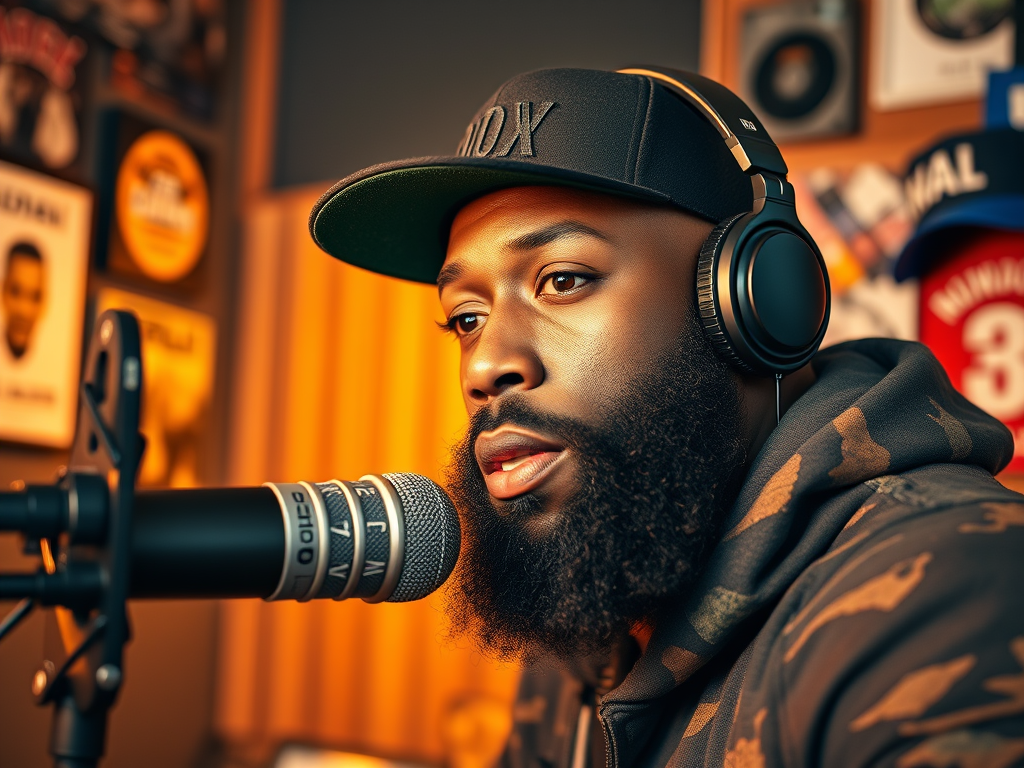

Joe Budden’s $900K Month: Lessons in Paid Podcasting

Joe Budden, a former rapper-turned-podcasting powerhouse often dubbed the “Howard Stern of hip-hop,” recently attracted widespread attention — though not quite in the way he intended. A social media post that was meant to casually display his success ended up sparking deeper conversations about podcast economics, creator independence, and the shifting dynamics of digital media.
Last month, Budden posted a screenshot on Instagram showing his traffic numbers on Patreon — a platform where fans pay creators directly through monthly subscriptions. The image revealed that his page had received over 30 million visits within a month. While he tried to obscure his earnings by scribbling over the revenue numbers, internet sleuths were able to manipulate the image and estimate that he had made over $900,000 — just for the month of June. This estimate made headlines across entertainment and business news outlets.
But that eye-catching sum represents only a portion of the bigger picture. According to Ian Schwartzman, CEO of the Joe Budden Network, the company is on track to generate more than $20 million in revenue for the year. In a rare move, Budden and Schwartzman decided to open up to The New York Times about their financial performance — a level of transparency that’s uncommon in the podcasting world, where details about downloads, ad revenue, and subscriber counts are often kept confidential to maintain a competitive edge.
According to Budden, this disclosure wasn’t just about showing off. He and Schwartzman aim to make a broader point about the value of creator independence — and why building a business without being tethered to a major media conglomerate can be both viable and lucrative.
The Revenue Breakdown

As of 2025, the Joe Budden Network averages around $1.04 million per month in revenue from Patreon alone, with approximately 70,000 subscribers. These subscriptions range in price from $5 to $50 per month, depending on the level of access provided. Higher tiers unlock more exclusive content, including spinoff shows, while two episodes of the main podcast are made freely available to the public each week.
With steady growth, this revenue stream alone is projected to surpass $12 million annually, positioning Budden as the highest earner on Patreon — a claim confirmed by a spokesperson from the platform.
However, subscriptions represent just one piece of the network’s financial puzzle. Advertising is another major contributor, reportedly bringing in several million dollars each year. What makes Budden’s operation unique among top-tier podcasts is that the team sells ads directly rather than partnering with major podcast networks such as SiriusXM, Wondery, or iHeartMedia. These networks typically offer guaranteed upfront payments but also dictate ad placements and revenue shares. Budden has opted instead to maintain control, choosing to limit advertising saturation by working with no more than three sponsors at a time, according to Schwartzman.
The network also earns income from what Schwartzman describes as “passive ads,” such as those automatically inserted into YouTube videos. Budden, who adopted video podcasting as early as 2016, has more than 1.5 million YouTube subscribers. Other modest revenue streams include merchandise sales and licensing content for use on various platforms.
The Cost of Doing Business
Running the Joe Budden Network isn’t cheap. The company employs more than 30 independent contractors, who manage everything from production to administrative logistics. By far, the biggest expense category is compensation for these workers — particularly the on-air personalities.
For instance, more than $1.5 million annually is allocated to co-host salaries on “The Joe Budden Podcast.” This team includes Queenzflip (Trevor Robinson), Marc Lamont Hill, Melyssa Ford, Parks Vallely, Ish (Antwan Marby), and Ice (Lamar Burney).
The Instagram post that sparked the viral revenue leak also led to some unexpected consequences. “Now everybody’s asking for a raise,” Budden joked.
Beyond staffing, the network’s costs include production fees, marketing, and real estate. Notably, the team is in the process of purchasing a waterfront condo in Edgewater, New Jersey — the same location where the podcast is currently recorded. The estimated purchase price is $2 million. While they’ve rented the unit until now, complaints from other residents in the building have accelerated the move toward ownership.
The Road to Independence
Budden’s current strategy reflects a broader trend among digital creators seeking greater autonomy and ownership. But his journey to this point has not been without challenges. In 2017, while working with Complex on a cultural commentary show, Budden says he was earning just $500 a week. “We were just getting by,” Schwartzman recalls.
A major step forward came in 2018 when “The Joe Budden Podcast” signed a licensing deal with Spotify. Though it brought increased visibility, the contract was limited in scope: the team was paid less than $2 million annually and did not receive any share of advertising revenue or equity. The deal also required that the podcast be available exclusively on Spotify, limiting its reach on platforms like YouTube.
When the agreement ended in 2020 under tense circumstances, Budden explored other partnership opportunities. Some proposals were extremely lucrative — one would have paid $44 million over two years — but came with heavy restrictions, including the removal of all content from YouTube. Schwartzman explained that these offers often required giving up control in exchange for financial security.
“The more money they offer, the more conditions they attach,” he said. “We were looking for a deal where someone would acknowledge our value by giving us equity — not just a check.”

A New Model with Patreon
In 2021, Budden and Schwartzman found a partner in Patreon, which didn’t provide guaranteed payments but offered equity and advisory roles within the company. This alignment allowed Budden to scale on his own terms while maintaining creative freedom.
“Joe is in a category all his own,” said Jack Conte, CEO of Patreon. “Very few people reach the point where they earn a million dollars a month on our platform.”
That milestone was first achieved by the Joe Budden Network in November 2021, and the team has consistently maintained it since.
Other platforms are now following suit. Substack, a newer rival to Patreon, recently launched a $20 million creator fund aimed at attracting high-profile talent. These platforms take roughly a 10 percent cut of a creator’s earnings, and the overall market is expanding: podcasters on Patreon collectively earned over $472 million in 2024, a 35 percent increase from the year before.
Still, Budden acknowledges that the concept of paywalled content remains intimidating for many creators. With media figures like Joe Rogan and Alex Cooper landing massive exclusive deals with Spotify, many up-and-coming podcasters see joining a major network as the fastest route to success.
That’s precisely why Budden ultimately decided to share his numbers publicly — despite the discomfort it brought.
“Even though it’s uncomfortable to lay our financials bare for the public and potential competitors,” Schwartzman said, “we knew it was necessary. How else will other creators know that this path is possible?”




Leave a Reply