
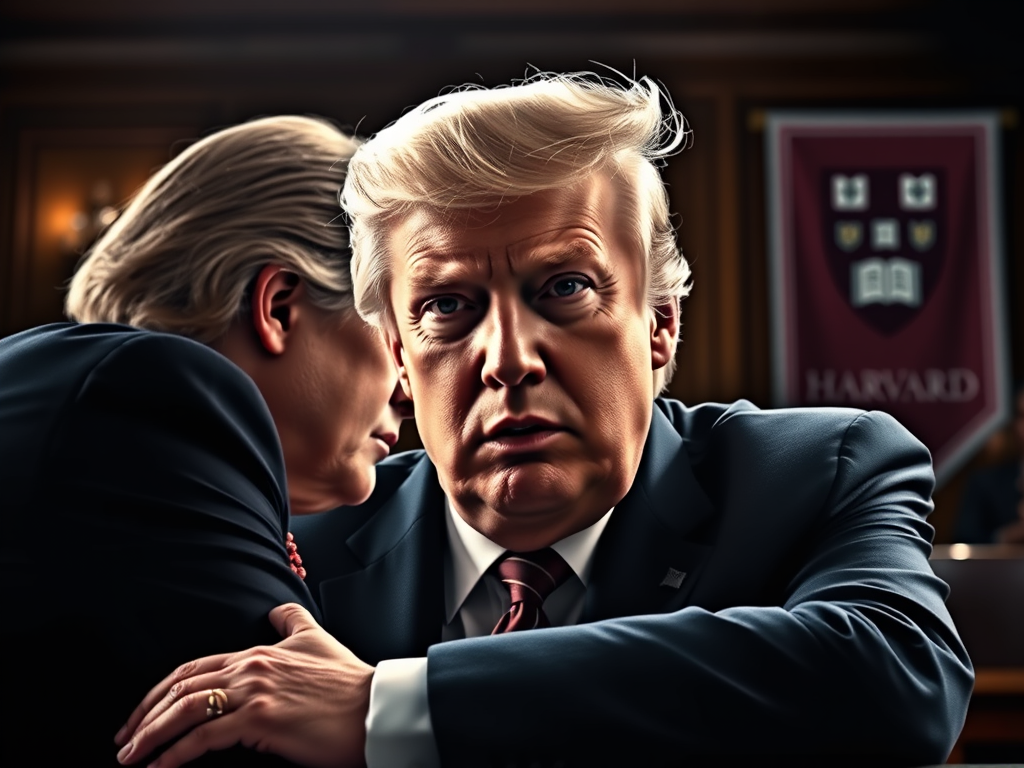

As Harvard and Trump Head to Court, the Government Piles on the Pressure

In June, former President Donald Trump took to social media to announce that his administration was potentially on the brink of securing a “mindbogglingly” historic agreement with Harvard University. He suggested that a deal could be finalized within a week.
Yet despite continued back-and-forth negotiations between federal officials and the university in the weeks that followed, no agreement emerged regarding the reinstatement of billions of dollars in frozen research funds.
Now, the dispute is heading toward a pivotal court hearing scheduled for Monday, where both sides will present arguments related to financial commitments and the broader issue of academic autonomy. Meanwhile, the Trump administration continues to exert pressure on Harvard, apparently aiming to strengthen its position at the negotiating table.
Just last week, U.S. Immigration and Customs Enforcement (ICE) issued subpoenas to the university, demanding extensive records. These included employee payroll documentation, several years’ worth of disciplinary records, and even footage of international student protests on campus dating back to 2020. According to individuals familiar with the situation—some of whom shared information with The New York Times—Harvard was given a mere seven days to respond.
This aggressive move came shortly after the administration formally charged Harvard with civil rights violations, alleging that the university failed to adequately protect Jewish students on campus. Additionally, federal officials lodged a complaint with Harvard’s accrediting body—an action that could eventually jeopardize the institution’s eligibility to access federal financial aid for students.

Despite these escalating confrontations, negotiations have continued behind the scenes in an effort to resolve both the investigations and the legal standoff. Progress, however, has been limited. This account is based on interviews with individuals closely involved in the discussions—who requested anonymity due to the sensitivity of the negotiations—as well as court filings and public statements.
Harvard’s leadership understands that a drawn-out legal battle with the federal government could have serious consequences. Jobs, research initiatives, the university’s reputation, and its independence as an academic institution are all at risk. Some within Harvard are concerned that what began as civil investigations might evolve into criminal proceedings if tensions persist.
For the Trump administration, the Harvard case represents a potential high-profile win in a broader campaign against what it perceives as ideological bias in elite educational institutions. Officials are striving to exploit their current governmental authority while navigating the preferences of a president who often favors striking headline-making deals over implementing long-term policy frameworks.
The two parties have exchanged numerous communications outlining what the administration is demanding from Harvard, and what Harvard might be willing to concede. But the upcoming court session in Boston could alter the dynamic, shifting the leverage either in favor of the government or the university.
The roots of the case trace back to April, when the administration moved to halt billions in federal research funding for Harvard. In response, the university filed a lawsuit to restore access to those funds, arguing that the administration’s actions were unconstitutional—violating its First Amendment rights among other legal protections.
During Monday’s hearing, both Harvard and the federal government are expected to urge U.S. District Judge Allison D. Burroughs to issue a ruling in their favor without proceeding to a full trial. This decision could prove pivotal, potentially setting the stage for appeals that may eventually reach the Supreme Court. Within both the White House and Harvard’s administration, the case is seen not only as a legal showdown but also as a bargaining tool in ongoing negotiations.
Prior to the lawsuit, the administration had sent Harvard a strikingly broad list of proposed conditions. These included mandates related to hiring practices, admissions procedures, and the oversight of faculty activities, along with requirements for regular reporting to the government and external audits of various academic departments. Although federal officials later admitted that issuing such a sweeping letter may have been ill-advised, they have shown little willingness to walk back their demands.
From the administration’s perspective, Harvard’s responses have been lackluster and overly cautious. “The Trump administration’s expectations are simple and reasonable: uphold the law, protect civil liberties, and prevent antisemitism and D.E.I. extremism from dominating campus life,” said Harrison Fields, a spokesperson for the White House. “We believe Harvard will eventually recognize the merit of the president’s vision.”
Harvard, for its part, has declined to make any public comment on the matter.

Dragging out the proceedings has political benefits for the administration. Public trust in higher education has eroded in recent years, and the administration has seized on this shift, portraying elite universities as havens of liberal ideology and as insufficiently accountable for their conduct. Harvard, like many leading research institutions, relies heavily on federal funding—making it a vulnerable and symbolic target for the administration’s broader message.
Though some polling indicates that Americans disapprove of the Trump administration’s confrontational tactics toward colleges, federal officials have shown little interest in backing down. For many within the administration and among its political allies, the conflict is not only strategic but ideologically satisfying.
Meanwhile, Harvard’s leadership is attempting to navigate the delicate balance between responding urgently to the government’s challenges and capitalizing on the sympathy and support the university has received. A favorable ruling from Judge Burroughs could serve to legitimize Harvard’s position and offer it more room to maneuver in negotiations with students, faculty, alumni, and donors.
Internally, some at Harvard believe that any final settlement must include an enforcement mechanism—possibly through the courts—given the administration’s unpredictable approach to dealmaking. University officials are reportedly reluctant to accept any informal or loosely defined agreement.
Former Harvard president Lawrence H. Summers, who has previously been critical of the institution, remarked that failure to reach an agreement could expose the university to further investigations and prolonged litigation. “Most people close to Harvard would prefer to move past this chapter—if that’s at all possible,” he said.
Still, Dr. Summers emphasized that certain conditions would be unacceptable. “If they start dictating which books we can keep in the library or who is allowed to be on the faculty, Harvard must refuse,” he asserted. “But if the government insists we comply with anti-discrimination laws, of course we can agree to that.”
He also suggested that the university might need to consider leadership changes as part of its efforts to regain stability and public trust.
Much will depend on the outcome of Monday’s hearing, where legal representatives from both sides will present their first major oral arguments before Judge Burroughs in this landmark case.
Judge Burroughs is also overseeing a separate but related case in which the federal government is attempting to restrict Harvard’s enrollment of international students. So far, she has ruled in Harvard’s favor on multiple interim matters.
At the heart of Harvard’s argument is the claim that the administration is overstepping constitutional boundaries in its efforts to influence university operations. The university is also raising procedural objections, arguing that the government failed to follow proper protocols when attempting to revoke funding.
On the other side, the Department of Justice insists that the government adhered to existing rules and that the issue at hand is fundamentally contractual. “Federal research funding is not a gift,” the DOJ argued in court filings. “These grants are bound by specific conditions. If those conditions are not met, the funding can legally be terminated.”
The administration also claims that an 1887 law mandates the transfer of the case from federal court in Boston to a special claims court in Washington, D.C., which handles monetary disputes with the government. Harvard maintains that Judge Burroughs should retain jurisdiction due to the constitutional implications of the case.
In one filing, Harvard pointed out that even after the government claimed it had rescinded certain grants, the Department of Defense continued to send payments related to them—an inconsistency that the university argues underscores the chaotic nature of the administration’s actions.
President Trump has not hidden his enthusiasm for challenging Harvard. In April, he even joked: “What if we just never pay them?”
Education Secretary Linda McMahon updated the president during a televised cabinet meeting on July 8, noting that tough negotiations with both Harvard and Columbia University were ongoing. “It’s not moving as quickly as I hoped, but we’re making progress,” she said.
That same day, ICE agents delivered the latest round of subpoenas to Harvard. The university’s public response was swift and scathing, characterizing the move as punitive and excessive.
“These retaliatory actions reflect the government’s continued overreach,” Harvard said in a statement. The university reiterated its commitment to defending its students, faculty, and institutional values against what it sees as unfounded political attacks.
Harvard emphasized that it remains resolute in its efforts to protect its community and uphold its core principles in the face of growing federal pressure.




Leave a Reply