
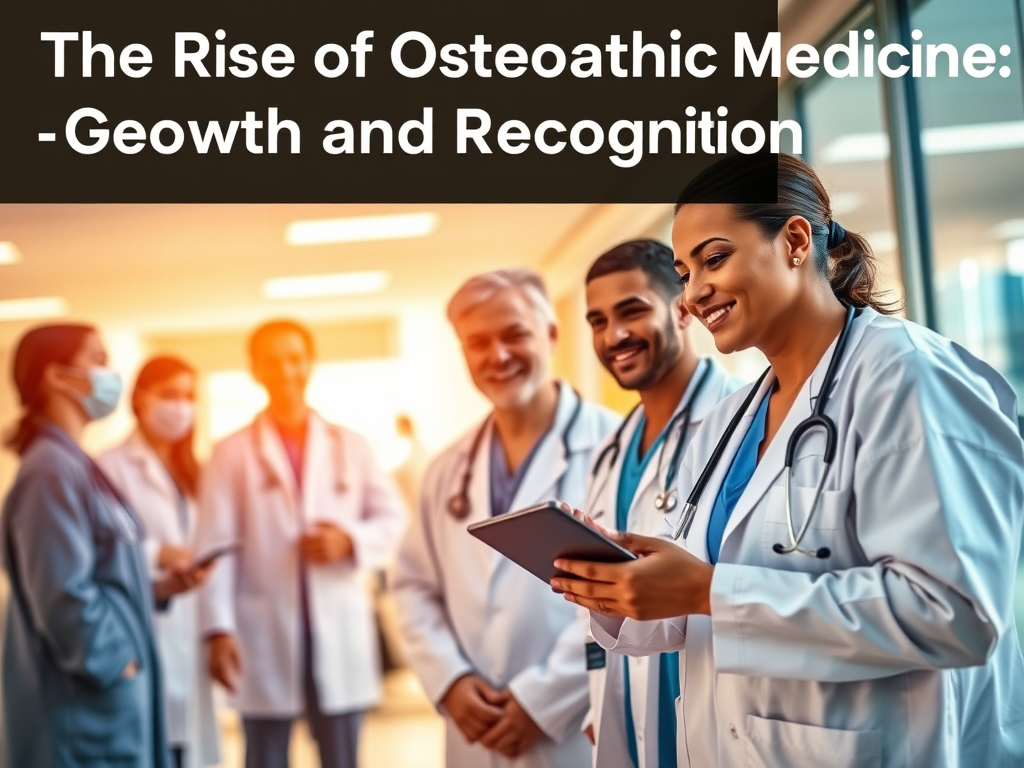

The Rise of Osteopathic Medicine: Trends and Insights

By almost every metric, osteopathic medicine is experiencing a period of remarkable growth and success.
Over the past ten years, the number of osteopathic physicians—doctors who hold a D.O. (Doctor of Osteopathic Medicine) degree—has surged by 70%, and this upward trajectory shows no signs of slowing down. In fact, more than 25% of all medical students in the United States are currently enrolled in osteopathic medical programs. This is partly due to the limited number of seats in conventional allopathic (M.D.) medical schools and the increasing availability of slots at D.O. institutions—14 of which have launched campuses in just the last five years.
In addition to their growing numbers, D.O.s have also achieved significant visibility and recognition in the medical profession. Osteopathic physicians now hold prominent positions across the healthcare landscape, from leading major health systems to directing medical teams at NASA. They’ve also gained a presence in the digital health space, managing highly followed social media accounts focused on medicine. Perhaps most notably, D.O.s have been entrusted with the care of U.S. presidents over the past three presidential administrations.
“We’re everywhere now—not to say we’re taking over, but we’re certainly present in all corners of healthcare,” remarked Dr. Teresa A. Hubka, who serves as the president of the American Osteopathic Association.
Despite this expansion, public awareness of the role and qualifications of D.O.s remains limited. Although many Americans have heard vague descriptions that D.O.s practice with a more holistic focus, or have encountered stereotypes that D.O.s only exist because of rejections from M.D. programs, few people actually understand how a D.O.’s medical training might influence their patient care. In fact, one of the most frequently searched questions about D.O.s on Google is whether they are considered real doctors. (They have had full medical practice rights in the U.S. since 1973.)
Throughout her career, Dr. Christina Weaver has been mistakenly identified as an orthopedist (commonly called a “bone doctor”), a homeopath (who generally lacks a recognized medical degree), and a chiropractor (whose training also doesn’t qualify them as physicians). Misunderstandings like these are common.
Often, patients remain unaware that their healthcare provider is a D.O. unless they spot the diploma on the office wall, according to Norman Gevitz, a medical sociologist and author who has extensively documented the history and development of osteopathic medicine. He even shared that his own mother remained unaware of what a D.O. was—despite the fact that he had dedicated an entire book on the subject to her.

Historically, the differences between M.D.s and D.O.s were more distinct. Osteopathy was developed in 1874 by Dr. Andrew Taylor Still, a former Civil War physician disillusioned with the aggressive and often harmful medical treatments of the era, such as bloodletting and the use of toxic substances like mercury.
Dr. Still believed that many illnesses stemmed from structural misalignments in the body, particularly in the spine. He proposed that these issues could be treated through physical manipulation of the musculoskeletal system rather than drugs or surgery. His approach quickly gained popularity, with reports circulating about his remarkable healing abilities.
Dr. Still went on to found a school in Missouri to train practitioners in his new method, which infuriated many conventionally trained doctors. Allopathic physicians at the time viewed osteopaths with suspicion, labeling them members of a fringe cult, and they worked diligently to eliminate the profession through legal action and legislative lobbying.
However, over time, the ideological gap between the two branches of medicine began to shrink. Osteopathic doctors gradually incorporated drug therapies and surgical procedures into their practice. By the mid-1970s, D.O.s had obtained licensure to practice medicine in all 50 states.
Today, the line between D.O.s and M.D.s has blurred even further. Although osteopathic and allopathic students still attend separate schools, their education is largely similar. D.O. programs cover all the standard medical sciences and clinical rotations, and many students from both pathways take the same licensing exams.
Since 2020, D.O.s and M.D.s have also trained alongside each other in the same residency programs, where they gain practical experience in medical specialties such as internal medicine, surgery, pediatrics, and more.
“We have more in common than differences now,” said Dr. Weaver, who serves as an associate dean at the School of Osteopathic Medicine at A.T. Still University in Arizona.
Though remnants of the original osteopathic philosophy remain, they are less prominent in daily practice. For instance, students at D.O. schools still receive around 200 hours of training in osteopathic manipulative treatment (OMT), a hands-on technique used to diagnose and manage various physical ailments. But most practicing D.O.s report that they rarely use OMT in routine care.
In the past, D.O.s were sometimes distinguished by their greater emphasis on whole-person care—such as considering emotional, social, and dietary factors when assessing a patient. Yet this kind of holistic thinking has become more common across the entire medical profession. “It used to set me apart,” said Dr. Anita Skariah, a primary care D.O. at UNC Health in North Carolina, “but now, even M.D.s are encouraged to ask about lifestyle and social stressors.”
Where D.O.s still stand apart is in the types of medicine they practice and the communities they serve. A significantly larger percentage of D.O.s work in primary care—around 60%—compared to their M.D. counterparts. Moreover, osteopathic medical schools tend to produce more doctors who go on to work in rural and underserved areas.
The reasons for this trend are up for debate. Some M.D.s argue that D.O.s gravitate toward primary care because those specialties are less competitive and more accessible than high-paying fields like cardiology or anesthesiology. Additionally, rural positions may be easier to secure due to lower demand.
However, many in the osteopathic community assert that this distribution reflects the core values of their profession. A foundational principle of osteopathy is serving communities that have historically lacked access to adequate healthcare. Many osteopathic schools are intentionally located in rural or underserved regions—such as Kirksville, Missouri; Harrogate, Tennessee; and Detroit, Michigan.
For osteopathic medicine, maintaining a unique identity is not just a matter of branding—it’s a matter of survival. Dr. Gevitz warns that if the profession loses its defining characteristics, it risks fading into obscurity. “Without a sense of what makes D.O.s different, the field could slowly erode from the inside,” he said.
Currently, the U.S. remains the only developed country to support two entirely separate paths to becoming a fully licensed physician. But some of the institutional structures that once kept the professions distinct—such as osteopathic-specific hospitals and residency programs—are now being absorbed into the allopathic system. Dr. Gevitz even speculates that osteopathic degrees or independent schools might eventually be phased out entirely.
Still, not all D.O.s are concerned about this potential future. Dr. John Licciardone, a researcher at the University of North Texas Health Science Center, has written multiple studies on the profession. He believes that the majority of osteopathic doctors are less interested in preserving a separate identity than simply practicing medicine. “Most of them just want to be doctors,” he said. “They’re happy to blend in.”




Leave a Reply