
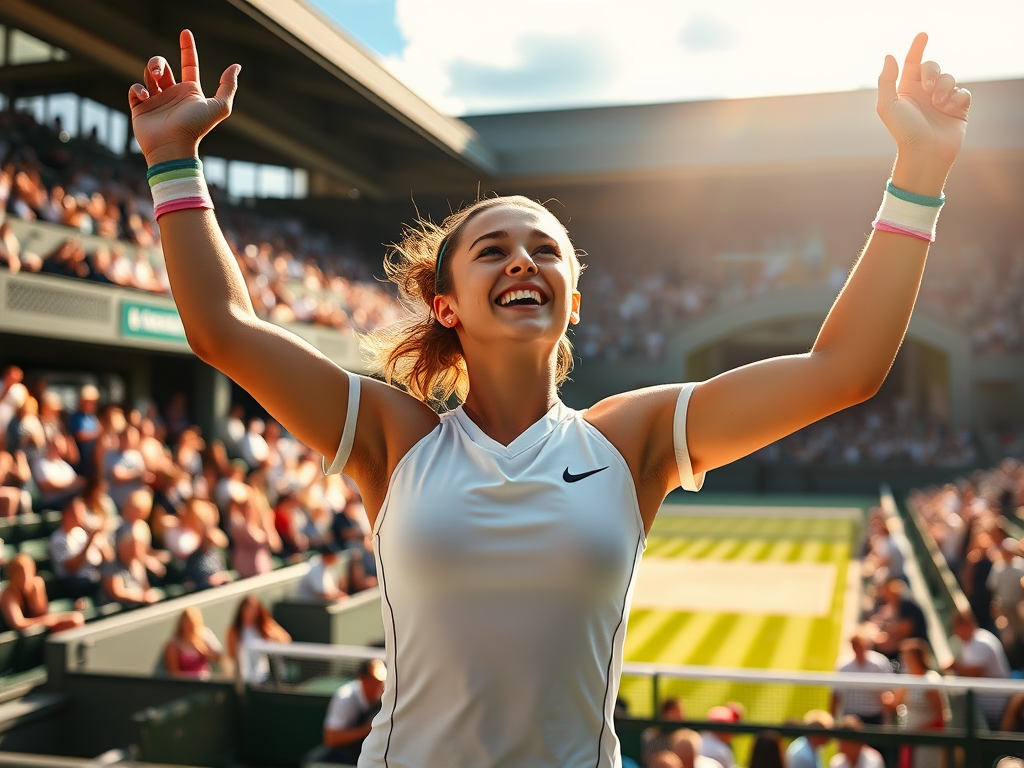

Amanda Anisimova stuns Wimbledon favorite Aryna Sabalenka to reach first Grand Slam final

Amanda Anisimova, once a teenage tennis prodigy, returned to the global spotlight in spectacular fashion at Wimbledon on Thursday. After years of personal struggle and professional setbacks following the sudden death of her father and longtime coach when she was just 17, Anisimova stunned world No. 1 Aryna Sabalenka in a dramatic 6-4, 4-6, 6-4 semifinal win under the sweltering Wimbledon sun. The victory secured her place in her very first Grand Slam final and marked the first time an American woman has reached the Wimbledon final since Serena Williams did so in 2019.
In a match that showcased both raw power and moments of tension-filled inconsistency, Anisimova maintained her composure during the most critical points, denying Sabalenka a spot in the only Grand Slam final still missing from her resume. Just when Sabalenka seemed poised for another of her trademark comebacks, Anisimova dug deep and found the mental strength to seize control.
“I knew I couldn’t hold back,” Anisimova said after the match. “Her level kept climbing as the match went on, and I realized I wouldn’t win just waiting for her to make errors.”
For Sabalenka, it was yet another painful defeat at the hands of an inspired American opponent in a Grand Slam’s closing stages. Since reclaiming the top ranking last autumn, Sabalenka has participated in three majors, but has struggled to convert her deep runs into titles.
Despite her remarkable consistency—11 appearances in Grand Slam semifinals or better over her last 12 events—Sabalenka’s struggles in decisive moments are becoming increasingly apparent. She now holds a concerning 3–9 record in third sets of major semifinals and finals.
This year alone, she fell to Madison Keys in the Australian Open final and then lost to Coco Gauff in the French Open title match. On Thursday, another rising American star stood in her way—and again, Sabalenka came up just short.

Compared to the French Open loss, where she had visibly lost control of her emotions on court and in the post-match press conference—at one point claiming that Gauff hadn’t won, but rather that she had lost due to the windy conditions—Sabalenka showed greater restraint at Wimbledon.
On Centre Court, as Anisimova inched closer to victory, Sabalenka kept her frustration mostly in check.
“We’re all human. We all lose our cool sometimes, and that’s okay,” she said afterwards.
“Today, every time I felt myself on the verge of exploding—whether yelling or smashing a racquet—I reminded myself that staying composed was my only shot at fighting for what I wanted.”
Sabalenka embraced her opponent at the net and was gracious in her praise of Anisimova, though she did admit to being annoyed when Anisimova mimicked her habit of grunting after shots during an exchange with the chair umpire.
“She was definitely braver today,” Sabalenka reflected. “While I tried to stay solid, she played with more aggression. I hesitated at times, made mistakes I shouldn’t have, and maybe forgot who I am—world No. 1—and what I’m capable of.”
In those moments, Anisimova stepped up and became the centerpiece of a story long in the making.
Now 23 and hailing from Florida, Anisimova’s win is a landmark in a journey marked by resilience. Just a year ago, she was struggling with injuries and mental fatigue, falling in the final round of Wimbledon qualifying in 2023. Her career, once brimming with promise, had been derailed not just by grief, but by physical setbacks that seemed to strike whenever she built momentum.
She had shown glimpses of form in tournaments across North America and won her first WTA 1000 title in Doha earlier this year, but persistent issues with her back and hip constantly interrupted her rhythm. It wasn’t until she hired physiotherapist Shadi Soleymani in April that things began to change. Under Soleymani’s guidance, Anisimova’s health and performance have steadily improved.
For a while during Thursday’s match, it appeared Sabalenka had seized control. She capitalized on a shaky service game from Anisimova at 3-3 in the second set, gaining her first break of the match. Though Anisimova tried to claw her way back, Sabalenka sealed the set with two blistering serves, evening the contest.
The momentum continued in Sabalenka’s favor at the beginning of the third set, as she broke Anisimova at love. But just when it seemed the Belarusian would pull away, her form faltered. A series of errors gave Anisimova a break back, and soon, she found herself up 3-1.
Anisimova’s strategy had neutralized Sabalenka’s diverse game, keeping her off the net for most of the match. The top seed attempted to reverse that late in the third set, bringing Anisimova forward as she had with success at the French Open. But this time, Anisimova responded in kind—matching Sabalenka’s tactics with deft drop shots and clever court positioning.
A turning point came at 4-2, when Anisimova, facing a tense service game, unleashed a risky forehand down the line that struck the top of the net and dropped in. It was the kind of shot that could have gone either way—but on this day, fortune favored her boldness. Sabalenka, already irritated by an earlier celebration from Anisimova, could only watch as the American pumped her fist with no sign of apology.
On her first match point, Anisimova missed a comfortable backhand, giving Sabalenka a chance to escape once more. But instead of capitalizing, Sabalenka faltered, giving Anisimova three more opportunities to finish the match. On the third, she pounced—sending a rocket forehand into the corner and dropping her racket in stunned disbelief.
In many ways, it was a moment that felt predestined. But in sport, destiny only rewards those who prepare for it.

After her father Konstantin passed away in 2019 from a heart attack, Anisimova continued to compete but was clearly burdened by grief. Her rankings plummeted over the following seasons, and although she managed to return to the top 30 by 2022, tennis soon became overwhelming.
Early in 2023, she stepped away from the sport entirely. She enrolled in college courses and explored her love of painting and art, distancing herself from the game that had defined her youth. For years, she had been compared to Maria Sharapova, another Russian-American star molded into greatness by her ambitious father. Anisimova resembled her in appearance and background—but she needed time to decide if that path was truly hers.
In 2024, she made the decision to return, though the comeback wasn’t seamless. The same injuries that had troubled her before continued to interrupt progress. It wasn’t until Soleymani joined her team that real progress began. With targeted strength training and attention to her overall wellness, she began to build the foundation she needed to stay healthy and compete consistently.
The result has been on display all tournament long. Anisimova outlasted Linda Nosková in a grueling fourth-round match, then held her nerve against a resurgent Anastasia Pavlyuchenkova in a dramatic quarterfinal.
On Thursday, under oppressive heat that had spectators requiring medical assistance, she produced her finest tennis when it mattered most. She remained composed, fending off match point pressure with nerves of steel and capitalizing on her moment when it came.
Now, she prepares to face Iga Świątek, a five-time Grand Slam winner, who is also making her debut in a Wimbledon final.
“I’ve never played a Slam final before,” Anisimova acknowledged, “but I’ve been in a lot of high-pressure matches. I try to remind myself to enjoy every moment, to stay present, and not focus too much on the result. That’s how I prepare.”
Wise words, and yet another sign of how far she’s come—not just as a player, but as a person.y in the present. So I’ll just keep telling myself that.”
Another good decision.




Leave a Reply