
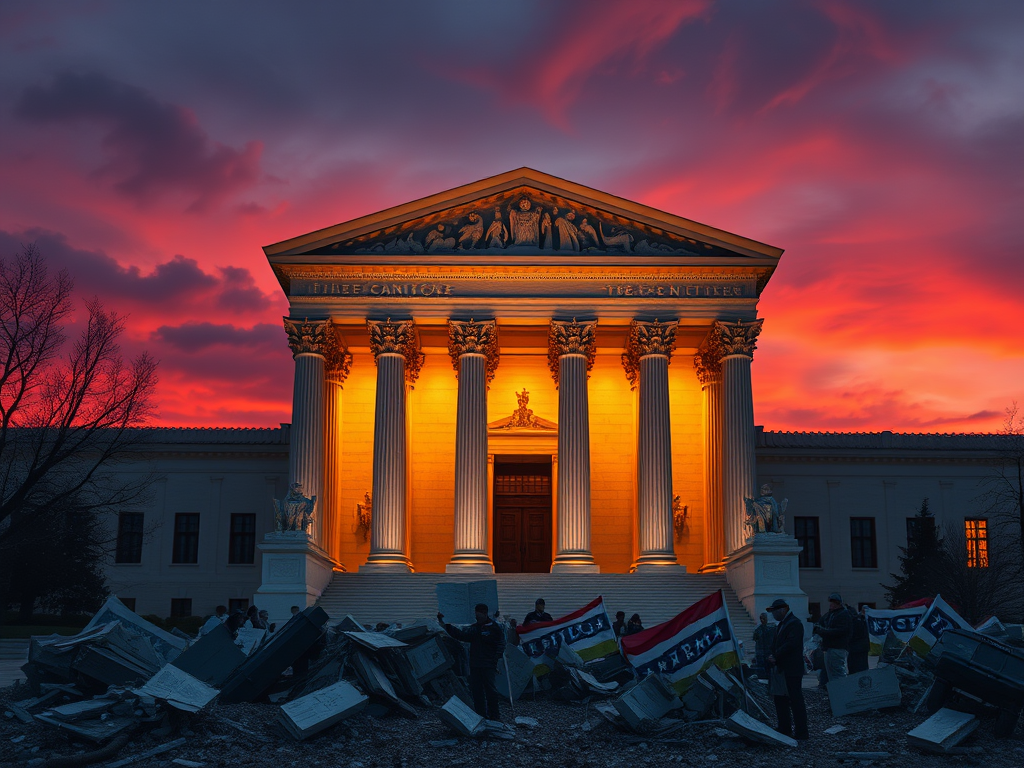

Supreme Court Clears Way for Mass Firings at Federal Agencies

On Tuesday, the Supreme Court issued a decision that permits the Trump administration to proceed with its plans to drastically reduce the federal workforce and dismantle several federal agencies. This development could lead to the dismissal of tens of thousands of government employees, with departments such as Housing and Urban Development, State, and Treasury among those likely to be heavily impacted.
The ruling, which reversed a lower court’s decision that had temporarily halted the layoffs, was delivered without a signature or a recorded vote count—an approach that is common in emergency judicial decisions. Justice Ketanji Brown Jackson authored a public dissent, signaling her opposition to the majority’s action.
At the heart of the case is a significant constitutional question: how far can a sitting president go in restructuring the federal government without Congressional approval? Although the Supreme Court’s order is temporary and addresses only the immediate procedural issue, it effectively greenlights President Trump’s broader efforts to reorganize federal operations while legal challenges are still being litigated in lower courts.
In a brief two-paragraph opinion, the justices stated that the government is “likely to succeed” in arguing that the executive order issued by President Trump—calling for downsizing and reorganization—falls within legal bounds. Importantly, the Court emphasized that it was not making a judgment on the legality of specific layoff or reorganization actions taken thus far by the administration.

This decision represents the latest in a series of Supreme Court rulings that have favored the Trump administration’s use of emergency powers to push through controversial policy changes. It follows a significant ruling on June 27 that limited the ability of lower courts to impose nationwide injunctions against presidential policies.
Although the breakdown of the vote was not disclosed, Justice Sonia Sotomayor—one of the three liberal justices—offered a short concurring opinion. She expressed agreement with the court’s decision to allow the administration to move forward but clarified that lower courts should retain the authority to review the specific details of the administration’s proposed reorganization.
Justice Ketanji Brown Jackson issued a 15-page dissenting opinion in which she strongly criticized the Court’s move, describing it as “not only truly unfortunate but also hubristic and senseless.” She argued that the majority’s decision undermines the authority of trial courts to evaluate the facts and legality of executive actions, cautioning against what she sees as the Supreme Court overstepping its role by overriding careful lower-court review.
According to Justice Jackson, the administration’s plan will have serious real-world consequences. “No one seriously disputes,” she wrote, “that the president’s executive order will lead to enormous real-world consequences,” including “the dismantling of much of the federal government as Congress has created it.” She added that what some might dismiss as “bureaucratic excess” actually plays a critical role in public life—from agricultural support to mine safety to early childhood education.
In recent weeks, the Supreme Court has issued other emergency rulings that have empowered the administration to take significant steps. These include granting access to millions of Americans’ personal data held by the Social Security Administration, ending a humanitarian protection program for over half a million immigrants, and allowing Trump to temporarily remove the heads of two independent federal agencies.
The controversy over mass layoffs began in February when President Trump signed an executive order directing federal officials to begin planning for large-scale reductions in government staff. In response, numerous labor unions, advocacy organizations, and local governments filed lawsuits seeking to block the initiative.
On May 9, Judge Susan Illston of the U.S. District Court for the Northern District of California issued a temporary injunction to stop the administration from moving forward with the layoffs and closures of nearly two dozen agencies. Her ruling argued that the plans posed a serious threat to essential government services.
Judge Illston initially halted the initiative for two weeks, and later extended the block indefinitely, reasoning that any large-scale government reorganization must be carried out in coordination with Congress. She emphasized that while presidents have the authority to pursue new policy directions, significant structural changes to the executive branch require legislative collaboration.
In her written opinion, Judge Illston acknowledged that it is within a president’s rights to set new policy priorities and to shape the executive branch in line with those priorities. However, she emphasized that meaningful, large-scale reorganizations—such as those affecting entire federal agencies—must involve consultation and cooperation with Congress, a coequal branch of government.
In response to the district court’s order, the Trump administration submitted an emergency application to the Supreme Court. Solicitor General D. John Sauer argued in the application that Judge Illston’s ruling had effectively paralyzed much of the executive branch. According to Sauer, the decision blocked 19 federal agencies, including 11 cabinet-level departments, from implementing the president’s restructuring plans.
Sauer maintained that the lower court’s reasoning was flawed because it assumed that the president requires explicit legislative approval for decisions involving the internal management of the executive branch. He described that assumption as “indefensible,” asserting that the executive should retain broad discretion over internal personnel matters.
Those opposing the administration, however, maintained that the president’s executive order overstepped constitutional boundaries. In their brief to the Supreme Court, the challengers argued that for more than a century, presidents from both political parties have traditionally sought and received Congressional authorization before making substantial changes to the federal government’s structure.
The challengers urged the justices to deny the Trump administration’s request, warning that allowing the executive order to take effect before the full legal case is resolved could cause irreversible damage. “There will be no way to unscramble that egg,” they wrote. “If the courts ultimately deem the president to have overstepped his authority and intruded upon that of Congress, as a practical matter there will be no way to go back in time to restore those agencies, functions and services.”
Among those affected by the proposed changes are nearly 2,000 employees at the State Department who were slated for termination as part of a broader staff reduction initiative. These layoffs had been paused by the preliminary injunction issued by Judge Illston, but with the Supreme Court’s new ruling, they may now proceed.
While the Supreme Court has not rendered a final judgment on the legality of the Trump administration’s broader reorganization plan, the decision marks a pivotal moment. It grants the president temporary authority to implement sweeping changes to the federal workforce and agency structure—changes that, if not ultimately reversed, could redefine the shape and function of the U.S. government for years to come.ston’s order on May 30.




Leave a Reply