
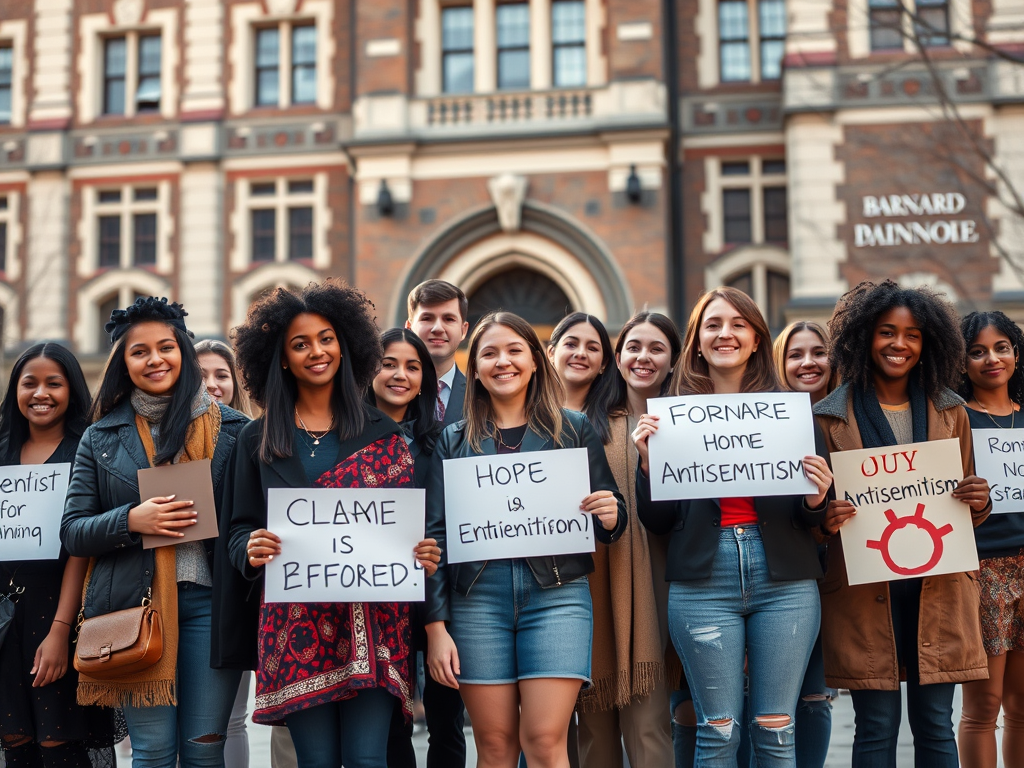

Barnard College Pledges ‘Zero Tolerance’ for Antisemitism in Settlement

Barnard College has reached a legal agreement with a group of Jewish and Israeli students who accused the institution of failing to adequately address persistent and widespread antisemitism on campus. In a joint statement released on Monday, both Barnard officials and the legal representatives of the students confirmed the settlement, which includes a reaffirmed commitment from the college to uphold a “zero tolerance” policy toward all forms of discrimination and harassment.
As an all-women’s college affiliated with Columbia University, Barnard has found itself at the center of controversy over the past two years, particularly in light of growing tensions related to the Israeli-Palestinian conflict. During the last 21 months, the college has seen multiple pro-Palestinian demonstrations, including a particularly high-profile sit-in that took place at the student center in March 2025. That protest ultimately concluded with police intervention and several arrests.
Jewish and Israeli students reported that the campus environment had become increasingly hostile. According to complaints made in the lawsuit and in interviews, some students were subjected to harassment not only during the protests, but also in everyday campus settings such as dining halls and public walkways. Others alleged they were ostracized or denied access to certain student organizations based on their identity or perceived political views.

In February 2024, two advocacy groups—Students Against Antisemitism and the StandWithUs Center for Legal Justice—filed a lawsuit in the U.S. District Court for the Southern District of New York. The suit named both Barnard College and its partner institution, Columbia University, as defendants. Although the case against Columbia remains ongoing, Barnard has chosen to settle independently.
Barnard College President Laura Ann Rosenbury expressed the school’s intention to foster a more respectful and inclusive community in light of the settlement. “This agreement is a reflection of our unwavering dedication to ensuring a campus climate where everyone feels secure and respected,” Rosenbury stated. “There is absolutely no place for antisemitism or any form of harassment at Barnard. Such behaviors are completely inconsistent with the values we strive to uphold.”
Barnard is not the first prestigious university to face legal challenges over how it handles antisemitism complaints. Similar lawsuits were previously brought against institutions such as New York University and Harvard University, both of which opted to settle the disputes. A related case involving the University of Pennsylvania, however, was dismissed by a federal judge in June 2025, though student attorneys are currently appealing that decision.
Marc Kasowitz, the lead attorney for the students and a partner at the law firm representing them in multiple cases, emphasized the broader goal behind these legal actions. “Through these settlements, we are holding universities accountable,” Kasowitz explained. “We aim to ensure that institutions act lawfully and responsibly to minimize, and ideally prevent, antisemitic incidents on their campuses.”
As part of the terms agreed upon in the settlement, Barnard will now prohibit the use of face coverings at protests when such coverings are used with the intent to intimidate or conceal identity in a way that disrupts enforcement of campus rules. Additionally, the college has pledged to reinforce and clarify its guidelines on the time, place, and manner in which student demonstrations may occur.
One of the more substantial commitments from Barnard includes the creation of a new administrative role: the Title VI Coordinator. This official will be charged with investigating complaints that fall under Title VI of the Civil Rights Act of 1964, which forbids discrimination based on race, color, or national origin. While the college already maintains a department for handling issues related to sex and gender-based discrimination, the new coordinator will have similar authority in overseeing matters pertaining to ethnic and national origin discrimination.

To ensure transparency and accountability, the Title VI Coordinator will deliver an annual report to senior leadership and the board of trustees. This report will detail all findings and disciplinary actions related to discrimination cases.
Barnard has also pledged not to engage in any discussions or negotiations with student activist groups affiliated with Columbia University Apartheid Divest, the organization behind many of the pro-Palestinian protests on both campuses. The college further stipulated that it will not direct its financial endowment toward political objectives, nor will it support efforts to economically sanction or isolate any specific nation, including Israel. This statement serves as a direct response to protestors aligned with the Boycott, Divestment, and Sanctions (BDS) movement, who have called for institutions like Barnard to sever all financial ties with Israeli entities.
In addition to administrative reforms, Barnard will implement mandatory educational initiatives for its student body, faculty, and staff. These initiatives will include training programs focused on preventing harassment and discrimination, with a particular emphasis on combating antisemitism. Furthermore, the college has agreed to expand academic opportunities by allowing students to enroll in courses at the Jewish Theological Seminary—Barnard’s academic affiliate—without incurring any additional costs.

Since the outbreak of the Israel-Hamas conflict on October 7, 2023, which began with a deadly Hamas attack on Israeli civilians and was followed by an Israeli military response in Gaza, Barnard has taken a noticeably firmer stance against campus protests than its counterpart, Columbia University. For instance, Barnard acted more swiftly to discipline students accused of crossing the line from protected political speech into direct harassment or violations of campus policies. However, attorneys for the Jewish students involved in the lawsuit stated that these actions were still inadequate, prompting legal recourse.
Columbia University, meanwhile, is facing its own scrutiny from both the federal government and accreditation bodies. The U.S. Department of Education recently revoked more than $400 million in scientific research funding due to concerns about the university’s handling of harassment complaints. Although Columbia is currently negotiating to regain those grants, it was recently issued a warning by the Middle States Commission on Higher Education, the agency responsible for accrediting the institution.
According to the commission’s statement, Columbia was found to be out of compliance with accreditation standards. This decision came shortly after the Department of Education’s Office for Civil Rights concluded that the university had failed to properly respond to reports of antisemitic harassment, showing what the office called “deliberate indifference.” Columbia now has up to three years to address the violations and restore full compliance, or risk the loss of its accreditation status.
In response to the warning, Columbia University stated that it remains confident in its ability to meet all accreditation requirements. The university reaffirmed its commitment to creating a safe and inclusive academic environment. “Columbia is fully committed to confronting antisemitism in all its forms,” a university spokesperson said. “We will continue to work diligently to ensure that all members of our community—students, faculty, and staff alike—feel supported, respected, and welcome.”
As legal and public scrutiny over campus antisemitism continues to intensify, Barnard’s decision to settle and implement systemic reforms marks a significant development. Whether this agreement sets a new precedent for other institutions facing similar challenges remains to be seen. What is clear, however, is that colleges and universities nationwide are under increasing pressure to ensure that all students, regardless of background or identity, are afforded the right to learn in a safe and inclusive environment.




Leave a Reply