

Risks of Medicaid Cuts: Martin County’s Healthcare Crisis

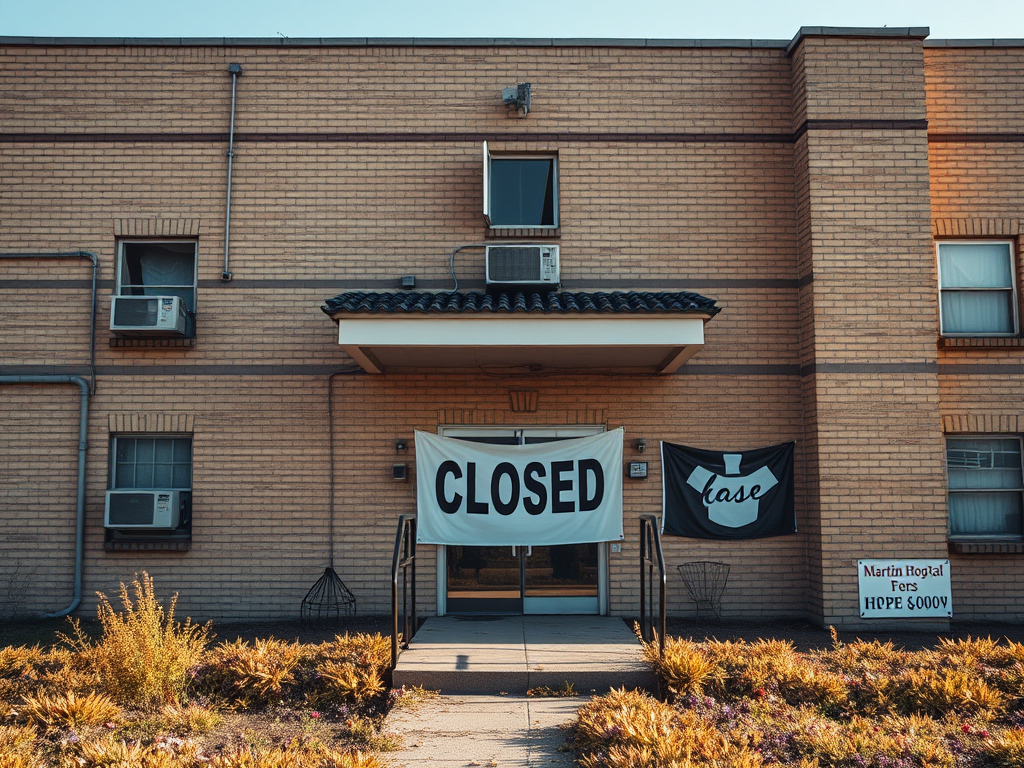
In 2023, Martin County in eastern North Carolina witnessed the closure of its only hospital. Despite the facility being shuttered, the power remains on. Air conditioning continues to cool the unused rooms, and the county still foots the bill for the medical gas system inside the building.
This is no accident. Residents of Martin County have gone to great lengths to preserve the structure, clinging to the hope that one day their hospital might reopen. The beige brick building has stood as a symbol of both loss and persistence, representing a community unwilling to give up on vital healthcare access.
When North Carolina opted to expand Medicaid later that year, providing health insurance to low-income adults, hope was rekindled in Martin County. With federal funds flowing into the state, there was renewed ambition to partially reopen the hospital. The expansion appeared to offer a second chance to a facility that had struggled financially for many years.
However, those efforts are now hanging by a thread. A sweeping domestic policy package backed by President Trump has passed through Congress, and it includes drastic cuts to federal Medicaid funding to offset the cost of large-scale tax cuts. As a result, North Carolina’s Medicaid expansion—and the fragile dreams of reopening Martin General Hospital—are now at serious risk.
Should Medicaid expansion be rolled back, experts say the chances of the hospital reopening would diminish entirely. Paul Roberson, a real estate agent and prominent voice in Williamston, where the hospital is located, expressed alarm at the potential consequences. “If this hospital doesn’t reopen, the consequences will be both tragic and fatal,” he warned. A sign outside the building now reads: “CLOSED. If you need immediate assistance, dial 911.”

Roberson pointed out that the nearest hospital is a 30-minute drive away—a dangerous delay in life-threatening emergencies. “Lives are already being lost because of the hospital’s absence,” he said. “This issue is life and death for us.”
Healthcare experts argue that rural communities like Martin County will suffer the most from reduced Medicaid coverage. According to a projection by the Congressional Budget Office, the new law could leave nearly 12 million more Americans uninsured by 2034. For a state like North Carolina—with one of the country’s largest Medicaid-eligible populations—the consequences could be especially severe.

Hospital administrators across North Carolina have said that the Medicaid expansion has provided a crucial financial cushion for rural medical facilities. For many struggling hospitals, the influx of federal funding has helped them stabilize their operations. Now, as Medicaid coverage comes under threat, many residents who had only recently gained access to healthcare are worried about losing it again.
Lori Kelley, a 58-year-old resident of Harrisburg, NC, is one such individual. Thanks to Medicaid, she underwent surgery that saved her finger and had tumors discovered during diagnostic screenings. “If I lose coverage, I’ll have to abandon the process of diagnosing my neurological condition and just try to live with it,” she said.
Since Medicaid expansion began, over 660,000 people in North Carolina have enrolled—most of them adults with low incomes. In Martin County alone, roughly 14% of adults now rely on this coverage.
Under the new federal law, adults on Medicaid will need to prove they are working, attending classes, or volunteering at least 80 hours a month. While many already meet these criteria, the bureaucratic hurdles of verification could lead to individuals losing their coverage simply due to red tape.
State leaders are even more worried about the law’s broader financial implications. North Carolina’s ability to fund Medicaid expansion depends in part on a specific tax that the new law will reduce. This could force the state to abandon not only Medicaid expansion, but also a program that increases federal reimbursements to hospitals caring for Medicaid patients. Though a legislative solution might be possible, partisan gridlock in the state legislature has stalled budget discussions, and healthcare analysts doubt a resolution will be reached in time.

Governor Josh Stein, a Democrat, urged the Republican-majority legislature to act swiftly. “Our bipartisan Medicaid expansion law must be protected,” he said, calling for a reassessment of the state’s budget and long-term fiscal plans.
Senator Thom Tillis, once a fierce opponent of Medicaid expansion during his tenure as Speaker of the North Carolina House, has since changed his stance. Like other Republicans, his views evolved as his constituents and the state’s hospitals benefited from the program. He recently came out in strong opposition to the president’s bill, saying it would force North Carolina to make painful cuts, including revoking coverage from hundreds of thousands.
This public opposition drew ire from Trump, who criticized Tillis online. In the aftermath, Tillis announced he would not seek re-election—joining two other Republican senators in voting against the bill.
As the Martin County community puts its hospital revival plans on hold, similar anxieties are surfacing in rural counties across the state. Prior to Medicaid expansion, more than a dozen hospitals had closed in North Carolina over the span of two decades.
Though Congress did allocate $50 billion to assist rural hospitals in the new law, many healthcare leaders have said the funds are inadequate to compensate for the looming Medicaid cuts.

Penney Burlingame Deal, CEO of Onslow Memorial Hospital in Jacksonville, called the situation dire. “This law is going to put immense pressure on our hospital staff, patients, and the entire community,” she said.
In Martin County—a community of around 22,000 where over 25% of the population is over the age of 65—the stakes couldn’t be higher. With only two physicians still practicing in the area and the nearest comprehensive hospital about 40 minutes away, many residents are facing a healthcare crisis. Some must take slow and infrequent bus routes just to access basic medical services.
Verna Marie Perry, 66, who once worked for the county’s Department of Adult and Aging Services, said she regularly receives urgent calls from friends and neighbors needing emergency medical attention. Some have lost loved ones in transit, unable to reach the hospital in time.

“When I think about that bill passing and us losing any hope of reopening our hospital,” Ms. Perry said with tears in her eyes, “my heart just breaks.”
It was Medicaid expansion and the enhanced hospital reimbursement program that had encouraged ECU Health—a major healthcare system serving much of rural North Carolina—to explore reopening Martin General for emergency and diagnostic services. But now those plans are uncertain.
Brian Floyd, ECU Health’s COO, explained the financial reality: “If we lose Medicaid expansion and the subsidy payments disappear, and we’re already running at a negative margin, we simply don’t have the resources to reopen a hospital in Martin County.”

Cathy Price, a 72-year-old retired nurse who worked at Martin General, said she supported Trump’s efforts to reduce fraud and waste in Medicaid. However, she now worries that the opportunity to reopen the hospital is slipping away. “We are literally in a life-or-death situation,” she said. “Without this hospital, people’s lives are at serious risk.”
Last August, tragedy struck when 91-year-old Bennie A. Moore, a well-known community member and Korean War veteran, suffered heart failure. His daughter, Jo Ayers, 72, called 911, but was told it would take emergency responders 20 minutes to reach them—and another 20 minutes to reach the nearest hospital. She rushed him to the hospital herself, but he stopped breathing at a traffic light near their destination and died before they arrived.
Recounting the story in their home, Jo’s son, Russ Ayers, wept. “A man of 91 shouldn’t have to depend on his daughter to rush him to the hospital, only to die in the car,” he said.
Now, with the federal legislation threatening their hopes, Jo and Russ Ayers fear more families will endure similar pain.
“This is going to bring suffering to so many,” Jo said.




Leave a Reply