

In Europe, Economists See a Chance to Rise on the Global Stage

Among central bankers, the term “uncertainty” has become almost a default expression, used so frequently that it risks sounding trite. As monetary authorities navigate an increasingly volatile environment shaped by trade tensions, geopolitical unrest—particularly in the Middle East—and shifting economic indicators, their vocabulary to describe this turbulence is wearing thin. To capture the depth of this unpredictability, they’ve resorted to phrases like “extraordinary uncertainty” and “unprecedented unpredictability.”
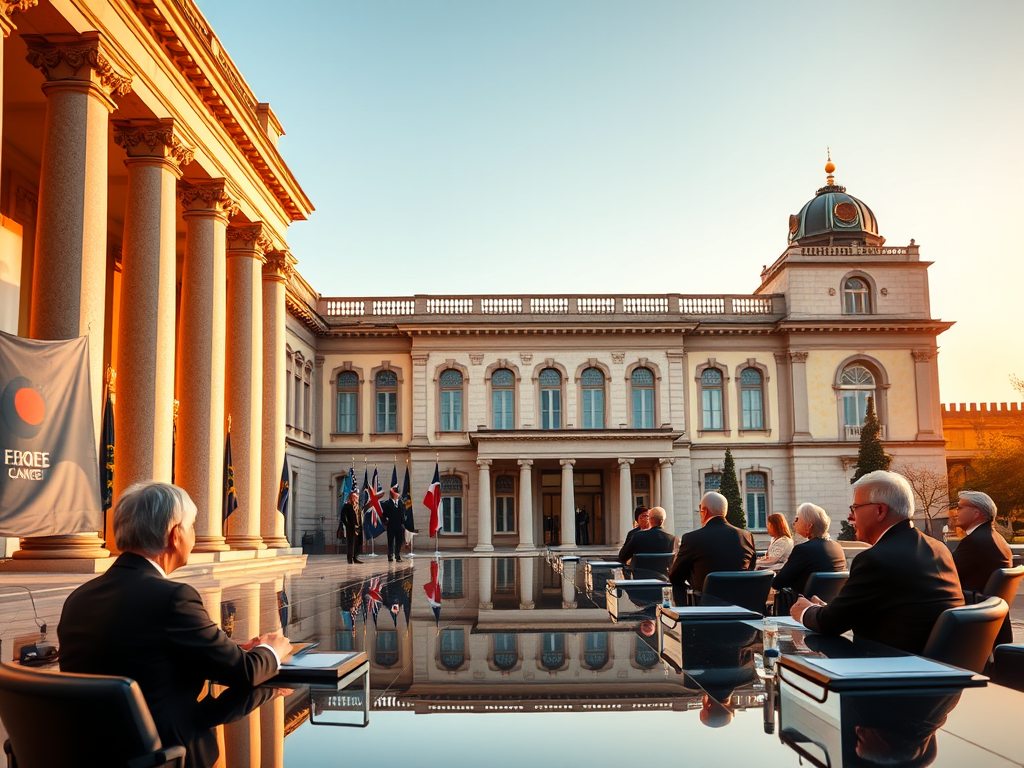
Yet despite these mounting concerns, a sense of composure pervaded the atmosphere at the European Central Bank’s (ECB) annual gathering this week in Sintra, Portugal. The conference, which brings together leading policymakers, economists, and financial experts, had a notably calm tone—even as the global economy remains full of potential hazards.
A significant reason for this measured confidence was the latest inflation data for the eurozone. As the primary day of the conference commenced on Tuesday, reports confirmed that inflation in June had reached the ECB’s long-standing target of 2 percent. This was a marked improvement after three years of inflation consistently exceeding desired levels. During that period, the ECB had enacted a series of aggressive monetary policy measures to rein in price growth.
“We have reached 2 percent,” announced Christine Lagarde, President of the ECB. “I’m not declaring victory just yet, but I can say that the target has been met.”
With inflation appearing more controlled, the focus of the conference shifted toward long-term structural concerns—especially Europe’s economic competitiveness relative to global giants like the United States and China. There was considerable discussion around how to make labor mobility easier and how to enhance access to capital across European borders. While such reforms have been proposed in various forms over the years, this time there appeared to be renewed optimism that European lawmakers might be more inclined to act.

A central theme throughout the sessions was that the economic strategies of former U.S. President Donald Trump had inadvertently created a window of opportunity for Europe to assert itself more forcefully on the global stage. By pursuing more isolationist policies, the United States, some argued, had opened the door for Europe to strengthen its economic unity and broaden its influence.
Joachim Nagel, the head of Germany’s central bank, the Bundesbank, remarked, “In Europe—and particularly in Germany—we’re quite good at diagnosing problems. But when it comes to executing solutions, we often become overly cautious and slow to react.” Nevertheless, he observed a noticeable shift in the mood in Sintra. “I’m getting the sense—from the conversations here—that things are starting to change. We’re beginning to move.”
That optimistic outlook was established early in the conference. On Monday, the ECB had released a report affirming that its monetary strategy had remained resilient during recent years, even amid sudden spikes in inflation. While only minor adjustments were made to the policy framework, the bank reaffirmed its commitment to the 2 percent inflation target. “This is a strategy that holds up under all conditions,” said Ms. Lagarde.

Increasingly, ECB officials have been calling on other European institutions—particularly the European Commission and legislative bodies—to introduce deeper structural reforms. Their aim is to fortify the internal market of the European Union so that the region can fully leverage its collective scale when competing with the economic might of the U.S. and China.
One of the early presentations at the conference, delivered by Benjamin Schoefer of the University of California, Berkeley, examined Europe’s labor dynamics. He pointed out that although unemployment rates across the continent were historically low—hovering around 6 percent—productivity growth was lagging behind that of the United States. In his view, part of the problem lies in the rigidity of the European labor market. Workers often remain in the same jobs for extended periods, discouraged from switching positions by generous pension schemes and strong severance protections. This lack of mobility, he argued, is a brake on overall productivity gains.
Schoefer’s analysis sparked spirited responses, with some participants defending the European model and questioning whether the U.S. labor market—with its weaker worker protections and greater volatility—should be considered an ideal alternative. Nevertheless, throughout the week, many experts continued to scrutinize the shortcomings of the European economy and propose actionable strategies for closing the productivity gap with more dynamic regions.

The conversation on economic competitiveness deepened with the final paper presented at the conference, which spotlighted the evolving relationship between Europe and China. The analysis demonstrated how China has positioned itself as a direct challenger to Europe by investing heavily in sectors where the EU had traditionally held an edge—such as advanced manufacturing, robotics, and high-tech machinery. While the United States has been deliberately distancing itself from China through economic decoupling, Europe has found itself moving closer, even amid fierce technological competition.
“China is not merely catching up with the euro area,” warned Ana Maria Santacreu, an economist at the Federal Reserve Bank of St. Louis. “It is actually converging with it. China is now a direct competitor.”
She emphasized that the solution lies not in retreat, but in acceleration. “The way forward is not a mystery,” she said. “Deepening the single market could allow Europe to harness its full size and potential, leading to increased output and greater innovation.”
Piero Cipollone, a member of the ECB’s executive board, summarized the takeaway message succinctly: “We shouldn’t point fingers at other nations or at global trade for our economic challenges. The priority should be to get our own house in order.”

Despite a general consensus among economists about the necessary policy directions, implementing them remains a separate challenge. Many of the decisions lie in the hands of elected officials, national governments, and the broader European public. Several attendees, in conversations between sessions, acknowledged that many of the proposals under discussion had been heard before—sometimes multiple times. Europe’s track record of acting on such recommendations, they admitted, has often been disappointing.
Still, the conference ended on a surprisingly hopeful note. There was a shared sense that Europe is on the cusp of something greater—a larger, more resilient, and economically vibrant union.
Philippe Aghion, a prominent professor affiliated with both Collège de France and the London School of Economics, delivered an impassioned closing message. “This is our moment. If we want a stronger European Union, the power to build it is in our hands.”
He concluded, “I believe in our ability to do this,” prompting spontaneous applause from the audience, a rare and uplifting moment of collective optimism in the realm of economic policy.




Leave a Reply