
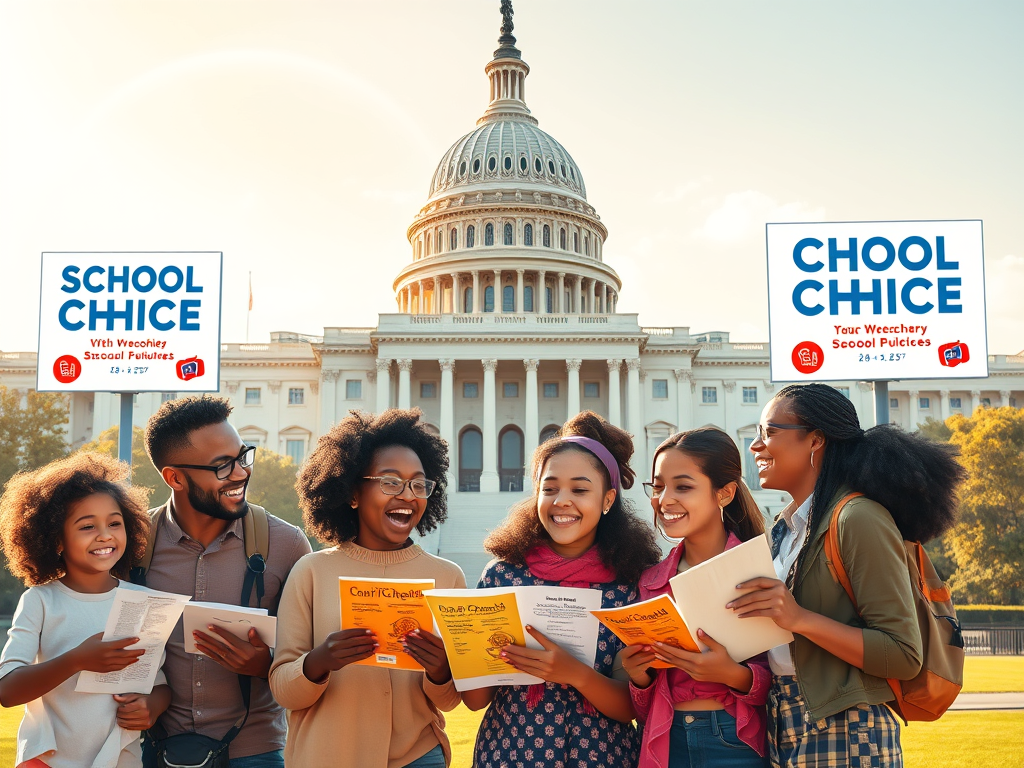

In a landmark decision, Congress has approved the country’s first nationwide school voucher initiative, a move that aims to ease the financial burden of private education for most American families, except for those in the highest income brackets. This plan, embedded in a broader domestic policy bill championed by Republicans, now awaits President Trump’s signature — an action he is widely expected to take, thereby enacting the measure into law.
Congress Passes a National School Voucher Program

The voucher program targets families earning up to 300% of the median income in their region. This threshold, which can reach over $300,000 annually in some areas, makes the majority of American households eligible, including those who are already paying for private education out of pocket.
The passage of this policy represents the culmination of years of lobbying by a coalition of education reformers, advocates of private and religious schooling, and parents who have long called for greater flexibility in choosing their children’s educational path. These groups have argued that public funding should support the principle of school choice, especially when parents believe that private institutions can better meet their children’s academic needs.
“This is the most significant step forward we’ve ever taken toward achieving educational freedom,” said Tommy Schultz, CEO of the American Federation for Children, a prominent school choice advocacy group.
State-Level Opt-In: A Compromise That May Limit the Program’s Reach
Despite the policy’s sweeping ambition, its implementation hinges on state participation. In a compromise reached during final Senate discussions, the program will only apply in states that choose to adopt it. This opt-in clause gives traditionally liberal states such as New York and California the opportunity to decline participation — a provision seen as a partial victory for Democrats and teachers’ unions, who have historically opposed voucher systems. Critics argue these programs divert both students and funding away from public schools, leaving behind the most vulnerable and resource-intensive students.
The Congressional Joint Committee on Taxation estimates the plan could reduce federal tax revenue by $3 to $4 billion annually, as it is structured around tax credits. However, without a formal cap in place, some analysts worry that the actual cost could balloon well beyond initial projections.
Randi Weingarten, head of the country’s second-largest teachers’ union, voiced strong opposition, calling the plan “a blank-check tax credit” that might ultimately cost taxpayers more than $50 billion a year. “That’s nearly double what the federal government currently invests in disadvantaged students and those with disabilities,” she noted.
An Expanding Movement for School Choice
Many Republican-led states have already adopted similar voucher-style programs, and over one million students nationwide are currently enrolled in them. With the new federal measure set to take effect in 2027, that number could see rapid growth as more states join the effort and additional funding becomes available.
However, the federal version of the voucher program is structurally distinct from many of the state-level models. It relies on individuals donating to approved nonprofit organizations in exchange for a dollar-for-dollar federal tax credit. These nonprofits then use the donations to issue scholarships for educational expenses, including private school tuition, textbooks, and related costs.
Carl Davis, research director at the Institute on Taxation and Economic Policy, explained that under the new plan, taxpayers can claim a federal tax credit of up to $1,700 per person. “It’s a full refund of your donation,” he said, emphasizing the generosity of the credit.
Still, logistical questions remain. For example, it’s unclear how much each student will receive, how scholarships will be distributed, and whether families who homeschool will be eligible for support. In states with existing voucher programs, this new federal funding may be combined with state aid, potentially helping to cover the full cost of private school, where average tuition hovers around $13,000 per year.
Davis estimated that approximately 138 million Americans could qualify for the credit, although actual participation will likely be much lower due to the effort required to donate and file appropriate paperwork. “If every eligible taxpayer claimed the credit, the program would strain the federal budget significantly,” Davis warned. “But participation levels are uncertain.”

A Revised, More Modest Credit Limit
Originally, the bill proposed allowing donors to claim a credit worth up to 10% of their income — a provision that would have disproportionately benefited wealthy contributors. However, Senate rules officials objected, prompting lawmakers to scale the benefit back to a flat $1,700 maximum per person. This revision forces nonprofit groups to secure smaller contributions from a much broader base of donors in order to sustain the program.
“You now have to convince thousands, even millions of people to each give $1,700,” noted Jim Blew, former assistant secretary at the U.S. Department of Education under President Trump and co-founder of the conservative Defense of Freedom Institute. Blew praised the bill’s passage but acknowledged that its effectiveness will depend on how successful nonprofits are in attracting donors.
Moreover, states still need to opt in for the program to take effect locally. James Cultrara, co-chair of the New York State Coalition for Independent and Religious Schools, expressed optimism that even blue states might eventually participate. “There’s no financial burden for the states themselves,” he said, though he conceded that similar proposals have repeatedly failed to gain momentum in places like New York.
Will Vouchers Improve Student Outcomes? The Research Is Mixed
The academic impact of school voucher programs remains the subject of ongoing debate. A 2019 randomized study conducted in Louisiana found that students who used vouchers to attend their preferred private schools performed worse on standardized tests than their public-school counterparts over a four-year period.
On the other hand, a recent Ohio-based study revealed that voucher students were more likely to pursue higher education and earn college degrees than those who remained in public schools. Similarly, a 2014 study in Florida showed that public schools facing competition from voucher programs improved their academic performance, suggesting that school choice can yield positive ripple effects.
Douglas Harris, a school-choice expert and economist at Tulane University, cautioned that evaluating the effectiveness of voucher programs is complicated. “Parents who apply for vouchers tend to be more involved in their children’s education,” he said, adding that private schools may also filter out students with lower academic performance or special needs, skewing results.
Political Shifts and Calls for a New Strategy Among Democrats
Amid a shifting political landscape, some Democrats are beginning to reconsider their traditional opposition to school vouchers. Jorge Elorza, CEO of Democrats for Education Reform, pointed to polling data showing declining public trust in Democratic education policies — especially in the wake of the COVID-19 pandemic, which intensified debates over school closures and remote learning.

According to Elorza, Black and Latino voters have shown greater openness to the idea of school choice than white liberal voters, who remain the strongest opponents. He urged his party to be more pragmatic in its approach.
“We’re losing the education debate both in terms of policy and public opinion,” he said. “It’s time to consider new solutions. We need to ensure that the most vulnerable students — particularly those in underperforming schools — have access to better opportunities. That should be our priority.”
Though the new federal voucher program still faces implementation challenges and political resistance in certain states, its passage marks a pivotal moment in the ongoing battle over the future of American education. Whether it will deliver on its promises or exacerbate existing inequalities remains to be seen. But one thing is clear: the conversation about school choice is far from over.g.”




Leave a Reply