
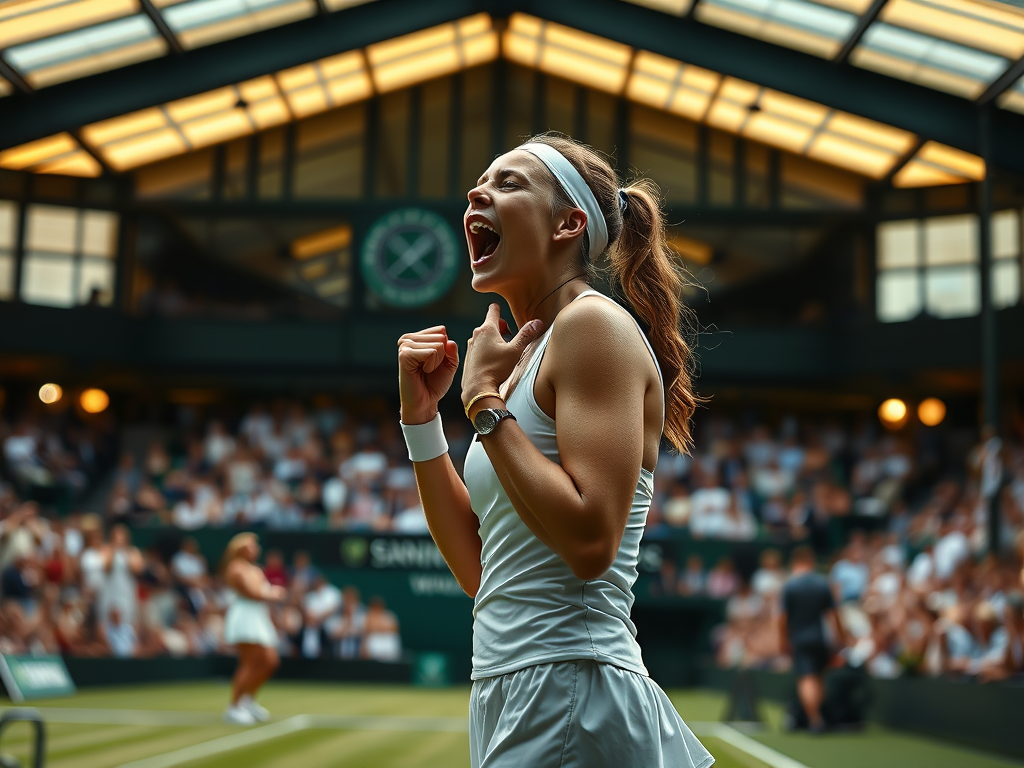

Coco Gauff loses in Wimbledon first round after nightmare draw against Dayana Yastremska

Under the closed roof and the fading light in southwest London, Yastremska took full advantage of the slick grass surface, consistently pressuring Gauff’s forehand and dominating her second serve. Her aggressive shot-making, particularly her skidding forehands and low-bouncing backhands, disrupted Gauff’s rhythm and left her struggling to find any consistent footing throughout the match.
Despite displaying the grit and defensive resilience that have become her trademarks, Gauff couldn’t find a way to turn the tide. Although she managed to apply pressure when Yastremska tensed up late in the first set, her serve—something she acknowledged pre-tournament would be critical to her performance—let her down when it mattered most. She served two double faults in the tiebreaker, errors that ultimately cost her a set she had been chasing all evening. In total, Gauff double-faulted nine times—too many to remain competitive at this level.
Yastremska, currently ranked 42nd in the world, brought her A-game to the court. Except for a brief lapse in the first set, she maintained high intensity and confidence. Fans may recall she had previously challenged Gauff to three sets at the Madrid Open, and she seemed determined to go further this time. On the final point of the match, she attacked Gauff’s first serve with a powerful return that pinned the American at the back of the court, sealing the upset with a triumphant roar.
Wimbledon holds special significance for Gauff, as it was the venue of her breakthrough moment in 2019, when she burst onto the scene as a 15-year-old. Ironically, she has never advanced beyond the fourth round at this tournament since then. The transition to grass continues to be a challenge, especially for a player whose topspin-heavy forehand loses its effectiveness on the low-bouncing turf. These weaknesses become more evident against aggressive opponents like Yastremska, who are adept at rushing her and forcing her into defensive positions.
Currently ranked No. 2 in the world and fresh off her French Open title, Gauff entered the tournament expecting to progress at least a few rounds, regardless of the surface. However, drawing a dangerous opponent like Yastremska in the opening round made things difficult from the outset. Yastremska’s run to the Australian Open semifinals last year is a testament to her potential when she’s in form. Despite her inconsistency, she can pose a serious threat to any top player on any given day.

During her post-match press conference, Yastremska admitted she had anticipated a tough battle but sensed the opportunity. “When I saw the draw, I thought the match could be decided on my terms,” she said confidently.
Gauff’s preparation for Wimbledon was far from ideal. After her triumph in Paris, she was quickly swept into a whirlwind of media obligations in New York, which shortened her grass-court season significantly. Her lone warm-up event was in Berlin, where she suffered a first-round exit. At the time, she wasn’t too concerned, assuming she could build momentum at Wimbledon. Unfortunately, that never materialized.
Now, she will have an entire year to prepare for another shot at the grass-court major.
Speaking to the press half an hour after the loss, an emotional Gauff gave full credit to Yastremska for her performance but reflected on the challenges she faced in transitioning from the clay courts of Roland Garros to the grass of Wimbledon. “Mentally, it was a lot,” she admitted. “There was so much going on after Paris that I didn’t really have time to celebrate, reset, and prepare.”
She described the experience as a learning moment, acknowledging that this was her first time navigating such a quick turnaround between a major victory and the next big challenge. “I’ve definitely learned what I would and wouldn’t do again,” she said.
For Gauff, the difficulty lies in adapting her game from clay—where her endurance and movement shine—to the fast-paced, low-bounce conditions of grass, which reward players who take initiative and dictate play. She recognized that she has to work on making that adjustment more effectively in the future.
Trying to stay optimistic, Gauff mentioned she had been consoled by her team in the locker room after the match. Despite their encouragement, she couldn’t shake off the disappointment. “I just feel a bit let down by how I performed today,” she confessed. “Especially in those high-pressure moments. I thought I had grown a lot in tiebreaks after Paris, but it didn’t show.”
This isn’t the first time Gauff has used an early Grand Slam exit as motivation to evolve. Last year, after a first-round defeat at Wimbledon to Sofia Kenin, she reevaluated her coaching team and brought in veteran coach Brad Gilbert. Two months later, she won her first Grand Slam title at the US Open. That loss ultimately marked a turning point in her career.
The pattern continued after another loss in the fourth round of the US Open to Emma Navarro, a result that mirrored her Wimbledon exit earlier that summer. Gauff again made changes, parting ways with Gilbert and hiring Matt Daly, a relatively unknown coach, to refine her serve. Daly introduced a new grip and strategy, which helped Gauff become less reliant on defense and more aggressive with her forehand. The improvements were evident, culminating in her winning the French Open.
Unlike those previous turning points, this defeat may not lead to any drastic changes. Gauff seemed aware of the obstacles and came into the tournament with realistic expectations. On the Saturday before Wimbledon began, she expressed a grounded perspective. “I’ve been to the fourth round here a few times. Of course, I’d love to go further, maybe even win it someday, but I’m focused on taking it one step at a time,” she said.
Looking ahead, Gauff plans to regroup for the hard-court season. She is expected to compete at the Citi Open in Washington, D.C. in late July, the same tournament she played after her Wimbledon exit two years ago. That will likely be followed by tournaments in Canada and Cincinnati as she prepares for the US Open, a tournament she now sees as her next big target.
“I’m not going to dwell on this loss for too long,” she said. “I want to be ready for the US Open. Maybe going out early here isn’t the worst thing—it gives me time to reset.”
Still, Wimbledon holds a special place in every tennis player’s heart. Regardless of the surface challenges, it remains the most iconic event in the sport. Gauff made it clear she hasn’t given up on her dreams of success at the All England Club.
“One of these years,” she said quietly, “I just want to have a good run here.”f these years,” she said.




Leave a Reply