
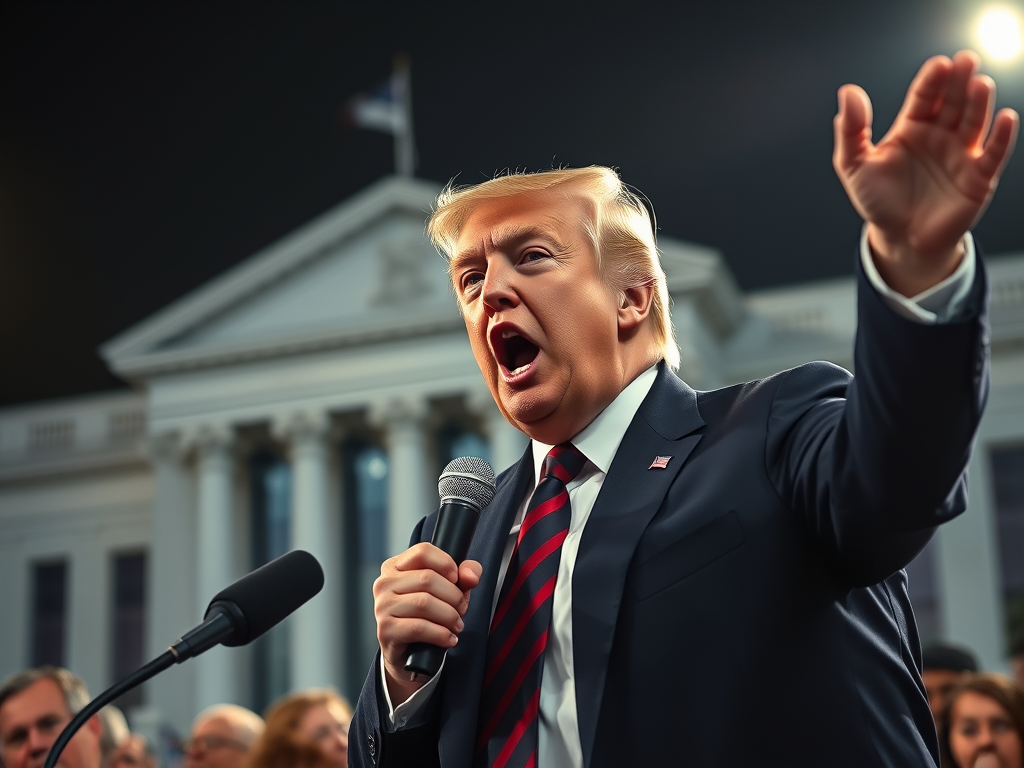

On Monday, former President Donald Trump significantly escalated his criticism of the Federal Reserve, specifically targeting its chair, Jerome H. Powell, with renewed demands for aggressive interest rate cuts. In a handwritten note, Mr. Trump accused Powell of costing the nation vast amounts of money and called for substantial reductions in borrowing costs.
Trump Steps Up Pressure Campaign on Powell With Handwritten Note

In a separate message posted on social media the same day, Mr. Trump did not hold back. He directed his frustration at Powell and the other members of the Federal Reserve’s Board of Governors — the group responsible for deciding monetary policy — stating that they should be “ashamed” of their actions, or lack thereof, in his view. “If they were doing their job properly,” Trump wrote, “our Country would be saving Trillions of Dollars in Interest Cost. The Board just sits there and watches, so they are equally to blame.”
These latest remarks continue a long-standing pattern of Trump’s combative stance toward Powell and the Federal Reserve. Over the past several months, Trump has not only publicly rebuked Powell on multiple occasions, but also suggested that he could remove him from his position. Most recently, on the preceding Friday, Trump even encouraged Powell to step down before the end of his term, which is scheduled to conclude in May. However, under existing statutes, Powell could continue to serve on the Board of Governors until 2028, even if his chairmanship ends earlier.
In addition to calls for Powell’s resignation, Trump has indicated an intention to nominate a successor well before the current term concludes. This kind of premature action would be highly unconventional and could interfere with the Fed’s ability to communicate its policies effectively, potentially undermining market stability.
The next scheduled vacancy on the Board of Governors will occur when Adriana Kugler’s term ends in January. On Monday, U.S. Treasury Secretary Scott Bessent floated the possibility of nominating Powell’s eventual successor to fill that vacancy, with the intention of later elevating that individual to chair the central bank.

Trump has made it clear that his top priority for any incoming Fed chair is their willingness to implement aggressive rate reductions. While this political litmus test aligns with Trump’s broader economic agenda, it raises serious concerns among economists and policymakers who fear it could erode the Federal Reserve’s longstanding independence from executive influence — a cornerstone of its credibility and effectiveness.
In his Monday note to Powell, Trump claimed that the country could save “hundreds of billions of dollars” if interest rates were lowered. This comes amid Republican efforts to pass an expansive tax and spending bill, one that would significantly expand the federal deficit. As the government borrows more, higher interest costs on the national debt would follow — costs that Trump believes could be mitigated by slashing interest rates.
Trump has publicly advocated for reducing the benchmark interest rate by as much as 2.5 percentage points, a dramatic shift that would bring rates far below the current range of 4.25% to 4.5%, which has been maintained since January. While the Federal Reserve did lower interest rates by a full percentage point over the course of the previous year, it has since adopted a cautious approach, pausing further cuts to assess how the broader economy is reacting to recent fiscal and trade policies, including tariffs imposed under Trump’s leadership.
A recurring theme in Trump’s rhetoric is his dissatisfaction with the Federal Reserve’s stance compared to other countries. He has repeatedly pointed to international central banks — particularly in Europe — that have continued to ease monetary policy by reducing interest rates. In fact, Trump’s handwritten message to Powell on Monday was composed on a sheet ranking global interest rates from lowest to highest, serving as a pointed reminder of where the U.S. stands in relation to other economies.
As Trump sharpened his verbal attacks, Powell was attending an international central banking event in Sintra, Portugal. The gathering, hosted by the European Central Bank (ECB), brought together some of the world’s most prominent monetary policymakers. During a dinner that marked the official start of the ECB’s annual conference, its president, Christine Lagarde, publicly praised Powell’s leadership and resilience.

“He epitomizes the standard of the courageous central banker,” Lagarde said, prompting applause from attendees. She went on to commend two other seasoned European economic leaders before the room rose in a standing ovation, a moment that sharply contrasted with the harsh criticism Powell was receiving from his home country.
Powell is scheduled to speak on a high-profile panel at the conference on Tuesday, alongside other global economic figures including Bank of England Governor Andrew Bailey. Trump has often contrasted Powell’s decisions unfavorably with those of his international peers, frequently highlighting the ECB’s actions. Over the past year, the ECB has cut interest rates eight times, and although the Bank of England has also reduced its rates, it held steady at its latest meeting in June — a move that still places it in a more dovish category than the Fed in Trump’s eyes.
Critics of Trump’s rhetoric argue that his ongoing efforts to pressure the Federal Reserve could set a dangerous precedent. Central bank independence is widely viewed as essential to maintaining investor confidence, containing inflation, and ensuring decisions are driven by economic data rather than short-term political goals. By publicly demanding rate cuts and tying them to political objectives — such as lowering the cost of servicing national debt — Trump risks politicizing an institution designed to remain above partisan influence.
Supporters of the former president, however, argue that the Federal Reserve has been overly conservative in its approach and that lower interest rates are necessary to stimulate economic growth and support fiscal initiatives. They share Trump’s view that the Fed has been out of step with other major economies, potentially placing the United States at a competitive disadvantage.
As Powell prepares to address the international economic community in Portugal, all eyes will be on how he responds — if at all — to the mounting pressure from Washington. Whether the Fed stays the course or shifts its policy in response to political demands remains to be seen, but the tensions between the White House and the central bank are now more visible than ever.
Ultimately, the showdown between Trump and Powell reflects deeper divisions over the appropriate role of monetary policy in today’s global economy. As Trump continues to seek aggressive rate cuts and a new Fed leadership more aligned with his views, the Federal Reserve finds itself at a crossroads — one where its commitment to independence will be tested like never before.




Leave a Reply