
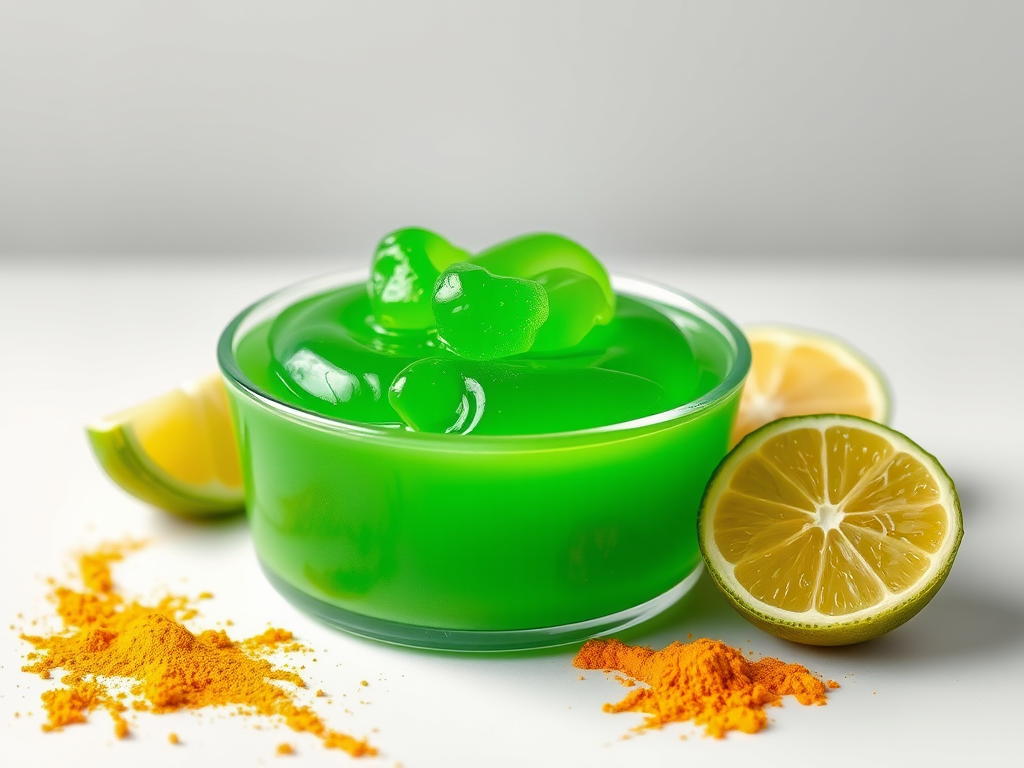

Transforming clear, trembling gelatin into shades of red or orange using natural elements is a manageable task with ingredients like beet juice and annatto, which comes from the seeds of a tropical tree. But turning gelatin green without relying on artificial coloring? That’s where the real challenge begins—especially for Simple Mixes, a company that specializes in naturally flavored and colored gelatin products.
Jell-O With Natural Dyes? It’s Not Easy Becoming Green.

Malathy Nair, the company’s founder and a Ph.D. in food science, blends turmeric extract with spirulina—an algae-derived substance that offers hues of green and blue—in her attempt to replicate green gelatin without synthetic additives. However, spirulina isn’t a perfect solution. It tends to clump, which isn’t ideal in a smooth dessert, and it comes with an earthy, somewhat “seedy” flavor that many consumers find unappealing.
To mask spirulina’s distinctive taste, Dr. Nair is forced to incorporate additional natural lime flavoring, which ultimately makes her green gelatin the priciest offering in the Simple Mixes product line. And even with all this effort, the resulting color is a muted green, lacking the vibrant brightness consumers might expect. “I’m still not quite satisfied with the way our green gelatin looks,” she admits.
This issue is emblematic of a broader problem facing the food industry as it shifts toward natural alternatives to artificial dyes. Kraft Heinz recently declared that it would eliminate synthetic colorings from all of its food products by the end of 2027. This aligns them with other major companies, such as General Mills, Danone North America, and PepsiCo, all of which have pledged to phase out artificial colorants in the near future.
To meet these goals, food scientists across the United States are experimenting with combinations of plant-based ingredients—like fruit and vegetable juices and various spices—to mimic the intense colors that synthetic dyes currently deliver. This transition is happening under growing regulatory and public pressure, spearheaded by individuals like Health Secretary Robert F. Kennedy Jr. and advocacy groups such as Make America Healthy Again. These advocates argue that artificial dyes pose significant health risks, particularly for children, and have pushed for tighter restrictions.
States like West Virginia and Texas have already taken action by passing laws that either ban certain petroleum-derived dyes or require warning labels on products that contain them. The push toward natural colorants is gaining momentum, but it comes with its own set of complications.
Plant-based dyes typically produce more subdued tones and are more sensitive to environmental factors such as light and heat. Furthermore, natural coloring agents often require greater quantities to achieve the desired effect, which increases costs. These drawbacks present a stark contrast to the synthetic dye industry, which has long delivered bright, stable colors at a low cost for manufacturers and consumers alike.

This isn’t the first attempt at a widespread shift to natural dyes. Roughly ten years ago, several companies tried to move in that direction. Some succeeded—Kraft, for example, managed to replace the artificial orange in its macaroni and cheese with turmeric and paprika without alienating customers. Others, however, did not fare so well.
In 2016, Kraft introduced the Simply Good Jell-O line, which contained no artificial colors or flavors. Despite the company’s best intentions, the line failed to resonate with consumers and was quietly pulled from shelves a few years later. M. Monica Giusti, a professor in the Department of Food Science and Technology at Ohio State University, commented, “There was some early interest, and companies reformulated products to meet that demand, but many consumers just didn’t accept the changes.”
A Kraft Heinz spokesperson recently confirmed that the Simply Good line is scheduled for a relaunch in 2026, though further specifics haven’t been released. Notably, the original lineup didn’t include a green Jell-O flavor—perhaps unsurprisingly, given the difficulties in achieving that color naturally.
When it comes to replicating colors with natural substances, some shades are more attainable than others. Reds can come from beet juice, red cabbage, radish, or even carmine—a crimson dye made from crushed cochineal insects. Yellow is typically easier, thanks to sources like turmeric, safflower, golden beets, and annatto.
Green, however, is tricky. To produce green, food scientists often need a natural blue pigment to blend with yellow. But finding a true blue in nature is rare. Despite their name, blueberries produce a purple or dark red pulp when mashed. While chlorophyll—a pigment found in leafy greens like spinach and kale—can offer green hues, it’s unstable and tends to degrade into an unappetizing olive or brownish color, particularly under heat or light.

“Green is arguably the toughest color to replicate naturally,” said Elad Tako, an associate professor of food science at Cornell University. “It’s prone to breaking down, and often brings along a flavor that doesn’t belong in sweets.”
Spirulina was once heralded as the answer to the natural blue pigment problem. Derived from blue-green algae, it yields a shade close to Brilliant Blue (Blue No. 1), a synthetic dye used in products like Lucky Charms and Gatorade’s Cool Blue. In 2013, the FDA approved phycocyanin, the extract from spirulina, for use as a natural food coloring. It works reasonably well in products that are cold and low in acidity, like yogurt or ice cream.
However, as Dr. Tako points out, phycocyanin is also sensitive to light and heat, which limits its usability in a wide range of processed foods. Despite its drawbacks, spirulina remains in demand because it’s a rare natural source of blue pigment. While it grows naturally in lakes, spirulina intended for human consumption must be cultivated under controlled conditions. In places like the California desert, it’s farmed in shallow, artificial ponds that are strictly monitored before being dried into powder form.
Companies like Ful Foods, which specialize in spirulina production, have started using photobioreactors—transparent tubes stacked in warehouses with controlled lighting and temperature—to grow algae. Founded in 2020, Ful Foods reports a growing number of inquiries from food manufacturers searching for vibrant, natural blues to use in products ranging from candy to beverages.

The company claims to have developed a method of extracting and stabilizing spirulina that retains its bright blue color even in more demanding environments. “Natural dyes offer incredible advantages, but they also come with challenges,” said Julia Streuli, co-founder and CEO of Ful Foods. “Still, none of those challenges are impossible to overcome.”
Despite its promise, spirulina remains more costly than artificial dyes. Dr. Nair, for instance, pays around $25 per pound for it—and because natural colorants are less potent, she must use much larger quantities to achieve desired hues. Combined with other high-quality ingredients like natural flavors and kosher gelatin, this drives up the retail cost of her gelatin mixes.
Her products are mainly sold through Amazon, where a three-pack of strawberry, orange, and lime gelatin goes for $11.98. By contrast, a single box of traditional Jell-O costs just $1.49 at a grocery store in New Jersey. Dr. Nair acknowledges that large corporations like Kraft Heinz have the leverage to negotiate better prices on natural ingredients. But she’s hopeful that as demand rises and technology advances, the costs will come down—and perhaps, better and brighter shades of green will finally become reality.




Leave a Reply