
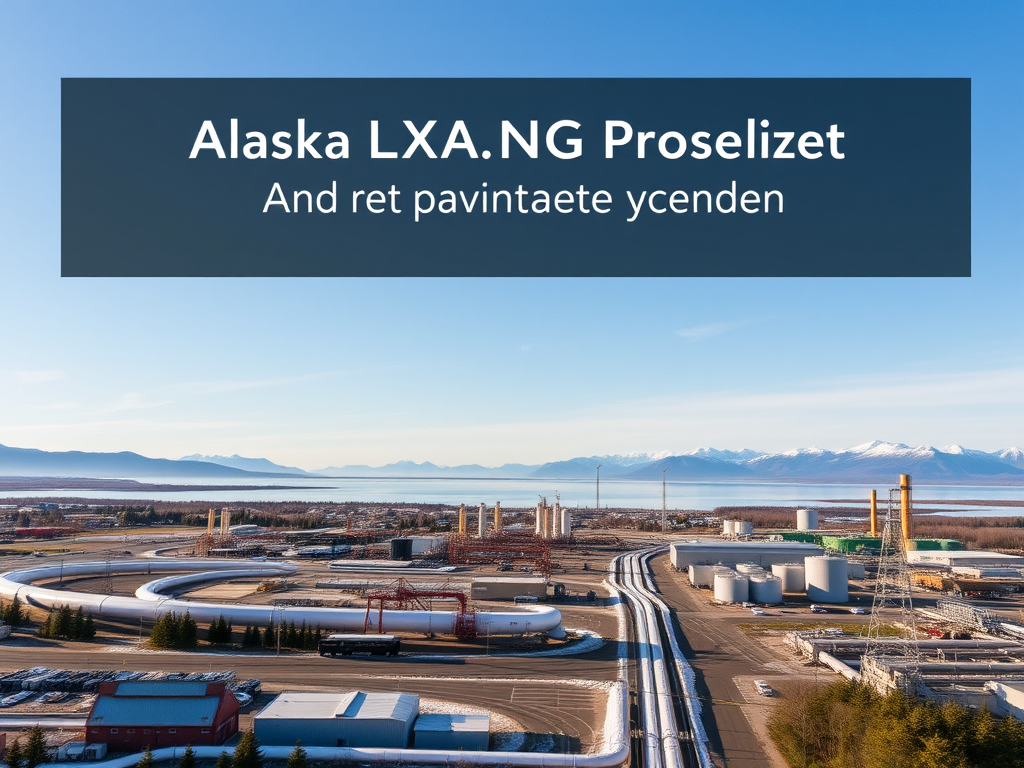

The Alaskan Outpost at the Center of Trump’s $44 Billion Energy Push

In the small southern Alaskan community of Nikiski, which is home to only a few thousand residents, a major topic of conversation lately has been President Trump’s strong endorsement of a long-anticipated energy venture known as the Alaska LNG project.
This project, valued at $44 billion, represents what could become the largest energy investment in the history of the United States. It centers on transporting liquefied natural gas (LNG) from the rich gas fields in Alaska’s northern region to Asian markets, particularly Japan. The route for these exports would run through Nikiski, placing the town at the heart of this massive initiative.
For decades, Alaska has dreamed of a project like this. The state, America’s northernmost, has long seen Alaska LNG as a potential game-changer but has been unable to bring it to life due to its sheer scale and cost. Now, under the Trump administration’s broader push to increase fossil fuel production and boost American energy exports, the Alaska LNG project is getting renewed attention.
For Nikiski and nearby communities, this project offers much more than just infrastructure. It holds the promise of economic revival.
Located on the Kenai Peninsula just south of Anchorage, Nikiski has relied heavily on nearby oil and gas reserves since the mid-20th century. But over time, those resources have declined. The once-thriving industrial scene in Nikiski now shows signs of wear, with closed-down facilities and empty storefronts along the town’s main road.

Peter Ribbens, a representative on the Kenai Peninsula Borough Assembly, moved to Nikiski in 1997 for a job at an oil refinery. Sitting in the lakeside log home he built himself, he acknowledged the town’s financial difficulties: “Everyone knows Alaska’s economy is struggling,” he said. “If we could start exporting hydrocarbons to Japan, it wouldn’t just help Nikiski—it would help the entire region.”
The Alaska LNG project has been discussed since the 1980s but has seen little actual progress. The main challenge lies in building the necessary infrastructure: an 800-mile pipeline from northern Alaska’s gas fields to Nikiski. Once there, the gas would be converted to liquid and shipped across the Pacific. The price tag for this endeavor has repeatedly stalled development.
After years of delays and dwindling hope, the project is now gaining momentum.
President Trump has promoted Alaska LNG since taking office, even incorporating it into trade talks with Asian leaders. Securing long-term purchase agreements from countries like Japan and Thailand is vital for the project to move forward.
Glenfarne, a New York-based energy company that recently assumed leadership of the project, reported in May that over 50 companies had expressed interest in buying LNG from the facility. One major breakthrough came when PTT, a state-owned oil and gas firm from Thailand, signed a 20-year agreement to buy gas from the Alaska project.

Back in Nikiski, the recent developments have sparked new conversations and optimism. However, Ribbens remains cautious. Having lived in Alaska since 1983, he’s seen many grand proposals that never came to fruition. “I’ll believe it when I see it,” he said.
Historically, the Kenai Peninsula Borough’s economy, which includes Nikiski, has revolved around oil and gas. The discovery of oil in the Cook Inlet Basin in 1957, followed by vast natural gas findings in 1959, attracted major industrial operations. A fertilizer plant, an oil refinery, and an LNG export facility were built in Nikiski, and the town prospered.
By the 1980s, Nikiski was thriving. Peter Micciche, now the mayor of the Kenai Peninsula Borough, started his career at the Nikiski LNG plant in 1985 as a laborer and later became its superintendent. He remembers how the area developed rapidly, gaining its first traffic lights, fast-food chains, and other amenities. “Those were booming times,” he said. “Japan counted on us. Our local economy owed everything to oil and gas.”
But things began to change around the year 2000. Local gas supplies started to run low. The fertilizer plant closed in 2007, the refinery cut back its operations, and LNG exports to Japan ceased in 2011. The export facility itself was put into hibernation in 2017.
Today, Nikiski’s industrial waterfront is mostly dormant. Large loading arms reach out toward the waters of Cook Inlet, now unused. On weekends, residents ride ATVs or stroll along the shore searching for polished stones and agates.
Driving from the coast inland, one sees a scattering of shuttered restaurants and sparse businesses—mainly churches and industrial supply shops—breaking up the stretch of forest. “When you lose your economic core, it affects everything,” said Ribbens. “Not just the plant workers, but also local shops, gas stations, and grocery stores—it’s all connected.”

One of the reasons many locals are hopeful about the Alaska LNG project is the belief that it could attract other industries back to the area by offering affordable, accessible natural gas. “It’s understandable why people are excited,” Ribbens added. “When you want something badly, you tend to look for signs it might actually happen.”
Just over a mile down the coast from the old LNG facility, land has already been cleared for the new terminal. Glenfarne, the project’s operator, has bought more than a dozen properties in preparation.
Louie Oliva, who recently took over his family’s hardware store, is one of the many Nikiski residents whose hopes have been rekindled. The store had been on the brink of shutting down earlier this year. Oliva, 45, said he has watched Nikiski slowly deteriorate over the years as gas resources declined. His sister, Amber Douglas, 44, who also works at the store, noted that her son just graduated from Nikiski High School. His graduating class was half the size of hers two decades earlier.
Their father had once worked on the trans-Alaska oil pipeline, a project completed in the late 1970s that transformed the state’s economy and employed tens of thousands of people. The proposed Alaska LNG pipeline would follow part of that same route, offering hope that it could have a similar impact.


“Oil and gas provided for our family,” Oliva said. “These kinds of projects create real opportunities—not just for jobs now, but for the future of our kids and their families.”
Still, whether the project can truly move forward depends on securing enough international buyers. With global competition increasing and cleaner energy alternatives gaining ground, some Alaskan officials see this moment as possibly the last chance for Alaska LNG to become a reality.
Glenfarne plans to begin construction this year on a pipeline segment linking the northern gas fields to Anchorage, located northeast of Nikiski. According to Glenfarne executive Adam Prestidge, that portion of the project is economically viable on its own. If sufficient demand is confirmed from foreign buyers, the company will complete the final stretch to Nikiski and construct the export terminal. That facility alone would account for half of the total project cost.
For Mayor Micciche, stopping short of building the Nikiski terminal would be a disappointment. If the pipeline only serves local needs, it will carry far less gas than originally planned.
Inside his office, beneath a mounted bear gifted by a local business, Micciche still keeps a red lacquer vase given to him by a Japanese executive who once purchased gas from Nikiski. “Alaska has the potential to become a key player in global energy markets once again,” he said. “But the challenge now is aligning the financial and logistical pieces. For our future, this might be our last shot.”




Leave a Reply