

Reviving Manufacturing: The Skills Gap Challenge

Former President Donald Trump’s ambition to restore America’s manufacturing dominance has encountered an unyielding challenge: a dwindling workforce capable of filling industrial roles.
The U.S. labor market is facing a stark reality—fewer individuals are both qualified and willing to work in traditional manufacturing settings. As the baby boomer generation heads into retirement, there is a noticeable shortage of younger workers eager to step into these roles. The Bureau of Labor Statistics reports that approximately 400,000 manufacturing positions currently remain vacant. Experts anticipate that this number will only increase, particularly if the U.S. shifts production back home and reduces its reliance on foreign manufacturing.
Since 2017, American manufacturers have consistently identified the difficulty of hiring and retaining skilled labor as one of their greatest operational obstacles, according to Victoria Bloom, the chief economist at the National Association of Manufacturers. While trade issues and the rising costs of raw materials—largely a result of tariff policies—have recently taken precedence, the shortage of a qualified manufacturing workforce remains a persistent concern for long-term growth.
Ron Hetrick, an economist at labor analytics firm Lightcast, believes this labor shortfall is the product of long-standing cultural narratives. “For decades, we’ve told people that failing to go to college meant you were a failure,” he explains. “Now, the country is grappling with the consequences of that mindset. We still need skilled tradespeople—people who can work with their hands.”

The reasons American factories are struggling to hire are varied and complex. One factor is the Trump administration’s strict immigration policies. Moves to restrict legal immigration and rescind protections for certain migrant groups have limited a source of potential labor. Many immigrants could have filled industrial jobs but now face significant legal uncertainty or barriers to employment.
At the same time, many Americans no longer view manufacturing as a viable or attractive career path. Factory jobs often lack the flexibility and environmental comfort of service industry roles, while not necessarily offering competitive wages. As a result, many potential workers opt for alternatives that better suit modern lifestyle expectations.
The nature of manufacturing itself has also changed. Advanced machinery and increasingly automated systems now demand a higher level of technical proficiency than in past decades. Workers are expected to operate complex software and handle sophisticated equipment—skills not typically taught in high school. As such, companies are forced to invest in extensive training programs to prepare new hires, which adds to their recruitment burden.
Moreover, there is a cultural disconnect between education and industry. High school guidance counselors are often evaluated based on how many of their students pursue college degrees, not on how many secure well-paying trade jobs. This incentive structure discourages students from considering careers in manufacturing. And even those who do attend college often emerge with skills that do not align with factory needs.
This mismatch between educational outcomes and industry requirements is a serious problem, says Hetrick. “We’re producing too many college graduates who struggle to find suitable employment,” he notes. “Meanwhile, we have a critical shortage of skilled tradespeople who could fill existing—and future—manufacturing roles.”
To address this imbalance, some business leaders are taking action. The Business Roundtable, an association of CEOs from major U.S. companies, has launched a campaign to develop and attract new talent for skilled trade professions. At a recent conference in Washington, executives discussed the difficulties they face in finding qualified workers and shared ideas for closing the gap.
One popular suggestion involved reassessing job qualifications—moving away from rigid degree requirements and instead focusing on relevant experience. Another strategy was to begin recruitment efforts as early as high school sophomore year, giving students hands-on exposure to manufacturing environments and sparking interest in industrial careers.
David Gitlin, CEO of Carrier Global—a company specializing in heating and cooling systems—shared a stark statistic: “Right now, for every 20 job openings, we only have one qualified applicant.” He emphasized the rising demand for technicians in the era of artificial intelligence, especially to maintain the cooling systems that support data centers. Gitlin estimates that each data center requires four technicians to maintain just one chiller unit.
Currently, the HVAC industry employs about 425,000 technicians, but Gitlin predicts that number will need to double over the next decade. Despite this looming demand, enrollment in vocational programs and community colleges continues to decline.
At the same Roundtable event, business leaders praised Trump’s focus on revitalizing American industry, yet many also acknowledged that his administration’s immigration policies present a significant barrier to achieving that goal. Peter J. Davoren, CEO of Turner Construction Company, voiced support for a more inclusive approach. “We need a clear and practical path to citizenship, especially for immigrants in construction and food production sectors,” he said.

In addition to immigration policies, the Trump administration also cut funding to key job-training initiatives, including attempts to dismantle Job Corps—a long-standing federal program designed to help at-risk youth aged 16 to 24 transition into skilled trade careers. This has made it harder to replenish the blue-collar workforce. For example, Huntington Ingalls Industries, a major U.S. shipbuilder, hired 68 Job Corps graduates in December alone to strengthen its team.
Chris Kastner, president and CEO of Huntington Ingalls, underscored the growing skills gap. “Technology is evolving rapidly, but our education and training systems just can’t keep up,” he noted. Without a strong pipeline of trained workers, the future of American manufacturing remains uncertain.
In response to this growing crisis, the Trump administration introduced the “Make America Skilled Again” initiative. This program aims to streamline and consolidate various workforce training efforts under a single umbrella, offering grants to states that meet specific criteria. A minimum of 10% of these funds must be allocated to apprenticeship programs.
In April, Trump signed an executive order directing the Secretaries of Labor, Commerce, and Education to develop a strategy for creating one million registered apprenticeships. However, questions remain about the feasibility of that goal, especially considering the $1.6 billion cut from workforce development in the same budget.
Treasury Secretary Scott Bessent stirred controversy when he proposed that displaced federal employees could be redirected into manufacturing roles. “We’re trimming excess labor from the federal government,” he said in a televised interview. “That surplus can be absorbed by our manufacturing sector.” This suggestion was not well received by many in the public sector—and was notably absent from discussions at the Roundtable.
Instead, companies are focusing on more viable long-term strategies such as training veterans and engaging high school students. Blake Moret, CEO of Rockwell Automation, described an in-house training academy that prepares military veterans for manufacturing roles through an intensive 12-week program.

Sara Armbruster, the chief executive of Steelcase—a Michigan-based furniture manufacturer—stressed the importance of early engagement. “We need to start recruiting in high schools and educating both students and parents about what a modern factory looks like,” she said.
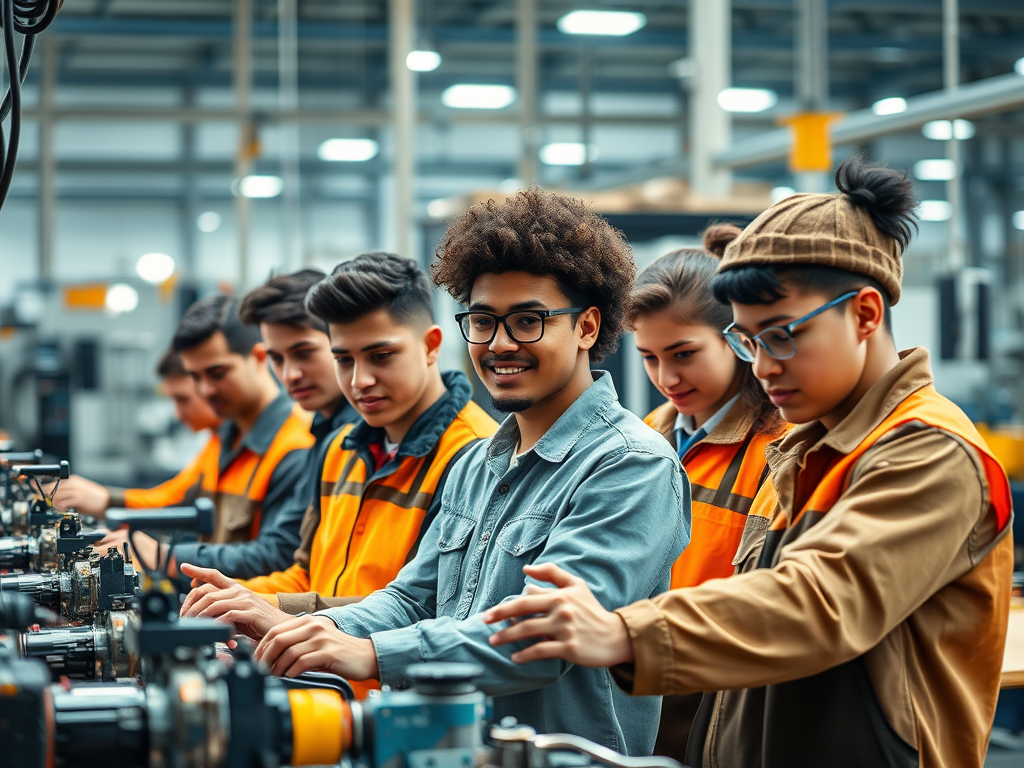
Often, young people are surprised to find that today’s manufacturing plants are not dark, noisy, or dirty spaces, but rather sleek, tech-driven environments. “When students see how clean and advanced our factories are, it completely changes their perception,” Armbruster said. “That moment of realization can open up a whole new world of career possibilities for them.”
In conclusion, while revitalizing American manufacturing is a worthy and necessary goal, it cannot be achieved without a fundamental shift in how the country approaches education, immigration, and vocational training. Without a new generation of skilled workers, the vision of a manufacturing renaissance will remain out of reach.opening up possibilities for them in their career,” she said.




Leave a Reply