
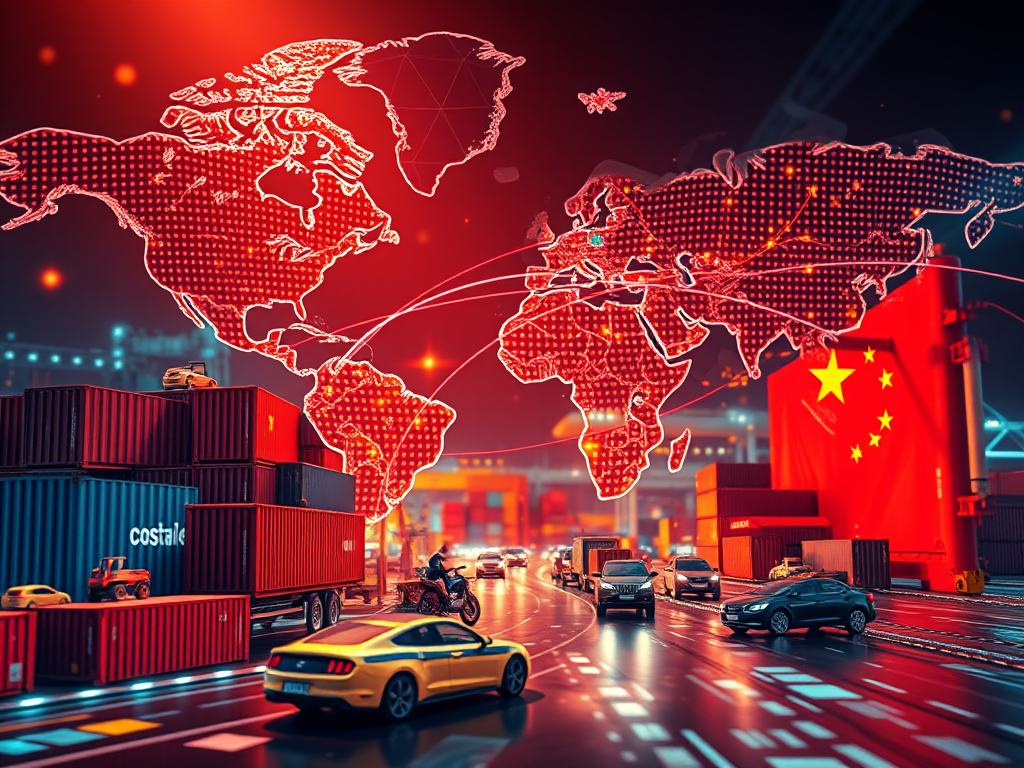

China Is Unleashing a New Export Shock on the World

Two decades ago, China stunned the world—particularly the United States—with its unmatched ability to manufacture and export goods at record speed and low cost. This vast and efficient production capacity not only transformed global supply chains but also had a profound impact on the U.S. economy and political landscape. American factories closed, jobs shifted overseas, and economic inequality deepened, triggering years of debate and policy shifts around globalization and trade.
Now, a second “China shock” is rippling across the globe. Unlike the initial wave, which primarily hit the U.S., this new disruption is being felt far beyond American borders—from Southeast Asia to Europe to Latin America. As the U.S. imposes steep tariffs that restrict Chinese access to its market, China is rapidly redirecting its surplus of goods—including toys, shoes, cars, and electronics—to other regions, reshaping global trade dynamics once again.
In the first part of this year alone, China’s trade surplus has ballooned to nearly $500 billion, marking an increase of over 40% compared to the same period in the previous year. This surge is not just a statistical anomaly—it signals deeper shifts in global economic currents.
As the world’s two largest economies—the U.S. and China—continue their tense standoff over trade, nations across the globe are bracing for the aftershocks. While tariffs may have slowed direct Chinese exports to the U.S., they have not stemmed the overall tide of Chinese goods entering world markets.
“China simply has an overwhelming volume of products it needs to export,” explains Leah Fahy, an economist specializing in China at Capital Economics. “Even with tariffs in place, it’s nearly impossible to halt the redirection of these exports. The flow is simply too large.”
The root cause of this export boom lies in a mix of internal economic pressures and strategic policy decisions by the Chinese government. In recent years, China’s domestic economy has been strained by a severe property crisis that has wiped out significant household wealth. In response, Beijing has poured financial resources into manufacturing sectors, aiming to prop up growth by boosting industrial output. The result? A manufacturing sector that now produces far more than the domestic market can absorb.
As Fahy’s research shows, China’s share in global exports across nearly all product categories has increased sharply. This upward trajectory shows no signs of slowing, especially as Chinese leadership remains committed to export-led growth. Even as geopolitical tensions rise, China is unlikely to abandon this strategy.
With U.S. demand waning, Chinese exporters have turned their attention to other markets. Southeast Asia, Latin America, and parts of Europe are now absorbing a growing portion of Chinese goods. This has helped China cushion the economic blow of reduced access to the American market—but it also poses new challenges for these countries.
For example, Vietnam, Cambodia, and Indonesia are all seeing a surge in Chinese imports, putting local industries under stress. Former President Donald Trump, who initiated the trade war with China, has even considered placing tariffs on these countries as well, although such measures have been temporarily shelved to allow room for negotiation.
Some countries have experienced short-term benefits from the trade shifts. Foreign companies eager to move production out of China have increased investments in Southeast Asia, creating new jobs and boosting industrial capacity. Others are re-exporting Chinese goods to the U.S., acting as intermediaries to bypass trade barriers.
However, these advantages may be fleeting. If new tariffs are imposed or if Chinese exports continue to undercut local manufacturers, domestic industries in these nations could face devastating losses. Without robust policy responses, many local businesses may be unable to compete, resulting in bankruptcies and mass layoffs.
Although the current administration has continued the trade policies initiated during Trump’s presidency, the groundwork for this major shift in China’s trade patterns was laid even earlier. China’s housing market began to unravel in 2021, leading to widespread bankruptcies and plummeting real estate prices. As construction activity—a major driver of economic growth—declined, Chinese policymakers quickly redirected financial resources to the export and manufacturing sectors to stabilize the economy.

For Beijing, this approach wasn’t new. When faced with economic uncertainty, the Chinese government often responds by ramping up production, even if it means flooding global markets. “China’s strategy has always been to overinvest initially to gain scale and market share, often with significant government support,” says Tommy Wu, an economist at Commerzbank. “That’s a key reason why we’re seeing such disruptive effects today.”
Back in 2015, China launched its “Made in China 2025” initiative—a strategic blueprint to move the country up the value chain by producing more high-tech goods like semiconductors and electric vehicles (EVs). In response, the U.S. and European countries imposed new tariffs on Chinese exports of solar panels, electric cars, and other advanced products.

But China’s industrial ambitions did not stop there. In fact, its manufacturing boom expanded beyond high-tech sectors to include a revival of the low-cost consumer goods it dominated in the early 2000s—such as trinkets, cheap electronics, and everyday household items. This unexpected return to producing lower-value goods, combined with the surge in higher-end exports, has created an unprecedented manufacturing juggernaut.

“China is not following the traditional path of economic development,” notes Priyanka Kishore, an economist based in Singapore. “Most countries move away from low-end manufacturing as they grow wealthier. But China is doing both—expanding in high-tech sectors while doubling down on cheaper goods. It’s a new development model, and it’s causing serious strain on global markets.”
As global supply chains realign in response to tariffs and political tensions, the economic impact is becoming increasingly visible. In Germany, for instance, imports of Chinese goods rose by 20% year-over-year last month. Automotive companies, in particular, are feeling the pressure.
China’s electric vehicle production has soared by 45% this year, despite sluggish domestic sales and a fierce price war among Chinese manufacturers. According to the China Association of Automobile Manufacturers, EV exports have climbed nearly 65% so far this year.
Meanwhile, countries on the receiving end of this export wave are seeing their local manufacturing sectors contract. In Indonesia, numerous garment factories have shuttered, unable to compete with the cheaper Chinese alternatives. Redma Gita Wirawasta, chair of the Indonesian Filament Yarn and Fiber Producers Association, reported that around 250,000 workers lost their jobs in the textile sector between 2023 and 2024.

Similarly, Thai auto parts suppliers have been forced to close due to the influx of Chinese electric cars. In Brazil, local automakers are demanding government action, calling for anti-dumping investigations to protect themselves from the deluge of cheap Chinese vehicles.
Countries now face a difficult decision. According to Sonal Varma, chief economist for Asia (excluding Japan) at Nomura, there are essentially two paths forward: Either allow Chinese imports to continue unchecked and risk hollowing out local manufacturing, or adopt protective measures such as tariffs and import restrictions.
However, either route comes with risks. Retaliating against Chinese exports could provoke economic or diplomatic backlash from Beijing, which has historically used trade and investment as tools of geopolitical influence. On the other hand, aligning too closely with the U.S. might strain relations with China, placing nations in the middle of an increasingly polarized world order.
“Supply chains are becoming fragmented along geopolitical lines,” Varma concludes. “For many countries, it’s no longer just an economic decision—it’s a strategic one. Who do you align with, and at what cost?”
As this new China shock unfolds, the world must grapple with the economic and political consequences of an export giant that shows no signs of slowing down. The old rules no longer apply, and the global economy is entering uncharted territory once again.become a lot more difficult for countries to decide: Who do you align with?”




Leave a Reply