
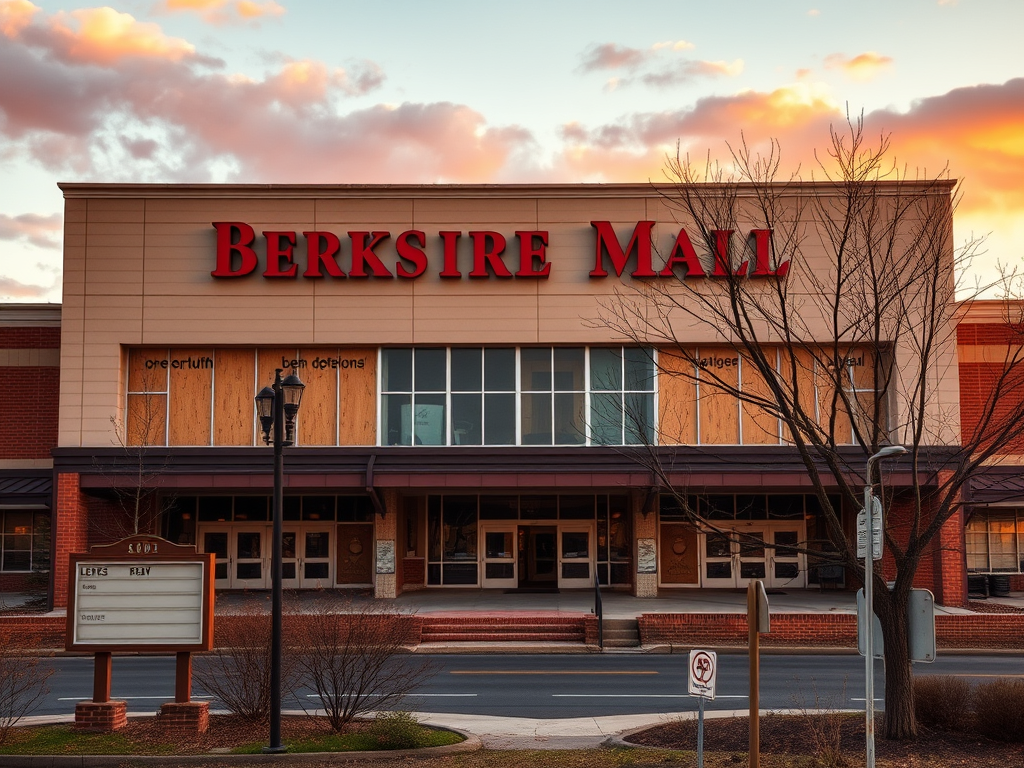

In its prime, the Berkshire Mall stood as a beacon of activity and economic prosperity in Lanesborough, Massachusetts. Opening its doors in 1988, the expansive 720,000-square-foot complex quickly became the town’s most visited attraction. For decades, it was the go-to destination for shopping, socializing, and local entertainment—contributing substantially to the municipal budget through tax revenue and supporting essential public services.
The Rise and Fall of Berkshire Mall: A Case Study

Timothy Sorrell, a town selectman and former police chief, recalls the mall’s heyday with a mixture of nostalgia and disbelief. “You couldn’t find a parking spot—ever. The place was packed wall to wall,” he said, describing how the mall transformed from a simple commercial complex into the beating heart of the small rural town of approximately 3,000 residents. For local teenagers, the mall wasn’t just a shopping center; it was a social sanctuary. “If we had to escort a teen out of the mall, it was like canceling Christmas,” Sorrell reflected. “Some would even cry. That’s how much it meant to them.”
At its peak in 2007, the mall generated an impressive $2.3 million in tax revenue annually, making it Lanesborough’s most significant contributor to public funding. That income supported key services like road maintenance, public schooling, and the local police department. Yet the glory days did not last. By the mid-2010s, the mall had begun its decline.
The departure of major anchor stores such as JCPenney and Sears marked the beginning of the downturn. The final blow came in 2019 when the on-site movie theater shut its doors, leaving the space eerily quiet and void of its former energy. Since then, the mall has become a hollow shell of what it once was—its infrastructure deteriorating. One entrance is now boarded up with plywood after a car allegedly attempted to drive through the doors. The roof, which is in dire need of replacement, comes with an estimated price tag of $5 million.
Now, as the mall sits largely abandoned, town leaders are facing an uphill battle. The property is owned by Boston-based JMJ Real Estate Holdings and their business partners. Town officials are eager to see the site repurposed for a more beneficial use, but the owners have shown no inclination to sell. This stalemate has created mounting frustration within the community and among town leaders, who see the unused property as both a missed opportunity and a financial liability.

Lanesborough is not alone. Across the United States, the demise of large enclosed malls is a familiar story. Many municipalities have turned these commercial relics into community centers, medical facilities, housing complexes, or mixed-use developments. However, transforming these vast spaces into something new is rarely straightforward. In smaller towns especially, where malls often serve as the highest taxpayer, acknowledging their decline can be politically and economically difficult. Additionally, disputes frequently arise between town governments and private owners, especially when there are conflicting visions for the property’s future.
Even when both parties agree in principle to redevelop a mall, the sheer cost and complexity of retrofitting such a large, specialized space can stall progress indefinitely. Mark Siegars, an attorney representing the Baker Hill Road District—an independent municipal entity responsible for infrastructure servicing the mall—emphasized this challenge. “Lanesborough is your typical agricultural town. When the mall was proposed, they saw the tax revenue and said yes. But they didn’t anticipate the decline,” he said. “They never planned for what comes next.”

Nationwide, the number of large enclosed malls is shrinking. From 1,100 in 2018, the figure dropped to around 950 today, with 10 to 20 malls closing every year. According to Vincent Tibone, a research director at Green Street Advisors, many of these closures are long overdue. “Frankly, more malls should close,” he remarked.
But demolition and redevelopment take time, and local services often suffer during the interim. In West Mifflin, Pennsylvania, the decline and eventual closure of Century III Mall in 2019 led to significant funding shortages for public schools. The property’s owners resisted even minimal maintenance, according to Mayor Chris Kelly. The town has since begun demolition and remains hopeful about redevelopment prospects for the 50-acre site.
In another case, the town of Bangor, Maine, was forced to sue the owner of the Bangor Mall due to serious neglect. Officials cited leaking roofs and a collapsed stormwater pipe, which created sinkholes that threatened nearby infrastructure, including the city’s sewer system. Most of the mall’s tenants have long since vacated. Namdar Realty Group, the mall’s owner, claimed it had taken steps to resolve the issues, including addressing the roof and pipe problems.


Back in Massachusetts, the Berkshire Mall was originally developed by Pyramid Management Group but was sold in 2014. Since then, the property has changed hands several times, each time at a lower price. Its assessed value has plummeted—from $60.5 million in 2008 to a mere $7.2 million in 2023. That year, JMJ Real Estate Holdings acquired the mall for just $100 and took on the mall’s $4 million mortgage.
Today, the only remaining business is a Target store, which owns its building and continues to attract steady foot traffic. However, the rest of the property paints a bleak picture. The parking lot is riddled with potholes, overgrown with weeds and small trees that push up through the cracked asphalt. Inside the mall, the utilities have been shut off, and emergency personnel rely on painted numbers on the building’s exterior to navigate break-ins—now a common occurrence.
Initially, JMJ had plans to repurpose the mall into a cannabis manufacturing site. That idea was later abandoned due to the downturn in the cannabis market. The company has since proposed building a housing complex with 400 to 600 units targeted at seniors—a plan that aligns with demographic needs, as over one-third of Lanesborough’s residents are over the age of 55. Despite a clear demand for affordable senior housing in the region, bureaucratic delays and disagreements have prevented progress.

At the center of the dispute is the Baker Hill Road District, established in 1989 to finance the construction of the mall’s access road. Though the original bonds have been repaid, the district still relies on tax revenue from the mall to sustain its annual $900,000 budget. These funds partially subsidize the town by covering salaries for two police officers, purchasing a new police cruiser every two years, and maintaining fire equipment capable of reaching the mall’s high ceilings.
From the owners’ perspective, however, the district has become more of a financial burden than a benefit. Joseph Jones, a manager with JMJ Real Estate Holdings, said the property’s tax bill—down to $1.15 million in 2024 from $2.38 million in 2007—is still disproportionately high, given the mall’s current dilapidated state. These high taxes, he added, are discouraging potential investors from backing the proposed housing development.
Town officials, however, are unsympathetic. They argue that JMJ knew what it was purchasing and the obligations that came with it. Lowering the road district’s budget would force the town to absorb those costs, increasing the burden on residents. In December, the district filed a lawsuit against JMJ for $524,000 in unpaid taxes from the previous year.

Police Chief Robert J. Derksen expressed concern over the implications of budget cuts. “My budget is already as lean as it can be. If we lose a third of our funding, I won’t be able to provide 24/7 coverage,” he said. “That shortfall will have to come from somewhere, and that somewhere is the taxpayers.”
Reflecting on the broader lesson, attorney Mark Siegars offered a somber conclusion: “Small towns often believe that money alone will fix the issue. But money only solves yesterday’s problems—not tomorrow’s. That’s the real challenge for communities like Lanesborough.”
If you’d like this edited for a specific tone (e.g., journalistic, persuasive, casual) or format (like an article or blog post), let me know!esn’t solve the problem of what’s going to be the future, and I think that’s where small towns are really disadvantaged.”




Leave a Reply