
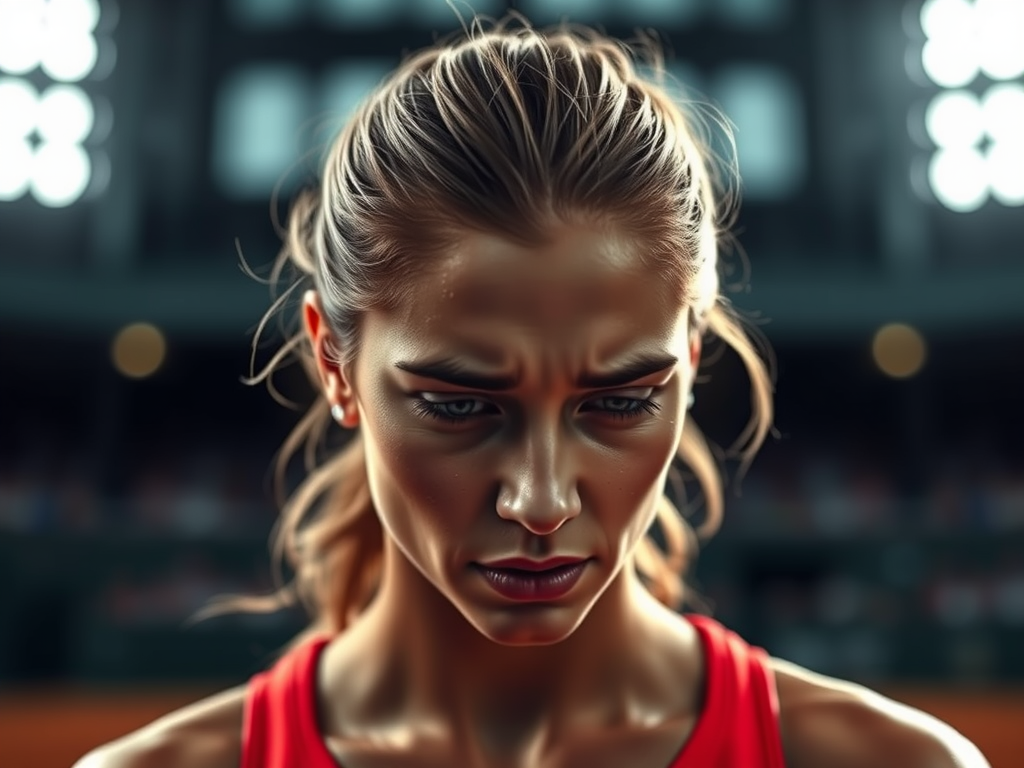

Aryna Sabalenka’s ‘terrible’ French Open final and the intangibles of tennis

Aryna Sabalenka did not attempt to mask her devastation after falling short in the French Open final against Coco Gauff on Saturday. Speaking with unfiltered emotion, she repeatedly described her performance as “awful,” going so far as to call it “the worst tennis I’ve played in months — I honestly don’t even know how many.”
Her honest assessment came after she left Court Philippe-Chatrier, following a hard-fought 6-7(5), 6-2, 6-4 defeat. Unlike most runners-up who start with congratulating the winner during the post-match interview, Sabalenka skipped the formalities and plunged directly into self-criticism. Fighting back tears, she admitted, “This one stings a lot — it really does. After two intense weeks of good tennis, to end it by playing like that, in such difficult conditions, it’s incredibly painful.”
She did eventually turn to acknowledge her opponent. “Coco, congratulations. You were the better player out there today, especially with how challenging the conditions were. You had a great two weeks,” she added.
Later, in her press conference, Sabalenka again addressed the disappointment, this time highlighting the impact of the environmental conditions. “The wind was horrible, and she just handled it better than I did. It’s probably the worst final I’ve ever played.”

Considering her world No. 1 ranking, Sabalenka’s frustration was understandable. This loss marked her second consecutive defeat in a Grand Slam final, both of which she entered as the clear favorite, only to fall in three sets. Just five months ago, she had lost to Madison Keys at the Australian Open. Now, with Gauff denying her at Roland Garros, Sabalenka’s campaign to become a complete all-surface champion has been derailed again.
Statistically, the match was there for her to win. However, Sabalenka tallied 70 unforced errors — nearly double her 37 winners. She struggled not only with the weather but also with the pressure and Gauff’s resilient defense.
When prompted to elaborate on Gauff’s performance, Sabalenka offered faint praise laced with criticism. She argued that the American won not through brilliance but through persistence and luck. “She was just getting to everything. A lot of her shots came off the frame of the racquet and still somehow landed in. It felt surreal, like someone up there was playing a prank on me. I mean, she wasn’t hitting winners — she was just surviving.”
Sabalenka went on, saying, “She didn’t beat me by playing great tennis — I lost that match because I couldn’t stop making unforced errors, especially on balls that should’ve been easy.”
Tennis is often described as a 50-50 battle, but in reality, individual styles and matchups can shift the balance. On Saturday, Gauff embraced her role as the reactive player. While Sabalenka tried to dictate the match, Gauff relied on her incredible defensive skills — moving laterally, reading the game, and simply outlasting her opponent.
Where Gauff adapted to the gusty, shifting winds, Sabalenka did not. She later admitted that as the match wore on, the conditions began to affect her mentally. “The wind picked up, and I got emotional. It reminded me too much of when I played Coco in the U.S. Open final a couple of years back — another disappointing performance in a final.”
Sabalenka even suggested that if Iga Świątek, the four-time Grand Slam champion, had defeated her in the semifinals, she likely would’ve claimed the title. “Honestly, if Iga had beaten me in the semis, I think she would’ve taken the trophy today,” Sabalenka said.
Gauff, when asked about Sabalenka’s remark, respectfully disagreed. “I don’t think that’s fair. I’m the one sitting here with the trophy,” she replied. “No disrespect to Iga — I beat her in straight sets last time we met. You never know what can happen in a final.”
Sabalenka now finds herself in a complex position. While she continues to top the rankings by a comfortable margin, she has failed to convert two major opportunities into titles this season. Throughout Saturday’s final, she appeared increasingly uncomfortable — not just with the wind or her opponent, but with the shifting energy of the match. In both the semifinal against Świątek and the final against Gauff, she held early 4-1 leads and even had a point for 5-1. In each case, she was dragged into a tiebreak and ultimately lost the set.
The difference between those two matches, however, may come down to the setting: the semifinal was played under the closed roof, whereas the final was outdoors, exposed to the swirling winds. In that more controlled environment, Sabalenka seemed steadier. In the chaos of the open air, the pressure and unpredictability appeared to engulf her.
For those who follow her career closely, Sabalenka’s post-match meltdown wasn’t surprising. It mirrored the way she sometimes reacts to minor setbacks mid-match — a tendency toward harsh self-talk and an inability to let go of small mistakes. While this fiery competitiveness is often what fuels greatness, it raises the question: is this mindset always productive?
Jason Stacy, her performance coach, touched on this very topic in a press conference the day before the final. He referenced a guiding principle of their training: “Don’t fight it, don’t feed it.”
Explaining further, Stacy said, “We recognize that stress, nerves, mistakes — they’re all part of this sport. You can’t pretend they don’t exist. But you also can’t dwell on them or give them more power than they deserve.”
Gauff, when asked whether she noticed Sabalenka’s frustrations during the match, said she tried not to let it affect her. “I didn’t pay too much attention to her body language, but of course, when you see your opponent visibly frustrated, it does give you a mental boost. It makes you feel like you’re getting under their skin, that you’re doing something right.”
As for what comes next, Sabalenka plans to take a brief escape from the tennis world. She joked that she would spend the next few days in Mykonos, unwinding with “tequila, gummy bears, and swimming.” Laughing through the pain, she added, “I’m going to be like any other tourist for a bit.”
Still, even as she looked ahead to her getaway, she couldn’t quite let go of what had just transpired. “I just need a few days away from all of this madness — from this insane, if I could swear I would, situation that happened today. You all get what I mean. I’m trying to stay polite here, but there’s really no better way to describe it.”
In truth, Aryna Sabalenka remains the most dominant force in women’s tennis. Her explosive power, athleticism, and technical prowess are unmatched. But tennis is not only a battle of physical skill — it is a game of nerves, emotions, and adaptability. As she moves forward, how well she learns to manage those intangible factors — wind, pressure, expectation, and self-doubt — may ultimately determine whether she continues to fall just short or finally claims her place among the game’s all-time greats.




Leave a Reply