
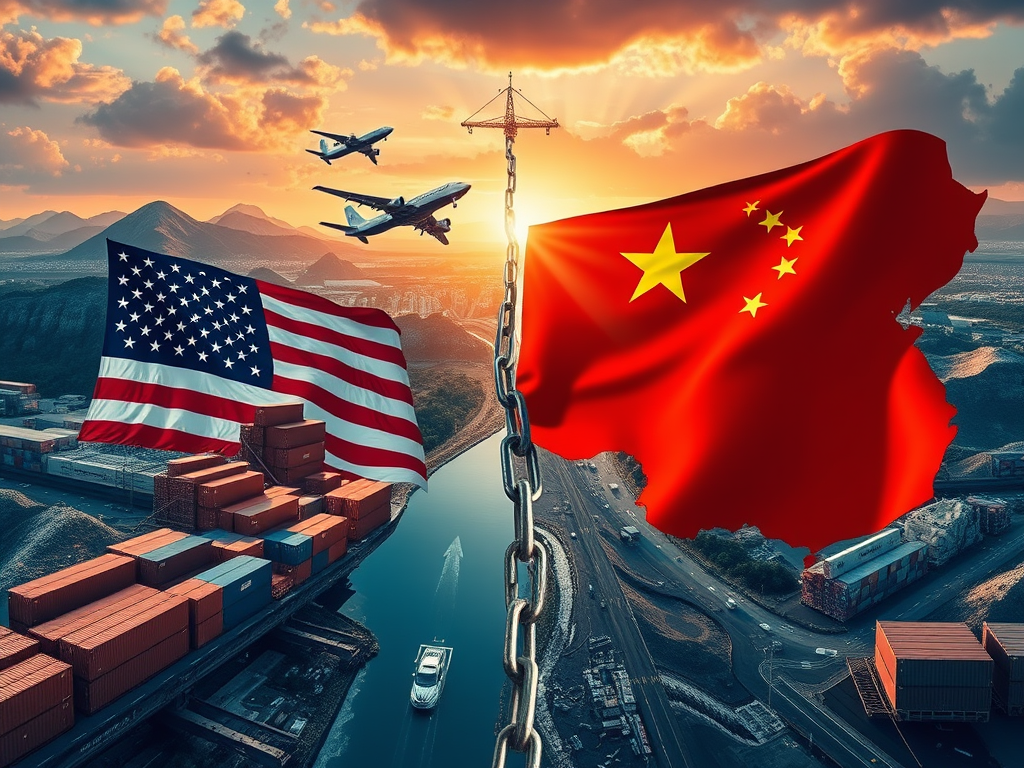

A New Era of Trade Warfare Has Begun for the U.S. and China

The ongoing trade dispute between the United States and China has evolved far beyond tariffs and is now centered on global supply chains and the flow of critical technologies. The recent actions taken by both nations suggest a deepening conflict that could have enduring consequences across a wide array of industries. The conflict, once primarily focused on economic imbalances and retaliatory tariffs, now includes restrictions on key components, technologies, and raw materials that are essential for modern manufacturing and innovation.
Last week, the U.S. government moved to restrict certain exports to China, specifically components and software used in jet engines and semiconductor technology. This action was a response to Beijing’s earlier decision to limit exports of critical minerals used across many manufacturing sectors. These measures reflect a growing mistrust between the two nations, as each side accuses the other of operating in bad faith and using trade as a tool for political leverage.
For companies on both sides of the Pacific, the intensifying supply chain dispute poses serious challenges. Businesses that rely on materials, parts, or technology from both the U.S. and China now find themselves caught in the middle. Many manufacturers argue that their operations depend on an uninterrupted flow of goods from both countries, and that any disruption could significantly hinder their production capabilities. The U.S. government has grown increasingly concerned about vulnerabilities in areas like pharmaceuticals and logistics, where dependence on Chinese suppliers could create national security risks.

The aviation sector has become a prominent example of how deeply entwined the two economies are. Jet engines, largely developed by American companies such as General Electric, are critical to global aviation. Yet even these sophisticated products depend on materials sourced from China. Rare earth minerals, processed primarily in China, are vital for the coatings and components that allow jet engines to withstand extreme temperatures. When Beijing imposed restrictions on these exports, it disrupted manufacturing chains and raised alarms in Washington.
These mineral restrictions followed the Trump administration’s decision to impose steep tariffs on a broad range of Chinese imports. The repercussions of China’s rare earth limitations have been far-reaching. For instance, Ford Motor Company had to temporarily close a plant in Chicago due to a shortage of magnets, which are dependent on Chinese materials. In response, the United States halted some export licenses that previously allowed the shipment of aviation-related technologies to China, as well as restrictions in biotechnology and semiconductors.
Simultaneously, various U.S. departments, including the Department of Defense and the Department of the Interior, began searching for ways to reduce dependence on Chinese supplies. Initiatives to develop new domestic sources of rare earths have gained momentum, though experts warn that building mines and processing facilities in the U.S. could take decades. Statistics from S&P suggest that developing a single mine in the United States typically takes close to 30 years.
The Trump administration is also considering expanding its list of restricted Chinese entities, potentially including leading semiconductor producers and tech giants such as Alibaba, Tencent, and Baidu. Such actions, if taken, would bar these companies from doing business with American firms, effectively cutting them off from critical technology.
The current confrontation is the result of years of buildup. Both countries have taken steps to diversify their supply chains and reduce dependency on one another. After the initial imposition of tariffs during Trump’s first term, many U.S. companies shifted manufacturing operations to other countries such as Vietnam and Mexico. Meanwhile, under Xi Jinping, China has invested heavily in its domestic technology and energy sectors, aiming to reduce its reliance on foreign suppliers.

Despite these efforts, the economic relationship between the two nations remains tightly bound. Hundreds of billions of dollars in trade continue to flow between the U.S. and China annually. Any attempts to fully decouple the two economies for national security reasons will be costly and complex. For instance, since 2022, the United States has expanded efforts to control the global flow of advanced semiconductor technology to China, particularly components that could aid in military applications or artificial intelligence development.
These rules have extended beyond U.S. borders, prohibiting foreign companies from selling products to China if they use American-made parts or software in their production. While some nations have expressed unease with this extraterritorial approach, many have complied, highlighting the influential role the U.S. still plays in global trade governance. At the same time, China has begun using its dominance in rare earth production as a counterbalance to U.S. influence.
China has implemented a licensing system to regulate and monitor rare earth exports. When the U.S. raised tariffs to 145 percent in April, China responded by limiting these critical shipments, pausing many altogether. This move placed significant pressure on Washington, especially as American businesses warned of potential supply shortages and market disruptions.
In an attempt to ease tensions, American and Chinese negotiators met in Geneva in May. The resulting agreement included a mutual reduction in tariffs and a commitment from China to suspend or lift the non-tariff retaliatory measures imposed since April. However, U.S. officials claim that Chinese compliance has been slow and incomplete. On a recent appearance on CNBC, the U.S. Trade Representative stated that critical minerals were still not flowing as agreed.
President Trump, taking a more aggressive stance, accused China of violating the agreement outright. In a social media post, he criticized Beijing for not upholding its commitments and suggested that further actions might be forthcoming. On the other hand, Chinese officials refuted these claims, asserting that they had acted in good faith and instead blamed the U.S. for breaching the agreement, including through new restrictions on Chinese tech firms like Huawei and the revocation of student visas.
Some U.S. companies in the auto and electronics sectors have recently received approval from Chinese authorities to import limited quantities of minerals, but the backlog of requests and general uncertainty continue to worry industry leaders. Additionally, there are growing concerns that China is favoring European firms over American ones when granting export licenses.
The dispute has spilled into other areas of the U.S.-China relationship, including proposed U.S. plans to revoke student visas for Chinese nationals with suspected ties to the Communist Party. These measures represent a broader attempt by the Trump administration to curb China’s influence across all domains, from education to technology.
Efforts to resolve the standoff remain uncertain. White House officials indicated that President Trump and Chinese leader Xi Jinping might speak in an upcoming call, though Beijing has offered no confirmation. Experts note that this conflict was long foreseeable. According to Daniel H. Rosen, a co-founder of the Rhodium Group, China anticipated the strategic importance of rare earths and invested early in securing dominance. In contrast, the U.S. underestimated the long-term demand for these materials.

Today, China mines 70 percent of the world’s rare earths and processes 90 percent of them. It also leads in the production of electric vehicle batteries, accounting for over 80 percent of global output, as well as commanding major shares of global steel, aluminum, and solar panel manufacturing. To secure alternative sources and reduce dependence on China, the U.S. will likely need to invest hundreds of billions of dollars and forge strong international partnerships to construct alternative supply chains.
While some mineral shipments have resumed, widespread concern about supply chain security remains. Experts like Paul Triolo from Albright Stonebridge Group warn that the Chinese licensing process remains slow and complicated, and that shipments of critical minerals have dropped significantly since April. In his view, the U.S. must engage in long-term planning, collaborate with allies, and negotiate pragmatically with China to ensure supply chain stability over the next five to seven years.
This ongoing issue is not one that will disappear quickly or be resolved with a single agreement. Instead, it represents a fundamental shift in how the U.S. and China approach trade, security, and technological leadership on the global stage.




Leave a Reply