
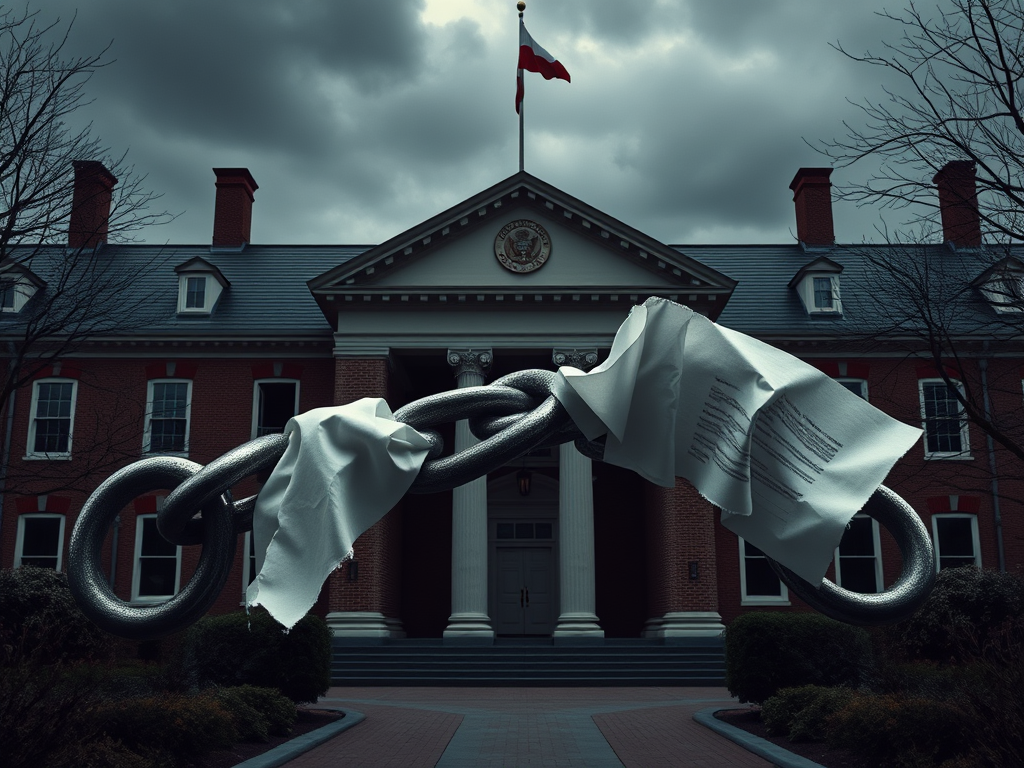

Trump Intends to Cancel All Federal Funds Directed at Harvard

In a bold move that could dramatically affect Harvard University’s finances and operations, the Trump administration is preparing to terminate all remaining federal contracts with the Ivy League institution. According to a letter distributed to various government agencies on Tuesday, the contracts—collectively worth approximately $100 million—will be canceled, and agencies are instructed to seek other providers for future projects.
This development marks a significant escalation in the Trump administration’s efforts to sever ties with Harvard. A draft version of the letter, obtained by The New York Times, reveals the administration’s intention to completely dismantle its longstanding business relationship with what is arguably the United States’ most prestigious and influential academic institution.
The letter serves as the latest demonstration of the administration’s hardline stance toward Harvard, which it has increasingly portrayed as a symbol of liberal elitism and ideological opposition. Over the past month, the government has already frozen nearly $3.2 billion in existing grants and contracts tied to Harvard, and it has taken steps to restrict the university’s capacity to enroll students from abroad.

The most recent letter, dated May 27 and sent by the U.S. General Services Administration (GSA), was formally delivered to government agencies early Tuesday morning. A senior administration official, who requested anonymity due to not being authorized to speak publicly, confirmed the delivery and its implications.
Federal agencies have been given until June 6 to submit a list of contracts to be terminated. While services deemed “critical” to government operations will be allowed to continue temporarily, they will eventually be reassigned to new providers. The letter was signed by Josh Gruenbaum, Commissioner of the GSA’s Federal Acquisition Service, the division responsible for managing the procurement of federal goods and services.
An estimated nine government agencies have contracts that will be affected, according to the official.
Examples from a federal contract database illustrate the wide-ranging scope of the planned cancellations. These include a $49,858 research agreement with the National Institutes of Health to examine the health impacts of coffee consumption and a $25,800 Homeland Security contract for executive leadership training. It is believed that some contracts have already been subjected to “stop work” orders, effectively halting operations even before formal cancellations.
The letter not only instructs agencies to terminate current contracts but also advises against working with Harvard in the future. “Going forward, we encourage your agency to identify alternative vendors for any services previously planned with Harvard,” the directive states.
The Trump administration has framed these actions as part of a broader effort to uphold civil rights and national values. It has accused Harvard of ideological discrimination, continuing to incorporate race in its admissions process despite a recent Supreme Court ruling prohibiting such practices. Moreover, officials have cited allegations of antisemitism on campus as justification for cutting ties.
Harvard, for its part, has responded by framing the situation as an attack on its constitutional freedoms—particularly the First Amendment. The university claims that the federal government is attempting to exert control over its academic and institutional autonomy, including decisions related to curriculum, personnel, and admissions.

The conflict between Harvard and the White House has intensified following a series of federal demands. Among them were restrictions on admitting students perceived to be “hostile to American values,” a political audit of faculty and students to ensure “ideological balance,” and regular compliance reports to federal authorities. Harvard has refused to comply and is now pushing back through the courts.
Last month, Harvard filed a lawsuit demanding the restoration of over $3 billion in federal funding that had been frozen. In a separate legal action launched more recently, the university requested a judicial order reinstating its right to admit international students. A federal judge, Allison D. Burroughs, issued a temporary ruling last week allowing the university to continue admitting foreign students, with a follow-up hearing scheduled to determine whether the ruling should be extended.
President Trump, during his re-election campaign, frequently targeted elite universities, branding them as hubs of radical leftism. He vowed to impose higher taxes on investment income generated by university endowments—a proposal that has already been approved by the House of Representatives and, if passed by the Senate, would cost Harvard an estimated $850 million annually. Harvard currently possesses an endowment of $53 billion, the largest of any university in the world.
This barrage of punitive actions has caused widespread anxiety within Harvard. Administrators and faculty alike have expressed alarm at what they see as a relentless federal assault on the university’s financial security and academic integrity.
The repercussions extend beyond funding and legal battles. Harvard enrolls about 6,800 international students, who comprise roughly 27% of its total student body. The potential loss of its ability to enroll these students could have severe academic and economic consequences. Harvard’s president, Dr. Alan M. Garber, released a statement last week condemning the administration’s actions.
“This unlawful and unjustified decision threatens the futures of thousands of students and scholars at Harvard,” Dr. Garber said. “It sends a chilling message to students and institutions across the country that international education is no longer welcome in the United States.”
The government’s letter cited what it described as a “pattern of behavior” from Harvard that demonstrated a failure to align with core American values, particularly regarding issues of discrimination and equal opportunity.
One example referenced in the letter is a decision by the Harvard Law Review, an independently managed student publication, to award a fellowship to a law student who had previously been accused of assaulting a Jewish peer during a pro-Palestinian protest on campus in 2023. While the student was not prosecuted and agreed to perform community service, the case drew national attention and controversy.
Additionally, the administration criticized Harvard’s alleged noncompliance with the Supreme Court’s 2023 ruling that declared race-based admissions unconstitutional. While Harvard did see a noticeable drop in Black student enrollment following the decision—first-year Black student representation fell from 18% in 2023 to 14% in 2024, and Harvard Law School’s Black first-year enrollment dropped to a historic low of 3.4%—the letter offered no statistical basis to support claims of ongoing discriminatory admissions practices.
Instead, it pointed to the introduction of a remedial math course at the university as indirect evidence that Harvard’s admissions process had prioritized diversity over merit. According to the letter, the course’s necessity underscored the administration’s belief that race-based considerations were still influencing admissions decisions.
As the conflict between Harvard and the federal government continues to escalate, the implications extend well beyond the university itself. The outcome could reshape how higher education institutions interact with federal authorities and redefine the balance between academic freedom and governmental oversight in the United States.




Leave a Reply