
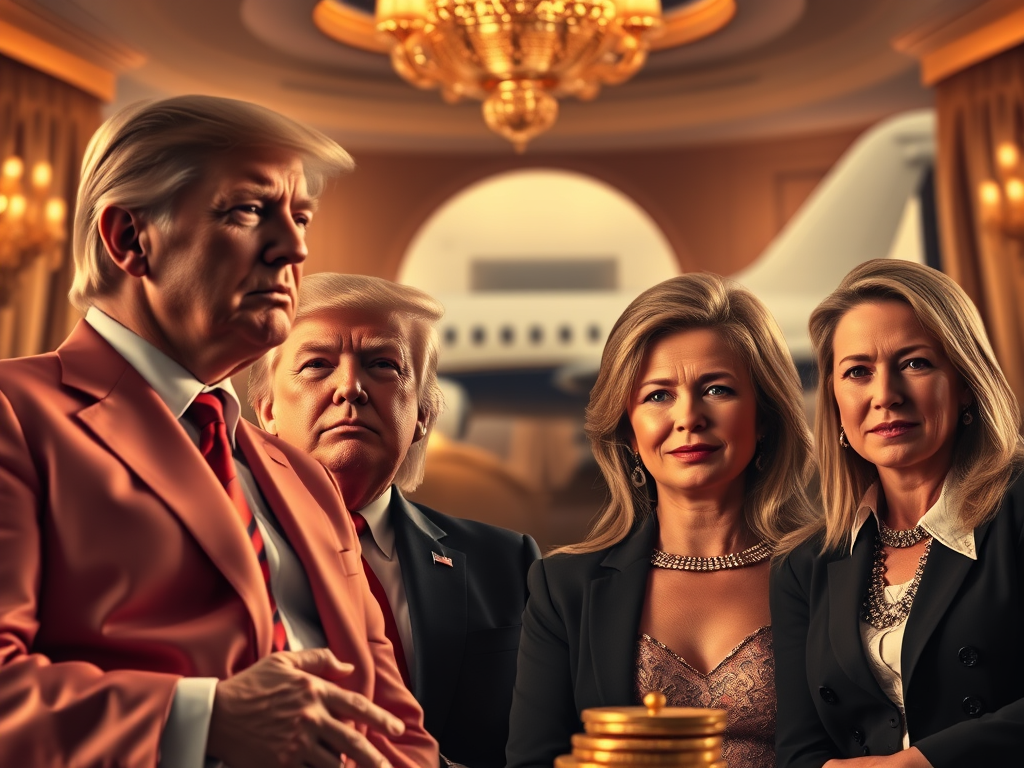

As Trumps Monetize Presidency, Profits Outstrip Protests

When Hillary Clinton was the First Lady, she became embroiled in controversy after it was revealed that she had once turned a $1,000 investment in cattle futures into $100,000. Although this transaction had taken place more than a decade before her husband assumed the presidency, it sparked weeks of intense media scrutiny and public debate, prompting the White House to conduct an internal investigation.
Fast forward thirty-one years, and Jeff Bezos reportedly agreed to fund a promotional film about Melania Trump after a dinner at Mar-a-Lago—an arrangement expected to result in a $28 million payment to her personally. That figure is 280 times what Clinton had earned in her now-infamous investment. Yet this news barely registered in Washington, drawing little outrage or even attention.
Presidential families have long found ways to benefit from their political connections, but the Trump family has taken the monetization of the presidency to an entirely new level. Their approach has been unprecedented in both scale and boldness. Over just the past few months, the Trump family and their associates have amassed $320 million through cryptocurrency ventures, sealed international real estate agreements worth billions, and launched a high-end Washington, D.C. club called “The Executive Branch,” where membership costs half a million dollars.
Only last week, the Qatari government gifted a luxury aircraft intended for Donald Trump’s use during his time in office and potentially afterward as part of his presidential library plans. Although the jet was formally presented to the U.S. Air Force, it is believed to be designated for Trump’s personal access. Experts estimate its value at $200 million—more than the total value of foreign gifts received by all previous American presidents combined.

Adding to the list of ethically questionable activities, Trump recently hosted a private dinner at his Virginia golf club for 220 individuals who had invested in the $TRUMP cryptocurrency he introduced shortly before reentering office. Participation in this exclusive gathering was directly tied to the amount each person had invested—not to a political campaign, but to a private business endeavor with direct financial benefits for Trump.
Observers of governmental ethics and corruption believe that this administration may represent the most open and audacious use of public office for personal enrichment in U.S. history—perhaps even more so than past scandals like Watergate or the Teapot Dome affair.
“I’ve been monitoring corruption for half a century, and I’m still stunned by what I’m seeing,” said Michael Johnston, professor emeritus at Colgate University and a prominent author on political ethics.
One of the most significant transformations since Trump returned to power has been the normalization of financial schemes that would once have triggered congressional hearings, widespread media coverage, and public condemnation. The erosion of outrage—or perhaps its complete absence—underscores the degree to which Trump has shifted the boundaries of acceptable behavior in American politics.
As the first U.S. president with a felony conviction, Trump has not only ignored ethical lines but also dismantled many of the mechanisms meant to enforce them. He has removed inspectors general, weakened internal watchdogs, and replaced key figures in the Department of Justice, FBI, and regulatory agencies with loyal allies. Congress, now largely controlled by Republicans, shows little interest in conducting oversight.

Consequently, while critics and Democrats attempt to raise alarm about the president’s financial entanglements, their efforts have been largely ineffective without formal investigations or institutional checks. With Trump generating headline-making news on a near-daily basis—from slapping tariffs on allies to openly disregarding court rulings—scandals are quickly overshadowed and forgotten.
Paul Rosenzweig, a former senior counsel to the investigation of Bill Clinton and a Bush administration official, noted that Trump’s continuous violations of ethical norms raise an uncomfortable question: did the public ever truly care about clean governance?

“Either the general public was never interested in this kind of thing,” he said, “or they once were, but have since stopped caring.” He speculated that the reality is probably a mix: “Eighty percent of people never cared. The remaining 20 percent are simply overwhelmed.”
“Outrage isn’t dead,” he added. “It may have always been a projection of elite opinion rather than something the broader public genuinely felt.”
The White House, for its part, has dismissed concerns about Trump’s financial dealings, insisting that the president is so wealthy he has no need for additional income. “He is following all the conflict of interest rules that apply to presidents,” said press secretary Karoline Leavitt. “The idea that he’s profiting off the presidency is ridiculous. He gave up a great deal to serve the public.”
However, this argument is misleading, as Trump himself has repeatedly pointed out: conflict of interest laws don’t actually apply to the president. And contrary to the White House’s assertion, Trump has not relinquished his business ventures. His sons continue to run the Trump Organization, and independent evaluations suggest his personal fortune has grown during his political career. As of March, Forbes estimated his net worth to be $5.1 billion—up $1.2 billion from the previous year, making it his highest ranking ever.
Trump’s sons openly reject the notion that they should scale back their business activities, even though these ventures directly benefit their father. Donald Trump Jr. remarked recently that during his father’s first term, they attempted to avoid business conflicts but were criticized anyway. Now, he said, they have no reason to hold back. “They’re going to attack you no matter what,” he explained at a business event in Qatar. “So you might as well just play the game.”

Yet there are signs that public discomfort may be resurfacing. The gift of the Qatari plane drew more attention than previous episodes, with a recent Harvard/CAPS Harris poll revealing that 62% of respondents saw it as ethically troubling. Even some Trump allies on the right, such as Ben Shapiro and Laura Loomer, voiced disapproval.
Tucker Carlson, the former Fox News host and a past Trump supporter, also expressed concern during a podcast with right-wing personality Shawn Ryan. When Ryan raised the question of the Trump family’s business activities during their recent Middle East visit, Carlson acknowledged, “It seems like corruption.”
Despite small-scale protests, Democrats remain divided on whether to make Trump’s profiteering a central campaign issue. While some advocate focusing on economic matters, others, like Senator Chris Murphy of Connecticut, are making corruption a primary concern. “Traditional avenues of accountability are off the table,” Murphy said. “There won’t be special counsels or DOJ investigations. It’s up to the public to respond politically. If Republicans keep losing elections over this, maybe they’ll change course.”
Trump rose to power in 2016 on a promise to “drain the swamp,” harshly criticizing the Clintons for accepting donations from Middle Eastern governments for their foundation. Now, money from the Middle East flows into Trump family ventures—not charities. These include real estate partnerships, cryptocurrency projects, and luxury gifts, many of which have been documented in detail by The New York Times.
Corruption scholar Michael Johnston calls the Trump case “an extreme outlier”—not just financially, but in its flagrant dismissal of ethical norms. “Presidents are expected to serve the public good,” he said, “not to treat the presidency as a personal business opportunity.”
During his first term, Trump made symbolic efforts to limit foreign business deals. Since then, he has been convicted of falsifying records, found liable in civil fraud, and awarded broad immunity by the Supreme Court for official acts. As he embarks on a second term, even those symbolic gestures are gone.
“He no longer pretends to follow the rules,” said Fred Wertheimer, founder of Democracy 21 and a longtime government ethics advocate. “There is simply no precedent in American history for using the presidency for such massive personal profit.”

Republicans, who have relentlessly investigated Hunter Biden for using his family name to secure business deals, have shown no similar interest in scrutinizing the Trump family’s far more lucrative ventures. While Hunter Biden’s earnings are a fraction of what Trump’s children and in-laws have made, GOP leaders remain silent.
J. Michael Luttig, a respected conservative judge, summarized the dilemma: “The American people have been forced to become numb to Donald Trump’s corruption, because neither the president nor his party have left them with any other choice.”
Indeed, Trump seems unbothered by the fact that individuals funneling money into his family’s enterprises may seek political favors. Some of the crypto backers at his dinner admitted they used the event to discuss regulatory issues with the president—who assured them that he would adopt a friendlier stance than the Biden administration.
One attendee, Chinese billionaire Justin Sun, had acquired more than $40 million of the $TRUMP coin and received VIP access to Trump that evening. Sun was accused of fraud by the SEC in 2023, but following Trump’s return to power, the case has been paused, even as other crypto investigations have moved forward.
In both Bezos’s case and Qatar’s, the motivations are clear. Each party stands to gain by staying in Trump’s good graces. And while the financial benefits to the Trump family pile up, America’s ethical standards continue to erode.




Leave a Reply