

Outsourcer in Chief: Is Trump Trading Away America’s Tech Future?

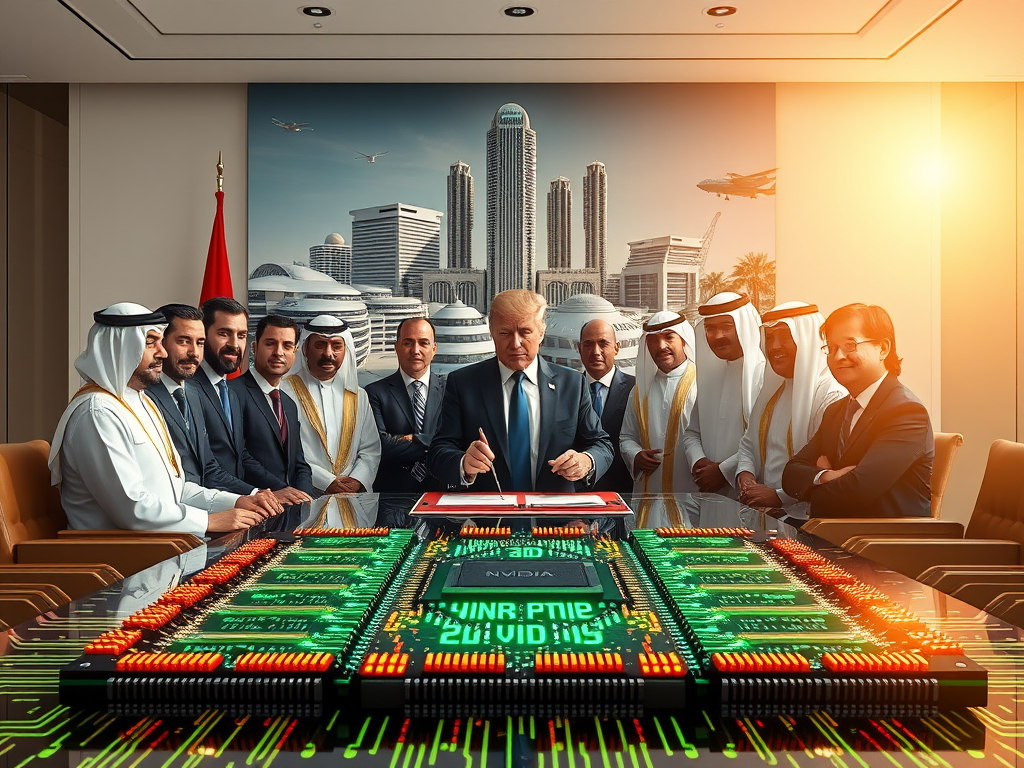
During a three-day diplomatic visit to the Middle East, President Trump and a team of Silicon Valley representatives brokered a transformative deal that positioned the Persian Gulf as a burgeoning hub for artificial intelligence. The United States and the United Arab Emirates reached an agreement to deliver hundreds of thousands of Nvidia’s most advanced chips annually, marking a significant leap in the region’s data processing capabilities, according to three individuals familiar with the discussions. While most of the chips are slated for U.S. cloud service providers, approximately 100,000 units will be supplied to G42, an Emirati AI firm.
The administration announced the deal on Thursday alongside the unveiling of a new AI campus in Abu Dhabi, powered by a substantial 5-gigawatt electrical grid. Once operational, it would represent the largest AI project outside of the United States, serving American firms as they extend their reach across Africa, Europe, and Asia. However, details regarding the chip shipments remain tentative and subject to potential revisions.
Trump’s visit also saw the U.S. striking multimillion-dollar agreements to supply advanced AI chips from Nvidia and AMD to Saudi Arabia. Ongoing discussions suggest that a larger contract for AI technology may still be in the works, according to five sources familiar with the talks.
These AI-centric deals have sparked debate within and outside the Trump administration, raising concerns over whether the U.S., in its eagerness to capitalize on the lucrative Middle Eastern market, is effectively exporting the industry of the future abroad. Spearheading the negotiations were David Sacks, the administration’s AI czar, and Sriram Krishnan, a senior AI policy advisor, both of whom hail from venture capital backgrounds. Industry heavyweights like Sam Altman of OpenAI and Nvidia’s Jensen Huang also participated in discussions that continued on the periphery of the President’s diplomatic mission.

Sacks and Krishnan argue that such deals are essential for maintaining U.S. dominance in the AI sector, fostering strategic global partnerships that would bolster American AI companies and cement their leadership in the technology race. “Our objective is to extend the influence of American AI globally,” Krishnan stated.
However, as more details of these deals reach Washington, concerns about the potential ramifications are mounting. Interviews with nine current and former U.S. officials revealed apprehensions that the agreements could inadvertently empower China by allowing cutting-edge technology to migrate to a region with strong ties to Beijing. Additionally, there are fears that by the end of the decade, the Middle East could emerge as a leading hub for AI data centers, displacing the United States.
The controversy illustrates the complex dynamics of Trump’s policies, which oscillate between protectionist rhetoric and globalist trade deals. Despite his efforts to reinvigorate domestic industries through high tariffs, Trump’s first major diplomatic mission seems to signal a more expansive vision for American tech companies — one that permits offshoring to cement global AI leadership.
Meanwhile, Trump companies have reportedly received substantial financial inflows from the Middle East, including a $2 billion investment from Saudi Arabia into a Trump-backed cryptocurrency and plans for a presidential aircraft from Qatar, raising questions about potential conflicts of interest.

Amid these developments, AI experts express mixed reactions. While some acknowledge the strategic logic of leveraging Middle Eastern energy resources to support AI infrastructure, others warn that the U.S. risks repeating past mistakes, allowing crucial industries to slip overseas as it did with manufacturing and energy.
Klon Kitchen of the American Enterprise Institute suggests that while it’s valid to seek strategic AI partnerships globally, there’s a danger that such deals could shift AI development abroad. “Foreign policy is rarely a matter of straightforward solutions; it’s about managing trade-offs,” he said.
The Biden administration had previously blocked similar proposals from the UAE, concerned that building massive AI data centers in the Gulf could undermine U.S. competitiveness and transfer vital security infrastructure abroad. However, Trump’s administration has adopted a more open stance, arguing that blocking sales could drive regional allies to seek Chinese alternatives, potentially undermining American influence.

“We must secure AI leadership by ensuring our technology is the standard worldwide,” Sacks stated at a recent conference in Saudi Arabia. To assuage U.S. concerns, the Emirates and Saudi Arabia proposed security agreements ensuring that chip usage and locations would be monitored, according to sources close to the negotiations.
Simultaneously, U.S. officials have pressed the UAE to balance AI investments abroad with commitments to develop similar infrastructure domestically. The Emiratis agreed to a reciprocal investment framework, pledging that for every data center constructed for a U.S. firm in the Gulf, they would provide financial support for a corresponding center in the U.S.
Despite such concessions, some U.S. officials remain skeptical. One Trump administration official, who requested anonymity, warned that by approving these deals, the U.S. risks allowing the most advanced AI facilities to be built overseas, potentially turning the Middle East — or even China — into formidable AI competitors.
Jimmy Goodrich, a senior adviser to RAND for tech analysis, criticized the move as “taking the easy way out,” arguing that the U.S. should focus on resolving domestic energy bottlenecks and streamlining permitting processes to retain AI development at home. “We’ve seen this story play out before, and we shouldn’t let history repeat itself,” he said.
Sam Winter-Levy of the Carnegie Endowment for International Peace echoed these concerns, questioning the wisdom of offshoring critical AI infrastructure to foreign partners. “If AI is to be the defining industrial technology of the next decade, why would we want to export the core infrastructure that supports it?” Winter-Levy asked.




Leave a Reply