
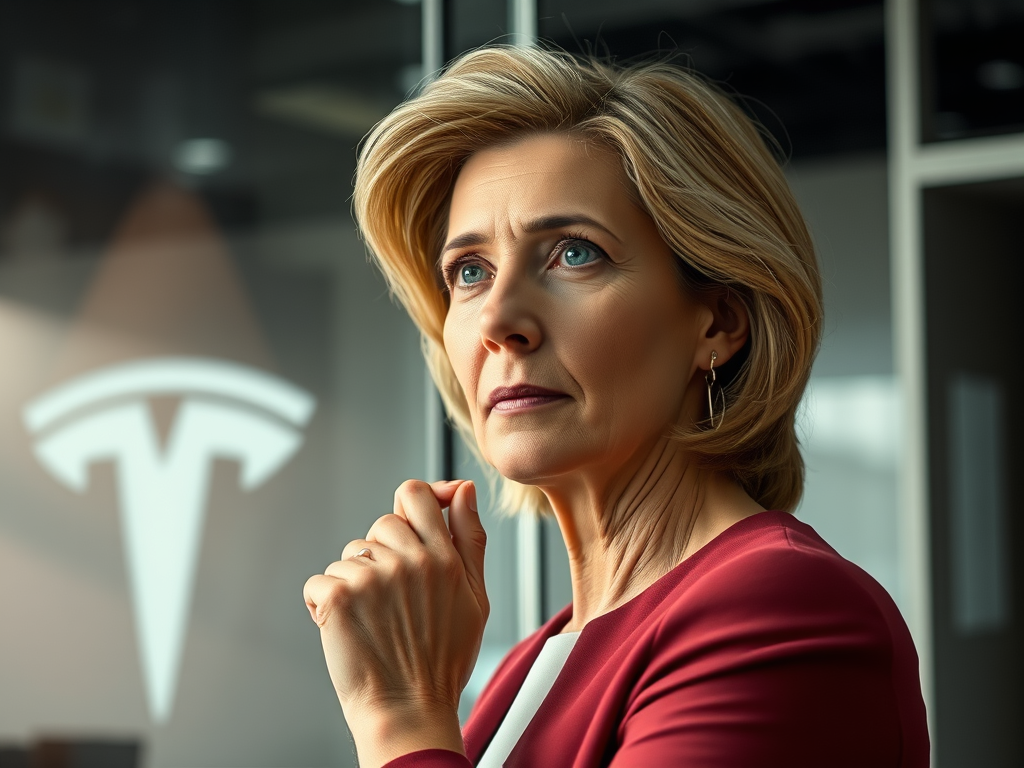

Tesla’s Board Chair Made $198 Million Selling Stock as Profit Fell

In March, following a significant drop in Tesla’s share price, Elon Musk advised employees to “hold onto your stock.” However, Tesla’s board chair, Robyn Denholm, has not adhered to that suggestion. Over the past six months, she has made $198 million by selling Tesla shares acquired as part of her board compensation, as analyzed by the New York Times based on securities filings.
Since taking on the role of board chair in late 2018, Denholm has amassed over $530 million in profit from selling Tesla shares — a figure significantly higher than what her counterparts at other leading U.S. companies have earned in the same period.
These share sales have raised questions regarding Denholm’s faith in Tesla’s future. Her most recent sales were conducted under a prearranged trading plan filed last summer, coinciding with Musk’s increasingly prominent involvement in the Trump administration. Tesla’s vehicle sales have dipped partly due to Musk’s political actions, which have alienated some consumers, leading to a decline in quarterly profits to their lowest level in four years.

Denholm, who joined Tesla’s board in 2014 and became its chair in 2018, was granted stock options as part of her compensation package. These options, awarded between 2014 and 2020, allow her to purchase shares at significantly lower prices than their current market value. For instance, last week, she acquired over 112,000 shares at $24.73 each and sold them the same day for over $270 per share.
Critics argue that Denholm’s decision to cash in her stock does not convey confidence in the company’s future. Brad Lander, the New York City comptroller overseeing public pension funds that hold over three million Tesla shares, stated that such large-scale sales by a board chair do not indicate a strong commitment to the company’s long-term success.
A spokesperson for Denholm emphasized that Tesla’s board member compensation structure aligns with shareholder interests, stating that the value of stock options increased due to Tesla’s performance relative to industry peers. Denholm still holds 85,000 shares and approximately 49,000 stock options.
Denholm’s recent sales were carried out under a trading plan initiated in July, shortly after Musk publicly endorsed Donald Trump for president. Securities regulations permit insiders to trade shares using such plans, but they are not obligated to disclose the specifics of these arrangements, including the rationale for initiating or terminating them.

A seasoned executive from Australia with a background in technology, Denholm keeps a low profile and rarely comments on Tesla or Musk. Her leadership of the board has come under scrutiny, with some investors and a Delaware judge criticizing Tesla’s directors for failing to counterbalance Musk’s influence. Chancellor Kathaleen McCormick of the Delaware Court of Chancery described Denholm’s oversight style as “lackadaisical” in a 2024 ruling that nullified Musk’s $56 billion pay package.
Despite the criticism, Denholm has defended her leadership approach, stating in a Financial Times interview that she is “intense and very diligent” in her work. During the trial, she referred to her earnings from Tesla’s board service as “life-changing.” Denholm and other board members reached a settlement in 2023 over a lawsuit related to director compensation, collectively agreeing to return $735 million in pay and cancel stock options valued at over $130 million.
Musk’s involvement in the Trump administration has further complicated Tesla’s public image and market performance. He has pledged to reduce his political involvement, though he continues to divide his attention among multiple ventures, including SpaceX and the social media platform X.
Denholm’s sales strategy began in November 2024, shortly after the presidential election, as Tesla shares were climbing. She continued to sell through early May 2025, even as consumer backlash against Musk’s political stances impacted Tesla’s sales and stock price. Despite a recent rebound, Tesla’s stock remains 34 percent below its peak.
In a March 2025 meeting with Tesla employees, Musk acknowledged the company’s challenges but assured them that Tesla’s future was promising, citing advancements in self-driving taxis and humanoid robots. Nevertheless, Denholm’s stock sales have far exceeded those of other Tesla directors, apart from Musk himself.
Tesla board members agreed in 2021 to forgo new equity grants following the shareholder lawsuit. However, Denholm has still outpaced her peers in capitalizing on Tesla’s stock gains. Compared to other nonexecutive board chairs of major U.S. companies, Denholm has made substantially more from stock sales. For instance, Stephen Hemsley of UnitedHealth Group, the next-highest earner in this category, made over $100 million from stock sales since November 2018 — less than a fifth of Denholm’s earnings.

Academic research indicates that insider stock sales can sometimes predict a company’s declining performance. Insiders have access to confidential information and can adjust trading plans based on their knowledge of potential economic shifts. Nejat Seyhun, a finance professor at the University of Michigan, emphasized that insiders can modify or cancel their trading plans if conditions change, allowing them to capitalize on their insights.
While Tesla’s leadership remains optimistic about the company’s future, the disparity between Denholm’s stock sales and those of her peers raises questions about her confidence in the company’s trajectory, especially as Musk’s political involvement continues to overshadow Tesla’s core business operations.




Leave a Reply