

Tufts Student Arrested by ICE Is Released From Detention

Rumeysa Ozturk, a doctoral student at Tufts University, was released from immigration detention on Friday after a federal judge expressed concern that her ongoing detention could potentially suppress the free speech of millions of non-citizens in the United States.
During a hearing at the Federal District Court in Vermont, Judge William K. Sessions III ordered that Ms. Ozturk be released immediately, stating that “Her continued detention cannot stand.”
Ms. Ozturk, a Turkish national, had been held for six weeks at the Basile, Louisiana immigration detention center. According to her legal representatives, she was expected to return to her home in Massachusetts on Saturday.
Although her release was initially delayed as federal authorities attempted to fit her with an ankle monitor, Judge Sessions issued a second order on Friday afternoon clarifying that she was to be released without any monitoring or travel restrictions. Ms. Ozturk was freed around 5:15 PM Central Standard Time.

On March 25, Immigration and Customs Enforcement (ICE) agents apprehended Ms. Ozturk outside her residence in Somerville, Massachusetts. The officers, dressed in plainclothes and wearing masks, detained her while she was on the phone with her mother. Ms. Ozturk was subsequently flown to the detention center in Louisiana. For 24 hours, her family, friends, and attorneys had no information regarding her whereabouts.
Ms. Ozturk’s arrest sparked public outcry, with many criticizing the government’s treatment of international students under the guise of addressing antisemitism. Her lawyers argued that her detention was in retaliation for exercising her First Amendment rights, noting that the primary evidence against her was an opinion piece she co-authored in a Tufts student publication that was critical of Israel.
According to her attorney, Mahsa Khanbabai, the conditions at the detention facility exacerbated Ms. Ozturk’s chronic asthma, preventing her from maintaining her academic work. Ms. Khanbabai expressed her relief at Ms. Ozturk’s release, questioning the justification for her detention: “When did speaking up against oppression become a crime?”
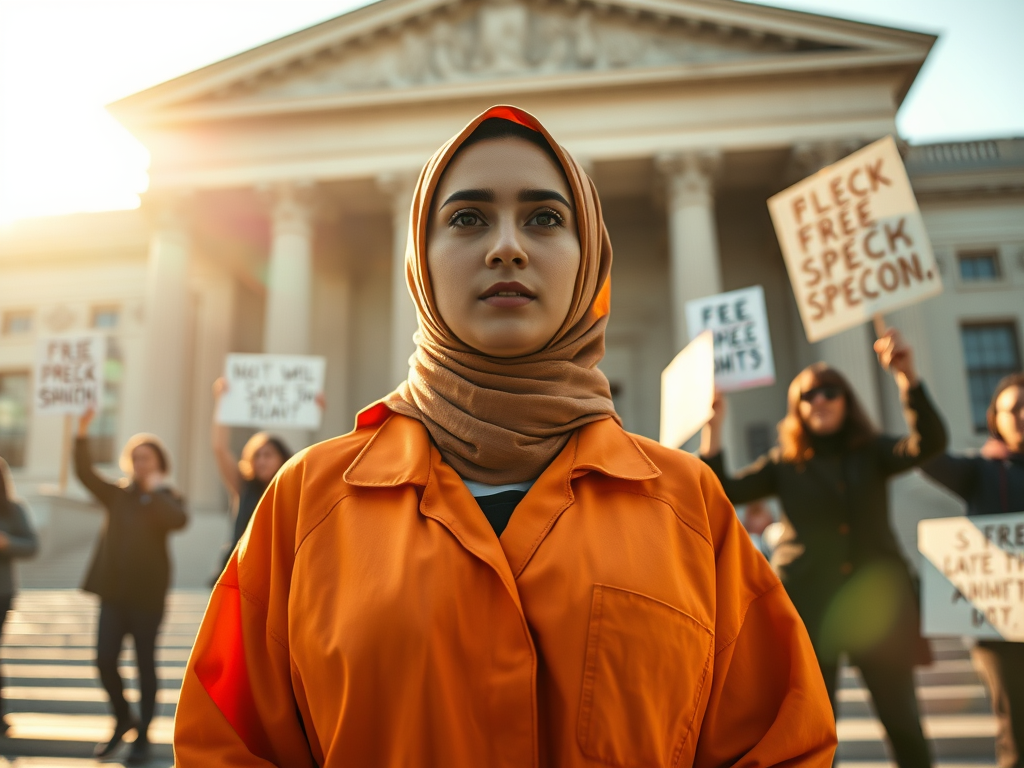
During the hearing on Friday, Ms. Ozturk appeared via video link from the detention center, wearing a headscarf and an orange jumpsuit. Approximately an hour into the session, she suffered a severe asthma attack and was permitted to leave the video feed momentarily.

Dr. Jessica McCannon, a pulmonologist, testified that Ms. Ozturk’s asthma was not being adequately managed while in custody. She warned that her condition would likely deteriorate if she remained in detention. Despite not having conducted a physical examination, Dr. McCannon had reviewed Ms. Ozturk’s medical records and spoken with her regarding her symptoms.
Judge Sessions expedited the hearing after a federal appeals court had ordered Ms. Ozturk’s transfer to Vermont for a bail hearing the following week. However, he chose to proceed while she remained in Louisiana, citing the urgency of her medical condition.
Government attorneys largely refrained from addressing the free speech arguments raised during the hearing. Instead, they focused on procedural matters regarding her bail conditions. Michael Drescher, representing the government, noted that while Ms. Ozturk was being released, deportation proceedings against her would continue.
The Department of Homeland Security alleged that Ms. Ozturk had “engaged in activities in support of Hamas, a designated terrorist organization.” At a news conference following her arrest, Secretary of State Marco Rubio asserted that Ms. Ozturk was not granted a visa to “become a social activist that tears up our university campuses.”
Nevertheless, Judge Sessions found the evidence against her insufficient to justify her detention, emphasizing that the only evidence presented by the government was the student newspaper Op-Ed. He warned that the government’s actions risked discouraging other non-citizens from exercising their First Amendment rights.
Ms. Ozturk’s advisor, Sara Johnson, testified that her doctoral work focused on the ways adolescents use social media for positive social impact. Johnson described Ozturk as a committed scholar who had organized a campus event that brought together community members to express solidarity with children in conflict zones worldwide, including Gaza, Israel, and Ukraine.
In her testimony, Ms. Ozturk stated that the conditions in the detention center had made it “impossible” to continue her research. She described being confined with 23 other women in a space designed for 14, dealing with poor air quality that aggravated her asthma. She also recounted being verbally mistreated by medical staff and having her headscarf forcibly removed by a nurse.
The judge permitted Ms. Ozturk to return home and resume her academic work, stating that there was no indication she would attempt to flee. He granted her unrestricted travel to Massachusetts and Vermont, allowing her to continue her legal fight and complete her doctoral dissertation, which is scheduled for completion in December.
This case follows a similar ruling the previous week, in which another federal judge in Vermont ordered the release of Mohsen Mahdawi, a Columbia University student who was also detained in what his lawyers described as retaliation for pro-Palestinian activism. Mahdawi, a U.S. permanent resident, was arrested after a naturalization interview, with the government accusing him of threatening U.S. foreign policy interests.
Judge Sessions’ ruling marks another setback for federal immigration authorities’ efforts to target international students involved in political activism. He concluded the hearing by stating, “Non-citizens in this country must not be forced to choose between exercising their constitutional rights and facing deportation.”




Leave a Reply