
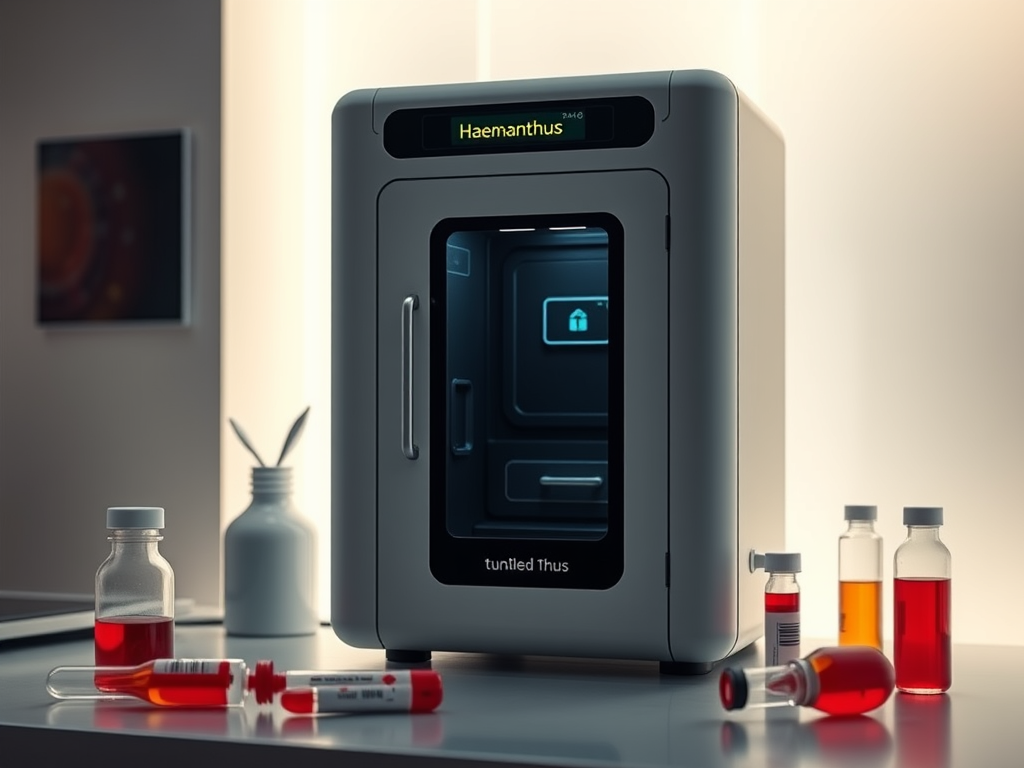

Billy Evans Launches Controversial Blood-Testing Start-Up

Elizabeth Holmes is currently serving a prison sentence for defrauding investors through her blood-testing company, Theranos. Meanwhile, her partner, Billy Evans, is attempting to launch a diagnostics start-up of his own.
Evans, who shares two children with Holmes, is actively seeking financial backing for a company that touts itself as “the future of diagnostics” and “a radically new approach to health testing,” according to promotional materials reviewed by The New York Times.
The pitch is reminiscent of Theranos, a Silicon Valley start-up that once captured global attention by claiming to revolutionize diagnostic testing. The company falsely asserted that its device could perform a wide array of laboratory tests using just a drop of blood. Ultimately, these claims proved to be fraudulent, and Holmes was convicted of fraud and sentenced to over a decade in prison.
Evans’s new venture, Haemanthus, is named after a flower also known as the blood lily. According to two investors familiar with the company’s plans, Haemanthus intends to begin by testing pets for diseases before moving on to human diagnostics. The company aims to raise over $50 million, with the ultimate objective being “human health optimization,” as stated in the marketing materials.
A photograph included in the promotional materials depicts a prototype that bears a notable resemblance to Theranos’s notorious blood-testing device, which was alternatively known as the Edison or miniLab. The Haemanthus device is described as a rectangular unit equipped with a door, a digital display screen, and “tunable lasers” for scanning samples.

The start-up’s marketing materials claim that the device can analyze blood, saliva, and urine samples. The documents also assert that there is “no regulatory oversight,” adding that the U.S. Department of Agriculture (USDA) allegedly confirmed this in writing. However, the specifics of this claim remain unclear. Seth W. Christensen, a spokesperson for the USDA, stated that while the agency regulates veterinary diagnostics, he could not confirm whether the USDA had communicated with Haemanthus.
In response, Evans commented in an interview, “When you’re in stealth, you’re trying to be in stealth. They aren’t going to find anything associated with the name Haemanthus.” He also provided a redacted document indicating that the USDA had stated that the proposed product did not fall under the regulatory jurisdiction of the Center for Veterinary Biologics.
Evans, 33, is the heir to a California hotel fortune. He reportedly met Holmes while she was under federal investigation. Thus far, he has remained largely silent about the new venture. According to the marketing materials, he has already assembled a team of approximately 10 employees and describes his role on social media as working for a “stealth start-up.”
James W. Breyer, a prominent venture capitalist known for his early investment in Facebook, was approached to invest in Haemanthus but declined, citing concerns similar to those that dissuaded him from investing in Theranos. “In diagnostics, the difference between a compelling story and a great company lies in scientific defensibility and clinical utility,” Breyer wrote in an email.
The rise and fall of Theranos serves as a cautionary tale in Silicon Valley. Once celebrated as a pioneering start-up, it attracted high-profile investors, including Rupert Murdoch and Larry Ellison, and a board that featured influential figures like former Secretary of State Henry Kissinger. Holmes became a media sensation, drawing comparisons to Apple co-founder Steve Jobs for her signature black turtleneck and grandiose vision.
However, the technology behind Theranos’s blood-testing device never lived up to its claims. Instead, the company relied heavily on conventional lab equipment while misleading investors and patients. The fallout was chronicled extensively in books, podcasts, and legal proceedings, culminating in Holmes’s conviction in 2022.

Evans’s concept for Haemanthus can be traced back at least 18 months, when he incorporated the company in Delaware. Public records indicate that the company has operated from several locations in Austin, Texas, where Evans resides with Holmes and their two children.
Initially, Haemanthus sought $3.5 million in funding from family and friends. This spring, the start-up began reaching out to potential investors in Austin and the San Francisco Bay Area to raise an additional $15 million, according to marketing documents.
One confirmed investor, according to public records, is Matthew E. Parkhurst, a part owner of a Mediterranean tapas bar in Austin. Parkhurst did not respond to requests for comment.
Much of the executive team at Haemanthus reportedly has ties to Luminar, a self-driving car company where Evans worked for two years. According to the company’s marketing materials, its initial target market is the pet diagnostics industry, a booming sector estimated to be worth billions of dollars annually.
The Haemanthus device is purportedly designed to scan blood, saliva, or urine samples from pets using a laser and to analyze the samples on a molecular level. The marketing documents suggest that the machine can detect biomarkers such as glucose and hormones within seconds and use “deep learning models” to identify cancer and infections.
The long-term vision for Haemanthus, according to the investor materials, is to develop a wearable, stamp-sized version of the device for human use. Achieving this goal, the documents assert, would require an estimated $70 million and three years of development.
Notably, the investor presentation makes no mention of Evans’s connection to Elizabeth Holmes, despite her high-profile association with Theranos and the striking similarities between the two ventures.




Leave a Reply