

Trump Administration Strips Harvard of Federal Grants

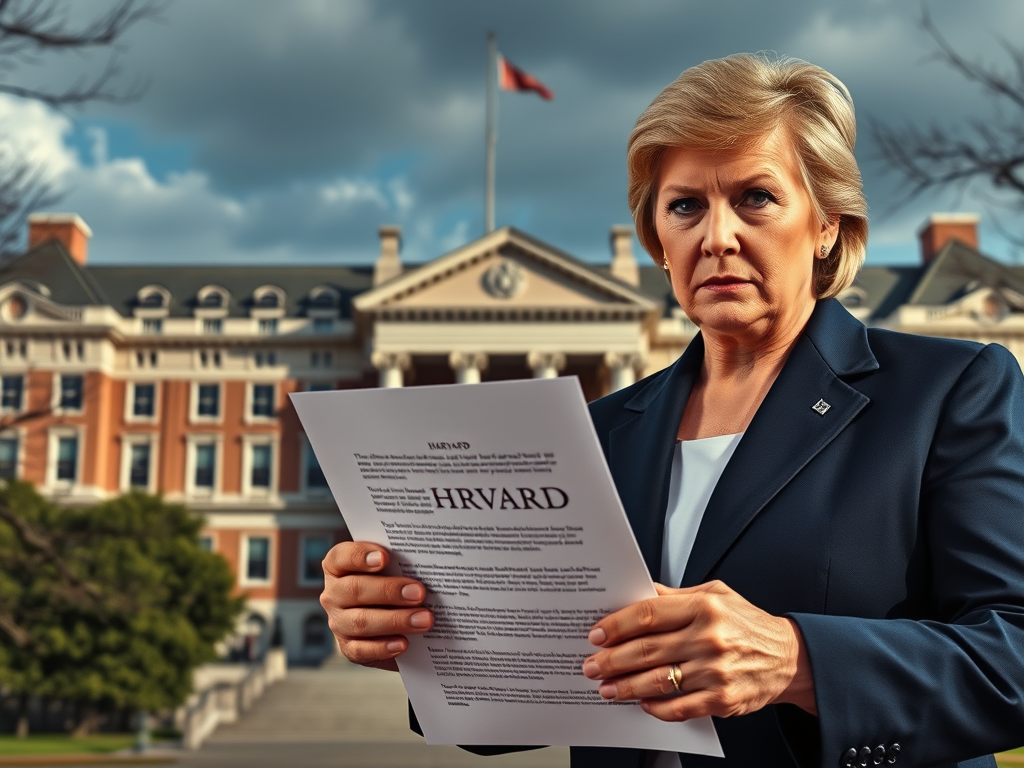
The Trump administration escalated its conflict with Harvard University on Monday by notifying the prestigious institution that it would no longer be eligible for new federal grants. The announcement was delivered through a strongly worded letter addressed to Alan M. Garber, Harvard’s president, by Education Secretary Linda McMahon, who criticized the university’s leadership for “catastrophic mismanagement.”
“This is to inform you that Harvard should cease seeking federal grants, as no further funding will be provided,” McMahon wrote in her letter.
This stern communication marked the administration’s first significant response since Harvard filed a lawsuit to contest the government’s decision to cut billions in research funding, a move prompted by the university’s resistance to stringent federal oversight.
According to an Education Department official, who briefed reporters prior to the letter’s release, Harvard’s access to federal research grants is now contingent on addressing specific concerns. These include alleged antisemitism on campus, race-based student policies, and the administration’s grievances that the university has strayed from its pursuit of “academic excellence” while maintaining a disproportionately low number of conservative faculty members.
In a statement released on Monday night, a spokesperson for Harvard characterized McMahon’s letter as evidence of the administration’s attempt to impose “unprecedented and improper control” over the university, warning that such actions could have a chilling effect on higher education across the country.
“Harvard will continue to comply with the law, advocate for viewpoint diversity, and combat antisemitism within our community,” the statement said. “We will also resist illegal government overreach that threatens to undermine research and innovation vital to the security and well-being of Americans.”

The response underscores Harvard’s firm stance against the administration’s tactics, which have intensified since President Trump threatened to revoke the university’s tax-exempt status. Harvard has repeatedly argued that such measures lack a legal basis.
McMahon’s three-page letter, riddled with capitalized words for emphasis, reiterated longstanding criticisms voiced by Trump and conservative critics of Harvard. The letter accused the university of making a “mockery” of higher education, engaging in “ugly racism,” and suffering from “humiliating plagiarism scandals,” among other allegations.
“At its finest, a university should embody the highest ideals of our nation, enlightening the countless students who pass through its grand gates,” McMahon wrote. “Yet, Harvard has betrayed these ideals.”
Beyond the scathing tone of McMahon’s letter, Monday’s announcement suggested a shift in the administration’s strategy toward elite universities. Initially, the government had stripped existing grants, a dramatic move that sparked court challenges. Harvard’s lawsuit, citing both the First Amendment and the Administrative Procedure Act, challenged the suspension of over $2 billion in federal funding, asserting that the cuts were executed without due process.
However, higher education officials nationwide now fear a more methodical and potentially harder-to-contest approach: a blanket prohibition on new federal grants. While such a measure could still prompt litigation, a calculated, less hasty implementation may be more difficult to overturn in court.
Since returning to the White House, Trump has intensified his assault on elite universities, accusing them of perpetuating liberal ideologies and suppressing conservative voices. Among these institutions, Harvard has become the most prominent target.

Last month, the administration sent Harvard a list of controversial demands, including audits of professors for plagiarism, mandatory reporting of international students accused of misconduct, and the appointment of external monitors to ensure “viewpoint diversity” in academic departments. Although the administration later claimed the letter was sent by mistake, tensions have only escalated.
Harvard responded by filing a lawsuit, accusing the administration of attempting to exert “unprecedented and improper control.” President Garber warned that the administration’s actions could inflict “severe and lasting” consequences on higher education.
Federal funding has been a cornerstone of American higher education since World War II, and Harvard has relied heavily on these grants to finance its extensive research programs. In the 2024 fiscal year, federally sponsored research accounted for approximately 11% of Harvard’s revenues, translating to roughly $687 million. While Harvard’s $53 billion endowment is one of the largest in the world, much of it is earmarked for specific purposes, limiting how it can be used.
A prolonged freeze on new federal grants could severely disrupt Harvard’s financial operations, potentially forcing the university to seek alternative funding sources or consider significant budget cuts.
In her letter, McMahon emphasized Harvard’s immense wealth, suggesting that the university’s substantial endowment should serve as a “head start” in an era without federal funding.
“Much of this fortune was amassed within the boundaries of, and through the prosperity created by, the United States and its free-market system — a system you teach your students to disparage,” McMahon wrote.
Since taking office, Trump has targeted elite universities, portraying them as bastions of liberal bias and political indoctrination. Harvard’s recent legal battle against the administration’s demands is only the latest flashpoint in a broader ideological clash.
Some higher education experts warn that the escalating conflict could have far-reaching implications, potentially emboldening the administration to impose similar measures on other institutions.

Richard Portes, an economics professor at the London Business School, noted that the situation is already creating unease among global investors. “The unpredictability of these policies is eroding confidence,” he said. “Even assets once considered safe havens are now subject to new and unpredictable risks.”
Meanwhile, university leaders are bracing for the fallout, fearing that Harvard’s predicament may foreshadow a broader campaign against other prominent research institutions. For now, the administration’s tactics remain focused on Harvard, but many fear that other elite schools could soon find themselves in the crosshairs.




Leave a Reply