

Federal Inquiry on Long Island School Mascot Controversy

On Friday, federal education authorities revealed that they had launched a civil rights investigation into whether New York State’s decision to withhold funding from a Long Island school district over its refusal to abandon its Native American mascot violates federal law.
This announcement followed a show of support from President Trump for the Massapequa, New York, school district, which is resisting a state mandate issued by the Board of Regents. The directive requires all public school districts to retire mascots, imagery, or names that draw from Native American culture, or face the loss of critical state funding.
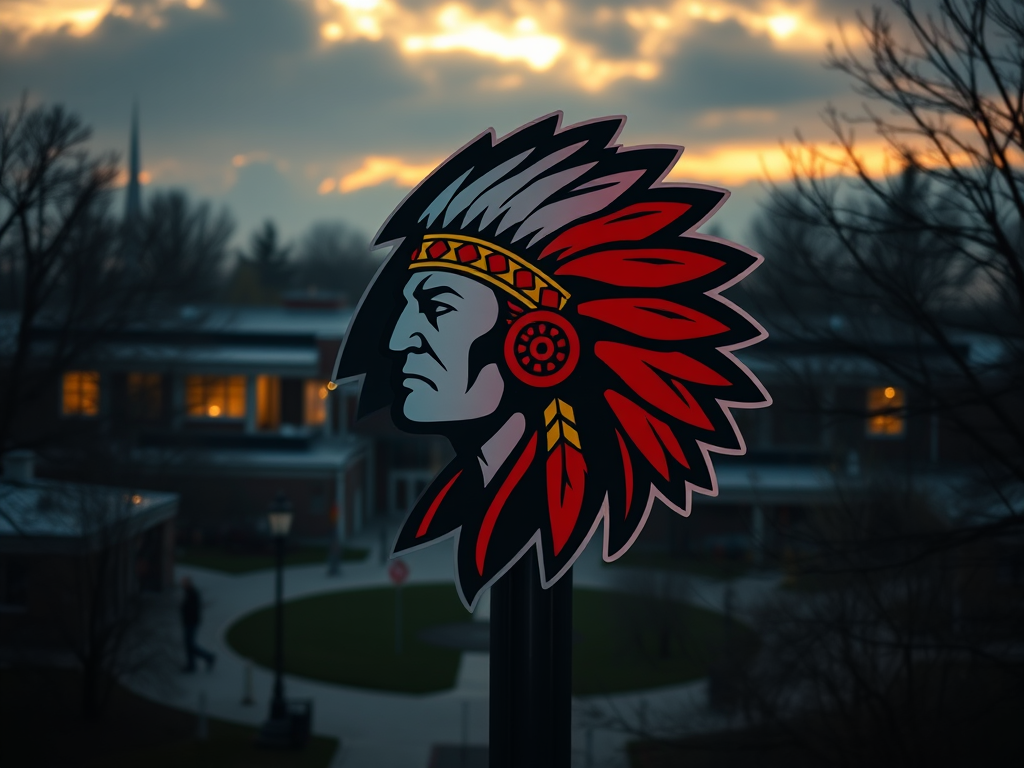
The Massapequa district, whose logo — the “Chiefs” — portrays a stylized image of a Native American man wearing a feathered headdress, is among several districts that have pushed back against the state’s order.
Interestingly, the town of Massapequa, a predominantly middle-class community located on the South Shore of Long Island, derives its name from the Native American word “Marspeag” or “Mashpeag,” meaning “great water land.” In the 2024 presidential election, the majority of the town’s voters supported President Trump, a reflection of the area’s conservative leanings.

Linda McMahon, the Secretary of Education, announced the federal investigation, stating that the Department of Education would not “stand idly by while New York State attempts to erase history and strip Massapequa of its ability to honor its heritage within its schools.”
JP O’Hare, a spokesperson for the New York State Education Department, responded with a statement indicating that state officials had not yet been contacted by federal authorities regarding the investigation. O’Hare also noted the contradiction between this federal move and Secretary McMahon’s earlier comments from March 20, 2025, in which she declared that her administration intended to “return education decisions to the states, where they rightfully belong.”
The controversy stems from a 2022 state policy designed to address the ongoing national effort to eliminate the use of Native American imagery and names as school mascots. The initiative mirrored broader legislative and cultural trends across the country that sought to move away from depictions seen as disrespectful or stereotypical.
At the time the ban was enacted, approximately 60 school districts across New York State continued to use Native American-themed mascots or logos. They were given until June of this year to comply with the new policy by replacing any prohibited symbols or names.
Since beginning his second term, President Trump has made fighting diversity, equity, and inclusion (DEI) efforts a central theme of his administration. He and his allies have argued that many DEI initiatives are unconstitutional or discriminatory, and they have aggressively targeted institutions that refuse to dismantle such programs. In a particularly controversial move, the president has threatened to cut off federal funding for low-income students in states that maintain DEI-related policies. New York became the first state to openly defy one of these presidential orders.

In the ongoing legal battle, the Massapequa school district filed a lawsuit in federal court seeking permission to retain the “Chiefs” name and logo. However, the presiding judge recently signaled an intention to dismiss the case, stating that the district had not provided sufficient evidence to support their claims. Among the rejected arguments was the assertion that the mascot was a form of protected speech under the First Amendment.
Earlier this week, President Trump voiced his outrage on social media, condemning New York’s policy as an overreach. He called on Secretary McMahon to intervene directly in support of Massapequa.
“Forcing them to abandon the name after so many years is absurd,” the president posted. “It’s actually an insult to our great Indian population.”
The federal Education Department’s statement on Friday included remarks from Kerry Watcher, president of the Massapequa Board of Education. Watcher applauded the federal government’s decision to investigate, arguing that the state’s approach does more harm than good.
“Efforts to eliminate Native American imagery from our schools do not contribute to better education,” Watcher said. “On the contrary, they divert attention away from our fundamental mission: to provide students with a high-quality education based on respect, history, and community values.”

The clash in Massapequa reflects larger debates taking place nationwide about how best to honor, represent, or discontinue cultural symbols, especially those associated with Indigenous peoples. Supporters of the state mandate argue that using Native American imagery as mascots perpetuates harmful stereotypes and fails to show appropriate respect for Native cultures. Opponents, including many Massapequa residents, counter that the “Chiefs” mascot is a source of community pride and a way of preserving local history.
While the Massapequa case garners national attention, it is not unique. Across the United States, other school districts and sports teams have faced similar controversies. Some have voluntarily rebranded to align with evolving social norms, while others have fought back in courtrooms and statehouses.
For now, the investigation by federal officials signals an escalation in the standoff between state authority and federal intervention in education policy. Depending on its outcome, the case could set a significant precedent for how disputes over school mascots and cultural representation are resolved in the future.
In the meantime, Massapequa school officials remain steadfast in their resolve to defend the “Chiefs” name and imagery, framing their resistance as a fight for local control, historical recognition, and freedom of expression.
As the legal and political battles continue, students and families in Massapequa find themselves caught in the middle — a community divided not just by questions of tradition and change, but by broader tensions that mirror the current American political landscape.




Leave a Reply