

The Trade Adviser Who Hates Trade

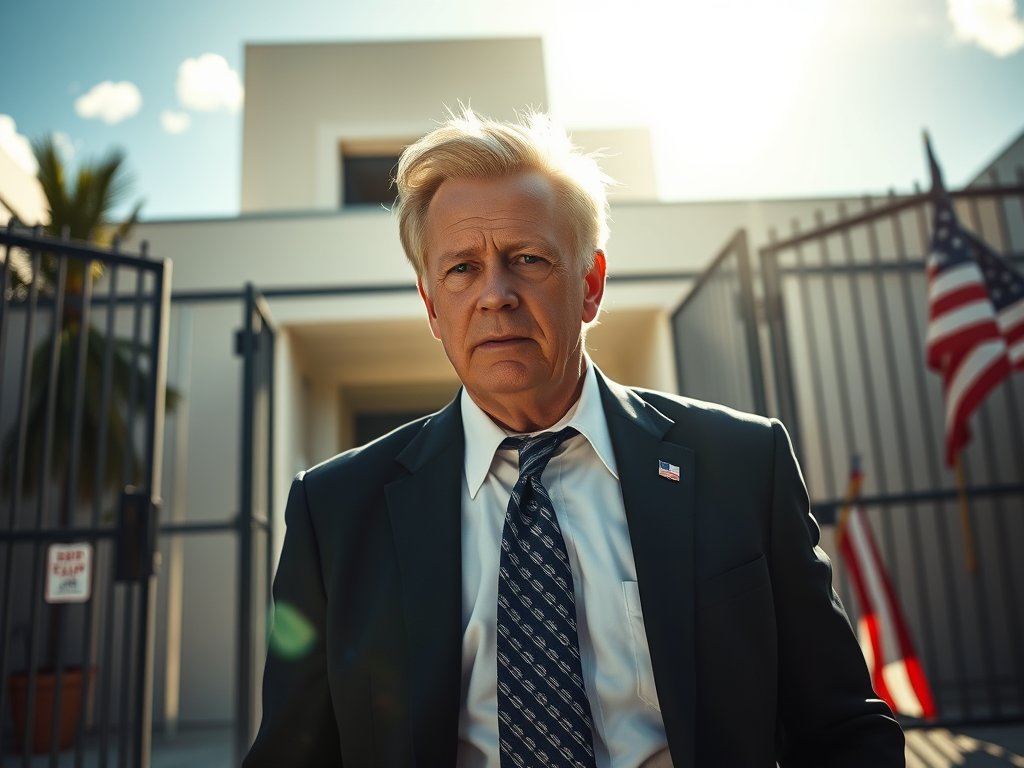
On a bright July day in Miami, Peter Navarro stepped out of a federal prison where he had spent four months behind bars for defying a congressional subpoena. His refusal to cooperate with the inquiry into the January 6 attack on the U.S. Capitol was, in his own words, an act of constitutional defense.
Barely hours after regaining his freedom, Mr. Navarro boarded a flight to Milwaukee. His destination: the Republican National Convention, where he took the stage to champion Donald J. Trump’s reelection campaign.

“They convicted me. They jailed me. But guess what? They didn’t break me,” he declared passionately to the cheering crowd. Each word was forceful, each pause deliberate—a public display of loyalty to Trump that appears to have strengthened his standing within Trump’s circle.
During much of Trump’s first term, Navarro—an economic advisor and staunch protectionist—was often dismissed by colleagues. Many within the administration viewed his hardline trade stances as factually dubious and potentially damaging to the country’s economy.
Now, however, with Trump back in the White House for a second term, Navarro has seen his influence grow. At 75, the economist has returned to Washington with renewed determination, undeterred by critics and armed with a bold, nationalist economic agenda. A stack of executive orders focused on trade had already been drafted by the time Trump was inaugurated again—many of which have since been enacted.
Trump, too, has re-entered office more intent than ever on reshaping America’s role in global trade. He is convinced that the international trading system has disadvantaged the U.S. for decades and sees drastic reforms as essential.

Approaching the 100th day of Trump’s second term, Navarro has already played a key role in unveiling several sweeping trade initiatives. These moves have raised tariffs to levels not seen in nearly a century, aiming to reduce U.S. dependence on foreign imports and bring manufacturing jobs back to American soil. According to sources familiar with internal discussions, Navarro was the architect of a controversial new tariff formula based on America’s trade deficits.
For over two decades, Navarro—an economist trained at Harvard and once a Democrat—has warned of the damage globalization has inflicted on American industry, particularly at the hands of China.
Some mainstream economists agree with Navarro’s premise that globalization and offshoring have decimated many American manufacturing communities. However, they often reject his methods—particularly tariffs—which they argue will stifle economic growth and increase prices for consumers.

Edward Alden, a senior fellow at the Council on Foreign Relations and a trade policy expert, has gone so far as to call Navarro “perhaps the worst trade adviser to serve a modern U.S. president.” While acknowledging that some of Navarro’s claims about unfair trade practices had merit, Alden contends that Navarro encouraged Trump’s most counterproductive instincts and supported erratic policies that have harmed both domestic and international economies.
“He’s enabled the transformation of the United States from a global economic leader into something more like a rogue trading power,” Alden said.
Navarro declined to participate in interviews for this article, but in a written statement, he emphasized that he was simply fulfilling Trump’s agenda. He also asserted that serving jail time demonstrated not only his loyalty to Trump but also his commitment to the Constitution.

He dismissed his critics in academia, accusing them of backing failed policies like NAFTA and China’s admission to the World Trade Organization—deals he believes enriched elites at the expense of ordinary Americans. “These so-called mainstream economists are the same clowns who thought outsourcing America’s jobs would benefit us. Maybe they should spend some time in Ohio or Pennsylvania before running their mouths,” Navarro said.
White House spokesperson Kush Desai praised Navarro, describing him as “an invaluable resource” and commending his foresight on China’s trade strategy, which he said undermined American labor for years while experts stood by and watched.
Despite a unified front on tariffs, internal tensions have begun to surface within the administration. Earlier this month, Navarro clashed publicly with Elon Musk over trade policy. Dismissing Musk as merely “a car assembler,” Navarro drew a sharp rebuke from the billionaire, who retorted that Navarro was “dumber than a sack of bricks,” later apologizing to bricks for the comparison.
Navarro, known for his fiery rhetoric and unorthodox style, has long been a polarizing figure in Washington. To many policy experts and lobbyists, he’s something of an oddity—mocked for his eccentricities, such as inventing a fictional economist named Ron Vara (an anagram of his own name) whom he quoted in his books.
Bryan Riley, director of the Free Trade Initiative at the National Taxpayers Union, compared his appointment to putting a flat-Earth believer in charge of NASA.
Yet, unlike many in Trump’s inner circle, Navarro isn’t driven by wealth or status. A career academic with modest personal assets, he appears fueled more by ideology than ambition. And he sees vindication in the current administration’s embrace of his long-criticized positions.
In a January interview with The New York Times, Navarro argued that academic economists had lost their credibility by consistently underestimating the impact of Trump’s economic policies. “They were wrong about us last time. They’re wrong again. End of story,” he said.
Richard Grenell, a former Trump official and now president of the Kennedy Center, credited Navarro’s unwavering focus on rebuilding American manufacturing. “If we don’t pressure other nations, we’ll lose the ability to make anything ourselves. That would be the beginning of the end for us,” he said. “And whether people like him or not, half the country supports what Peter Navarro stands for.”
“A speck in the ocean of humanity”
About 90 miles from the Miami correctional facility where he served his sentence lies the place where Navarro spent some of his happiest early years. His father, a musician, played saxophone and clarinet in a seasonal house band in Florida. Young Peter helped make ends meet by selling avocados and coconuts, pedaling past the luxurious Mar-a-Lago estate and endless beaches.

Following his parents’ divorce, Navarro lived with his mother, a Saks Fifth Avenue cashier who later became a store manager. Though money was tight, his academic talents earned him a scholarship to Tufts University. Drawn to international service, he joined the Peace Corps and was stationed in Thailand, traveling widely throughout Southeast and East Asia.
“It really puts your life in perspective,” he recalled in an interview. “You’re just a tiny dot in a vast sea of people.”
After returning home, Navarro earned his Ph.D. in economics from Harvard. Early in his career, he supported free trade and even included a chapter defending it in his first book, published in 1984. “I was totally sold on the idea,” he said.
He later taught business and economics, first in San Diego and then at the University of California, Irvine. Over two decades, he built a reputation as a dedicated professor and prolific writer, publishing books like Big Picture Investing and If It’s Raining in Brazil, Buy Starbucks. He also contributed to respected economic journals and once co-authored a paper with a future Nobel Prize winner.

An avid triathlete, Navarro spent his free time swimming, biking, and paddleboarding. Politically, he was an environmentalist and social liberal who ran for office multiple times as a Democrat, even speaking at the 1996 Democratic National Convention.
But the tide turned for him when China joined the WTO in 2001. He began to see American jobs evaporate, including those held by his students. This observation led him to investigate Chinese trade practices more deeply.
His conclusion: China’s pricing advantages weren’t simply due to cheap labor, but rather a web of unfair tactics, including government subsidies, currency manipulation, and minimal labor and environmental protections.
These findings formed the backbone of a series of books on China, most notably Death by China, co-authored with Greg Autry and released in 2011. The book was adapted into a documentary narrated by Martin Sheen. Though widely criticized as alarmist, it resonated with Donald Trump, who praised it as “spot-on.”

Robert C. O’Brien, Trump’s former national security adviser and a close friend of Navarro, recalled that despite his academic background, Navarro had a real connection to working-class Americans. “He knew people in the Rust Belt got screwed. He felt that in his core.”
“Where’s my Peter?”
Navarro’s first encounter with Trump, he claims, stemmed from a blog post he read in 2011. The post mentioned that Trump, in an interview with Chinese media, had cited The Coming China Wars among his favorite books. Though the interview’s authenticity is questionable and the original article has disappeared, the mention sparked an exchange of messages between the two men.
Navarro later became an adviser to Trump’s 2016 campaign, with his anti-China, pro-American worker message striking a chord among voters. After Trump’s victory, Navarro believed he’d be tapped to lead the National Economic Council. Instead, the job went to Goldman Sachs veteran Gary Cohn, whom Navarro viewed as a “globalist” and personal rival.
Though assigned to head the newly created National Trade Council, Navarro found himself with little staff or influence. He frequently clashed with Cohn and other officials who dismissed his proposals—such as exiting NAFTA or imposing high tariffs—as reckless.
But today, with many of those same policies now enacted, Navarro sees his persistence as justified. He once stood alone in the administration. Now, he stands vindicated.




Leave a Reply