
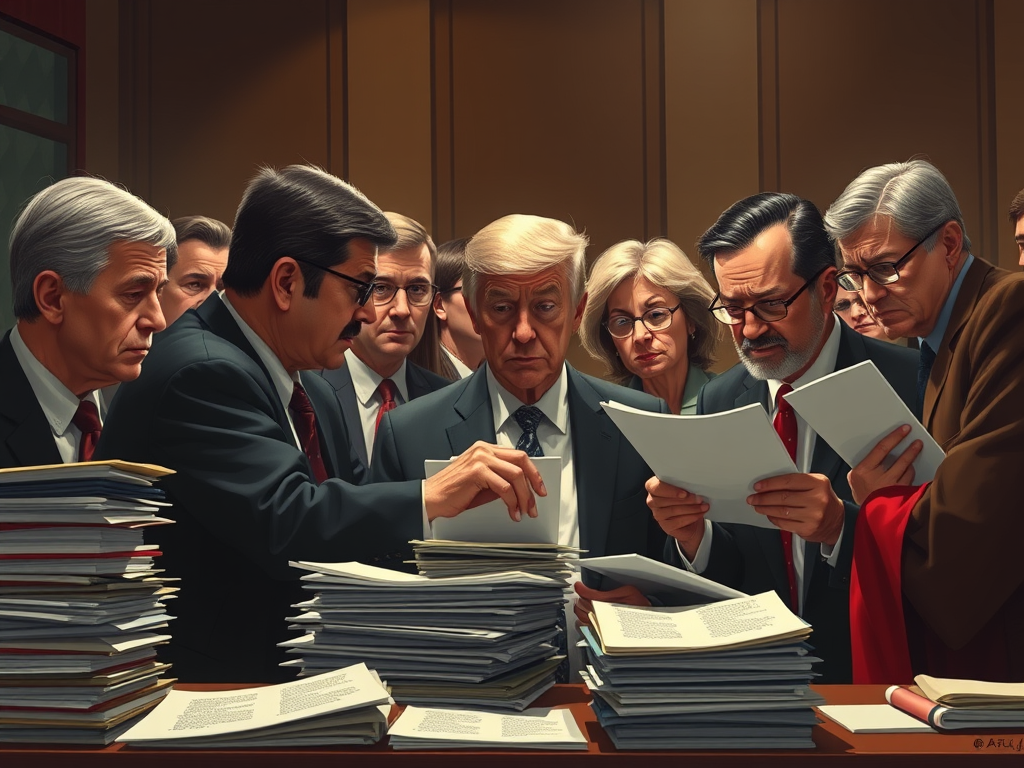

Harvard Professors Sue Trump Administration Over Threat to Cut Funding

In a significant move aimed at defending academic freedom and constitutional rights, two prominent faculty organizations affiliated with Harvard University filed a lawsuit on Friday against the Trump administration. The complaint, submitted in federal court in Massachusetts, challenges the administration’s attempt to withhold nearly $9 billion in federal funds from the university. According to the plaintiffs, this punitive measure violates the First Amendment rights of faculty members and constitutes an abuse of executive authority.
The lawsuit was jointly brought by the American Association of University Professors (AAUP) and its Harvard chapter, both of which represent hundreds of faculty members. They argue that the administration’s actions are politically motivated and seek to suppress freedom of expression on campus by leveraging financial threats.
“This is a blatant attempt to use federal funding as a tool to silence dissenting voices in higher education,” the lawsuit contends. “Such conduct is not only unlawful but poses a grave threat to the core principles of academic freedom and open inquiry that define America’s universities.”
The legal complaint asks the court to grant a temporary restraining order that would immediately block the administration from carrying out its threats to reduce or cancel federal financial support to Harvard.
The White House has yet to issue a formal response to the lawsuit. Officials did not reply to multiple requests for comment following the filing.
This legal battle comes in the wake of heightened tensions between the Trump administration and some of the country’s most prestigious academic institutions. The administration has launched an aggressive campaign accusing certain universities of failing to adequately address antisemitism on campus. Harvard, in particular, has found itself in the crosshairs of these criticisms.

Earlier this month, the administration sent a letter to Harvard stating that it was launching a review of the university’s federal funding and issued a set of conditions that Harvard must fulfill if it intends to retain continued financial support. The letter accused the university of failing to ensure the safety of Jewish students and staff, asserting that Harvard had “fundamentally failed to protect American students and faculty from antisemitic violence.”
Other elite universities such as Columbia University and Cornell University have also come under scrutiny, with similar warnings issued in recent weeks.
In response to the allegations, Harvard has maintained that it takes the issue of antisemitism seriously. University President Alan Garber has publicly acknowledged the challenges the school faces and noted that Harvard has taken substantial steps over the past year to address incidents of antisemitic behavior. “We have made considerable efforts in the past 15 months,” Garber said in a recent statement, “but we recognize that more work is needed.”
However, faculty groups believe the administration’s intervention goes beyond concerns over antisemitism and instead reflects a broader attempt to curb academic independence and punish institutions perceived as politically or ideologically opposed to the Trump administration.

Andrew Manuel Crespo, a constitutional law scholar at Harvard and general counsel of the AAUP-Harvard Faculty Chapter, voiced strong concerns about the precedent the administration is setting. “This is not really about antisemitism,” Crespo said. “It’s about creating a chilling effect across academia. Faculty members should be able to engage in teaching, research, and public discourse without the looming threat of financial retaliation from the federal government simply because their views don’t align with those in power.”
The broader academic community has begun to rally around Harvard’s faculty. On Saturday, a large demonstration took place in Cambridge, Massachusetts, near the university’s campus. Hundreds of students, professors, alumni, and local residents turned out to voice their opposition to what they see as an attack on higher education.
The protest, held in a local park despite bitter winter temperatures, featured speeches from university faculty and local leaders. Cambridge Mayor Denise Simmons also took the stage, issuing a call to action for Harvard to take a firm stance in defense of academic freedom.
“Harvard is not just any institution—it has the capacity, the influence, and the resources to push back against this dangerous overreach,” Mayor Simmons told the crowd. “But more than that, it has a moral obligation to do so. The rest of the academic world is watching.”
She added that allowing the federal government to wield funding as a weapon against institutions based on ideological grounds sets a troubling precedent that could affect all universities, not just Harvard.
Legal scholars have echoed similar concerns, warning that the administration’s actions could undermine not only the principle of free expression but also the separation of powers. By tying funding to compliance with certain political viewpoints, the government may be violating constitutional limits designed to protect institutions from coercion.
The lawsuit highlights the broader implications of this conflict. Should the Trump administration succeed in cutting or conditioning federal funding based on perceived ideological noncompliance, it could have ripple effects across the nation’s academic landscape. Universities and colleges might begin censoring faculty or avoiding controversial topics in order to safeguard their budgets.
“This is about much more than Harvard,” said Crespo. “If the government can go after one university for its speech, it can go after any university. And that puts the entire system of higher education—and the freedoms it embodies—at risk.”

It’s worth noting that federal funding to universities typically supports a wide range of activities, from scientific research and technological innovation to student financial aid and public health programs. At Harvard, these funds play a critical role in sustaining research initiatives in medicine, engineering, and the social sciences, many of which benefit the broader American public.
To many observers, the administration’s move appears less about policy and more about politics. With an election year underway, critics argue that the Trump administration is using higher education as a political scapegoat to rally its base, while ignoring the real needs of students and researchers.
As the legal process unfolds, the outcome of this case could have lasting consequences for the relationship between academia and the federal government. If the court rules in favor of the plaintiffs, it may reaffirm the longstanding tradition of academic autonomy. But if the administration’s actions are upheld, it could mark a shift toward a more politicized and conditional model of federal support for higher education.
Either way, the battle lines have been drawn, and the stakes are high.
“This is a moment of truth for American higher education,” Mayor Simmons said at the protest. “Do we stand by and let fear dictate policy? Or do we stand up and protect the values that make our universities a beacon of knowledge and progress?”
As the lawsuit gains national attention, faculty members and students at other institutions may also be inspired to push back against what they view as politically motivated intrusions into academic life. For now, all eyes are on the federal court in Massachusetts, where the future of free expression on campus may be decided.





Leave a Reply