
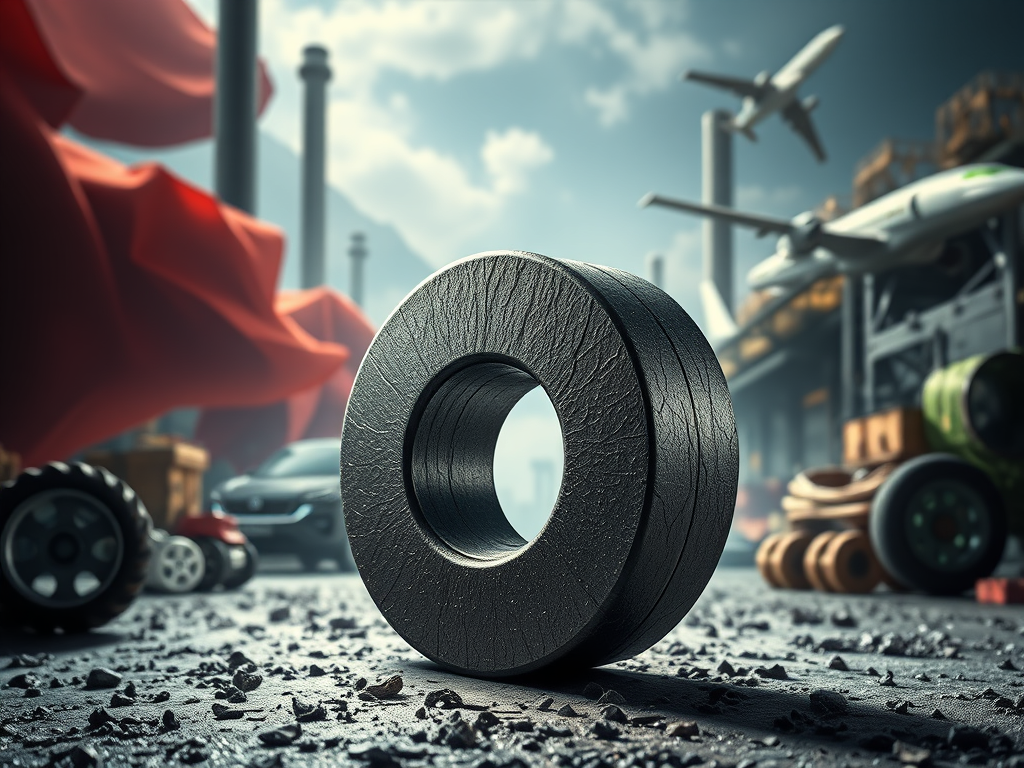

China Halts Critical Exports as Trade War Intensifies

China has recently imposed a halt on the export of a broad array of critical minerals and rare earth magnets—materials essential for the global production of electric vehicles, aerospace systems, semiconductors, and defense equipment. This sudden suspension has already disrupted shipments from major Chinese ports and raised serious concerns among international manufacturers.
These powerful magnets, indispensable in the manufacturing of items ranging from automobiles and drones to advanced robotics and precision-guided missiles, are now stuck in limbo as China drafts a new export licensing framework. Analysts warn that once finalized, this system may permanently restrict access to these materials for select companies, particularly those involved in the U.S. defense sector.
This move appears to be part of China’s broader response to the trade conflict initiated by former U.S. President Donald Trump, who significantly increased tariffs on Chinese goods starting April 2. In retaliation, China tightened its grip on the global rare earth supply chain.
On April 4, Beijing implemented new limitations on the export of six types of heavy rare earth elements—metals that are almost exclusively refined within China—as well as on magnets made from these elements. Currently, around 90% of the world’s rare earth magnets are manufactured in China. Under the new rules, companies must obtain a special export license to ship these products abroad.
However, the process for issuing these licenses remains in its infancy, leaving companies in limbo. Industry leaders worry that the licensing system may take weeks or even months to become operational, causing potential shortages of these crucial materials outside China.

The delay is already sparking fears in manufacturing hubs like Detroit, where rare earth magnets are critical components for electric motors used in vehicles. Production lines could soon be affected if emergency reserves of these materials are depleted. Yet, the extent of disruption will vary, as companies differ in how much surplus inventory they hold to weather such crises.
The heavy rare earth elements in question are essential in crafting magnets that power many forms of electric propulsion systems, including those found in EVs, drones, and aerospace machinery. Even conventional gasoline-powered vehicles rely on rare earth magnets for functions such as power steering.
Beyond transportation and defense, these metals also play an indispensable role in producing key components for high-tech applications. They are used in chemical processes that manufacture jet engines, lasers, automotive lighting systems, and specific types of spark plugs. Furthermore, they are integral to the functioning of capacitors—crucial parts of semiconductors used in AI servers and smartphones.
Michael Silver, CEO of Los Angeles-based chemical supplier American Elements, revealed that Chinese authorities had informed his company that export licenses would take approximately 45 days to be processed. In the meantime, American Elements is relying on inventories stockpiled in anticipation of worsening U.S.–China trade tensions.

Daniel Pickard, who leads the Critical Minerals Advisory Committee within the Office of the U.S. Trade Representative and Department of Commerce, also expressed alarm over the situation. Pickard, who also heads the international trade and national security division at the law firm Buchanan Ingersoll & Rooney, emphasized the potential severity of the disruption and warned that China’s image as a dependable supplier could suffer if the suspension continues.
Further complicating matters, the Chinese Ministry of Commerce has issued a directive barring domestic companies from conducting business with an expanding list of U.S.-based entities, particularly defense contractors. This decision could intensify the pressure on sectors that are already heavily reliant on Chinese raw materials.
James Litinsky, CEO of MP Materials—the only U.S.-based company currently operating a rare earth mine—voiced particular concern about the implications for American military manufacturing. Litinsky highlighted that drones and robotics, which represent the future of modern warfare, could face production hurdles due to blocked access to essential input materials.

MP Materials owns the Mountain Pass mine in California and is currently preparing to begin commercial-scale magnet production in Texas later this year. Clients include General Motors and other major manufacturers who are now closely monitoring the supply situation.
Japan, which experienced a similar embargo in 2010 during a territorial dispute with China, has since maintained substantial reserves of rare earth materials—often enough to last more than a year. However, many American companies operate with minimal inventory, reluctant to tie up capital in stockpiles of expensive resources. For instance, dysprosium oxide—one of the rare earth metals under new restrictions—currently sells for over $200 per kilogram in Shanghai, and even more in international markets.
Although rare earth magnets account for only a small fraction of China’s total exports to the United States and other nations, their suspension could have outsized consequences. For China, the economic cost is minimal, but the ripple effect could be severe for industries in the West that depend on consistent supply.
Notably, Chinese customs officers are enforcing the ban not only on exports to the U.S., but also to other key markets such as Japan and Germany. While the enforcement of these new rules varies between ports, rare earth industry executives confirm that the situation remains unpredictable.
Magnets containing heavy rare earths are especially affected, as these metals are necessary to maintain magnetism under high heat and electric field conditions. Some magnets, made solely from light rare earth elements, are not restricted—but officials at certain ports demand thorough testing to confirm the absence of heavy elements before approving shipments.

Meanwhile, customs agents at other ports appear slightly more lenient, allowing exports of magnets that contain only trace amounts of heavy rare earths, provided they are not destined for U.S. recipients.
The implementation of these export controls coincided with the Trump administration’s announcement of tariff exemptions on various consumer electronics imported from China. Nevertheless, exports of rare earth magnets remain blocked, according to several executives in the industry.
Adding another layer of strain, these magnets are also subject to the latest round of U.S. tariffs upon arrival at American ports.
Until recently, China produced nearly all of the global supply of heavy rare earth elements—accounting for 99% of output. A refinery in Vietnam had offered a modest alternative, but it has been shut down for over a year due to tax disputes, reinforcing China’s monopoly.
China is also responsible for producing around 90% of the world’s estimated 200,000 tons of rare earth magnets annually. Japan handles much of the remaining production, with Germany contributing a small share—both of whom rely on Chinese raw materials.
Officials at China’s Ministry of Commerce have not responded to requests for comments on the matter.
The core of China’s rare earth mining industry lies in a lush valley near Longnan, nestled in Jiangxi Province’s red clay hills. Refineries in Longnan purify ores from nearby mines and ship the refined materials to magnet factories in Ganzhou, located about 80 miles away.
Among the most prominent of these factories is JL Mag Rare-Earth Company, headquartered in Ganzhou. According to industry sources, JL Mag supplies cutting-edge magnets to Tesla and China’s BYD, the world’s leading electric vehicle producers. BYD has publicly stated that it sources high-performance magnets from JL Mag, which boast magnetic power 15 times greater per volume than traditional iron magnets.

In 2019, during a period of escalating U.S.–China tensions, Chinese President Xi Jinping visited JL Mag’s facility in what many interpreted as a symbolic warning. While China refrained from deploying export controls at that time, current developments indicate a shift toward more assertive use of its rare earth leverage.
China temporarily halted mining near Longnan in recent years due to environmental concerns stemming from the chemical-intensive extraction process. However, signs suggest that mining has resumed, as evidenced by activity at one local site where machinery and chemical flows have been observed.
Heavy rare earths are typically extracted through a leaching process that involves pouring strong chemicals into holes drilled into hillsides. The chemicals dissolve the minerals, which are then collected from the base of the hill and pumped to facilities for initial processing.
This aggressive supply-side tactic from China serves as a reminder of the nation’s dominance in the rare earth market—and the vulnerability of global industries that rely on these materials. As the world navigates this growing tension, manufacturers and governments alike are left to weigh their dependency on Chinese supply chains and explore alternatives before the next disruption.




Leave a Reply