
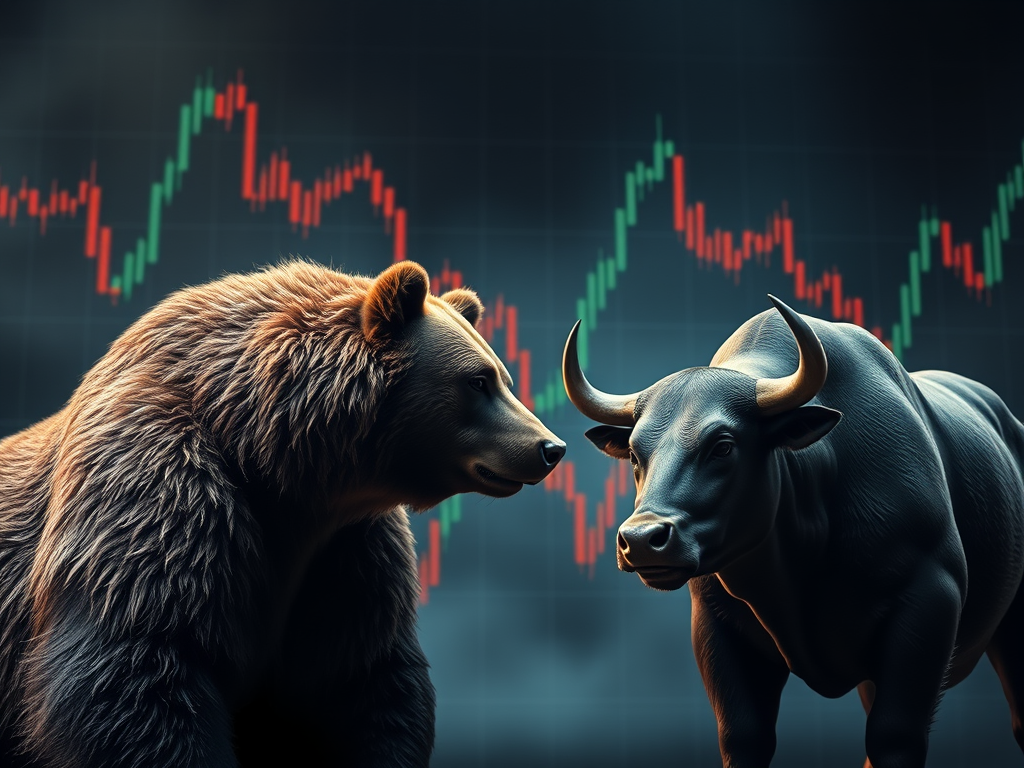

U.S. financial markets took another downturn on Thursday, with investor anxiety reigniting after the White House confirmed that Chinese imports would be hit with a total tariff rate of 145 percent. The announcement reignited concerns about the intensifying trade conflict between the United States and China, the world’s two largest economies.
Market Volatility: Consequences of Rising Tariffs Explained

The S&P 500 index dropped 3.5 percent, a stark reversal from the previous day’s dramatic 9.5 percent surge — its strongest daily gain since 2008. Thursday’s steep loss erased much of that momentum and underscored that investor fears about the economic consequences of aggressive trade policies remain front and center.
The volatility continues a trend of wild market swings that began after President Trump unveiled sweeping tariffs last week affecting nearly all of America’s trading partners. The market’s instability is also drawing the attention of regulators and policymakers, particularly with regard to government bond markets — a cornerstone of the global financial system. They are closely monitoring trading activity to ensure those markets continue functioning properly.
Just a day earlier, optimism had temporarily returned to Wall Street after President Trump announced a 90-day delay in the implementation of higher tariffs, which investors had initially interpreted as a sign of possible de-escalation. However, that delay excluded China, and markets were under the impression that the tariff rate on Chinese goods would be capped at 125 percent.
However, Thursday morning brought a shift in sentiment. Analysts pointed out that even with the reprieve, a new universal 10 percent tariff would still go into effect — a figure already significantly higher than prior levels. Furthermore, existing tariffs on products like steel, aluminum, and automotive components would remain in force. Investors were further rattled when the White House clarified that the 125 percent figure previously cited was being added on top of an existing 20 percent duty on Chinese imports, bringing the effective tariff rate to 145 percent.
James Rossiter, head of global macro strategy at TD Securities, summed up the concerns in a research note: “Even though there was some positive news, policy uncertainty is still high, and that’s going to weigh on the U.S. economy. Companies will find it difficult to plan for the future under such ambiguous conditions.”

President Trump left the door open for negotiations regarding the new 10 percent base tariff, calling it a “starting point” during a cabinet meeting. He also indicated it might be adjusted depending on how individual countries respond. “It depends on what they’re bringing to the table,” he remarked.
Despite such flexibility, business leaders have already begun voicing their concerns. On Wednesday, Delta Air Lines cited economic unpredictability as a reason for its inability to offer financial guidance for the current year. The airline’s stock price subsequently plunged more than 11 percent.
Economists warn that the sharply increased duties on Chinese imports are likely to have wide-reaching effects on the U.S. economy. Many American companies — particularly publicly traded ones — rely heavily on Chinese imports to stock their shelves and run their businesses. For instance, Nike, a major apparel company, saw its stock fall by more than 8 percent during Thursday’s trading session.
Wendong Zhang, a professor of applied economics and policy at Cornell University, emphasized how deep the reliance on China runs in certain product categories. “Roughly 73 percent of smartphones, 78 percent of laptops, 87 percent of gaming consoles, and 77 percent of toys imported by the U.S. come from China,” he explained in an interview. “Finding new sources for these products will not only take time but also drive up costs considerably.”
Thursday’s sell-off spared few sectors. More than four out of five stocks in the S&P 500 ended the day in the red. Energy stocks led the downturn, dragged lower by declining oil prices — a sign that investors are preparing for a possible slowdown in global demand. Meanwhile, the U.S. dollar also faltered, falling 1.7 percent against a basket of currencies from major trading partners — marking its worst performance of the year so far.
Among the worst-hit individual stocks was CarMax, which tumbled 17 percent. The auto retailer reported that macroeconomic uncertainty had made it difficult to make accurate forecasts. In a statement accompanying its earnings release, the company said: “We remain committed to our long-term growth strategy, but due to broader economic headwinds, we’re removing specific timelines for achieving our goals.” Analysts attribute much of the disruption to the new 25 percent tariffs on imported vehicles, which are expected to raise prices and dampen demand in the auto market.

Meanwhile, credit rating agencies are warning of an increased likelihood of defaults on corporate debt due to the economic drag created by tariffs. Corporate borrowing costs have risen noticeably in recent days, reflecting growing apprehension among lenders about the financial health of businesses.
The S&P 500 is once again nearing bear market territory, typically defined as a decline of more than 20 percent from its most recent high. Since peaking in mid-February, the index has dropped roughly 14.3 percent. Other major indexes, including the tech-heavy Nasdaq Composite and the small-cap-focused Russell 2000, have already fallen into bear market zones.
Officials at the Federal Reserve are keeping a watchful eye on the turbulence, particularly following a sell-off in U.S. government bonds earlier in the week that disrupted what is normally considered a safe haven during market upheaval.
Although bond markets stabilized somewhat on Thursday, yields on the 10-year Treasury note — a key indicator of borrowing costs — climbed to about 4.4 percent, up from under 4 percent just days earlier. Such moves can ripple through the economy, affecting everything from mortgages to business loans.
Jeff Schmid, president of the Federal Reserve Bank of Kansas City, told reporters that the Fed was closely monitoring developments “by the minute” to ensure liquidity remained intact. He described the week’s bond market fluctuations as “very instructive” in understanding the risks currently at play.
Some market experts have raised alarms over the role of complex financial strategies in amplifying volatility. In particular, trades involving small pricing differences between cash bonds and derivatives — often favored by hedge funds — have come under scrutiny. Regulators have previously flagged such trades for contributing to sharp market swings during periods of stress.
Beth Hammack, recently appointed president of the Cleveland Fed and a former longtime executive at Goldman Sachs, offered a cautious assessment. “U.S. financial markets are under stress, but they are still functioning,” she said on Wednesday.
While American equities sank, global markets painted a contrasting picture. Major indices in Asia and Europe ended Thursday on a positive note. Taiwan and Japan both saw their benchmarks jump over 9 percent, while South Korea’s index rose by 6 percent. In Europe, the Stoxx Europe 600 surged more than 5 percent, with Germany and France also posting gains above 5 percent.
China, for its part, has taken a number of steps to stabilize its markets. Several state-owned enterprises announced share buybacks earlier this week, a move that can often lift share prices. On Thursday, a state-run media outlet published an editorial suggesting that the People’s Bank of China should consider cutting interest rates and adopting other stimulus measures to support the economy.
As the world watches the unfolding trade tensions between the U.S. and China, markets remain fragile and susceptible to further swings. For now, uncertainty is the only constant.




Leave a Reply