

Stanford Protesters Charged With Felonies for Pro-Palestinian Occupation

Twelve individuals connected to a pro-Palestinian demonstration at Stanford University are now facing serious legal consequences after being charged with felonies related to a June 2024 protest that involved the occupation of administrative offices and significant property damage. Eleven of the twelve charged are either current or former Stanford students, according to prosecutors.
The charges, announced Thursday by Santa Clara County District Attorney Jeff Rosen, include felony vandalism and felony conspiracy to trespass. If convicted, each defendant could face up to three years and eight months in prison, in addition to restitution for the damages inflicted upon the university’s facilities.
These charges stand among the most serious leveled against any participants in the nationwide campus protests that erupted in spring 2024, in which more than 3,000 individuals were arrested during sit-ins, encampments, and demonstrations across U.S. colleges. Most of those arrests resulted in misdemeanor charges or were dropped entirely. However, the scale and intensity of the Stanford protest set it apart, drawing particular attention from federal and state authorities.
Extent of Damage and Level of Coordination Prompt Felony Charges
District Attorney Rosen emphasized that the decision to pursue felony charges was based solely on the facts of the case and the legal standards of California law, not on any political considerations or external pressures. While Stanford has been under investigation by the Trump administration over its handling of pro-Palestinian protests and its response to campus antisemitism, Rosen was clear that these federal actions had no influence on his office’s decision-making.

“My role is to enforce California’s laws fairly and consistently,” Rosen stated. “While protest is protected speech, damaging property and forcibly occupying private buildings are not. This is about conduct, not content.”
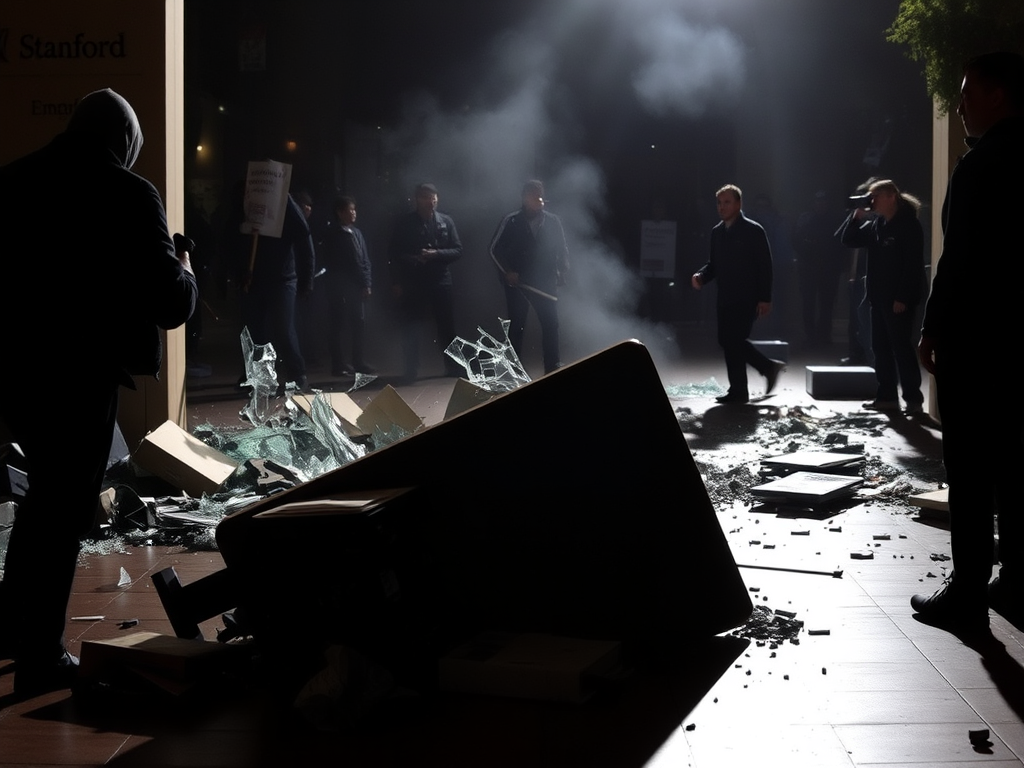
According to Rosen, the June 5 incident involved a coordinated group of demonstrators who forcibly entered the office of Stanford’s president in the early morning hours. Once inside, they barricaded themselves, caused extensive property damage—including smashing windows and furniture, disabling surveillance equipment, and splattering artificial blood around the space—and issued demands to the university’s leadership. Chief among those demands was a vote by the Board of Trustees on divestment from companies tied to Israel’s military efforts.
The group was removed and arrested by law enforcement after several hours, but not before leaving behind a scene of substantial destruction. Authorities later recovered backpacks containing hammers, goggles, screwdrivers, chisels, and other tools, which prosecutors say were brought to aid in the break-in.
Investigation Uncovers Strategic Planning

In the months following the protest, investigators from the District Attorney’s office conducted a thorough inquiry. They found what they described as clear evidence of premeditation and coordination among the protesters. This included deleted communications from encrypted messaging apps such as Signal, surveillance of the building in the days prior, and an apparent assignment of roles within the group—such as who would force entry and who would secure the building from the inside.
Rosen cited these factors as key reasons for escalating the charges beyond misdemeanors. “When multiple people conspire to carry out a calculated illegal act, the threat to public safety increases significantly,” he said.
One individual arrested during the protest, Dilan Gohill—a student journalist with The Stanford Daily—was not charged. Rosen clarified that Gohill had been covering the protest in his capacity as a reporter and was not an active participant. Press freedom organizations had rallied in Gohill’s defense for months, urging prosecutors to recognize the distinction between journalism and activism. Gohill, who was detained for 15 hours following his arrest, was officially cleared of any wrongdoing in March.
Delays and Controversy Over Timing of Charges
Tony Brass, an attorney representing one of the defendants, Hunter Taylor-Black, expressed frustration over the lengthy delay in bringing charges—nearly ten months after the original incident. Brass argued that his client, a 25-year-old film student, and others had already completed university-imposed suspensions and were attempting to move on with their lives.
“Student protest has always played a vital role in American history,” Brass said. “My client was prepared to face the consequences for her actions, but dragging this out for nearly a year has only prolonged the disruption to her future. The delay serves no one.”
University officials confirmed that disciplinary action had been taken independently of the legal proceedings. Spokeswoman Dee Mostofi stated that Stanford had imposed its own sanctions on the involved students, including multi-quarter suspensions, delayed graduation approvals, and community service obligations.
Controversial Graffiti Not Linked to Protesters

On the same morning as the occupation of the president’s office, university buildings in Stanford’s historic main quad were defaced with inflammatory graffiti. Phrases like “Death to Israehell” and “Pigs Taste Best Dead” appeared on the sandstone walls, referencing the university, police, and Israel. However, Rosen said there was insufficient evidence to connect the charged protesters to the graffiti, and thus no hate crime charges were filed.
Alternative Sentencing Proposed
Despite the severity of the charges, Rosen expressed that he does not believe incarceration is the most appropriate outcome. Instead, he has proposed that the protesters plead guilty and participate in a community work program administered by the Santa Clara County Sheriff’s Office. Under this program, participants clean public spaces such as government buildings and roads.
“You caused destruction—so your restitution should involve cleaning things up,” Rosen remarked. “There’s something almost biblical about it. It’s a fitting response to what occurred.”
Felony Charges at Other Campuses Highlight National Trend

Stanford is not the only university where pro-Palestinian demonstrations have led to felony charges. Other notable examples include:
- University of Michigan: In May 2024, seven protesters were charged with felonies after clashing with police officers who were attempting to dismantle an encampment.
- Case Western Reserve University: In February, 11 people were charged with felony vandalism after allegedly causing $400,000 in damage by splattering red paint over buildings and statues on campus.
- University of Rochester: Four students faced felony criminal mischief charges for posting “Wanted” posters depicting university officials, some of whom were Jewish. Although the posters were denounced as antisemitic by the university president, the charges stemmed from the high cost of removing the posters, which had been affixed with industrial-strength adhesive.
Safa Robinson, a defense attorney representing one of the Rochester students, noted that while felony mischief charges can be legally justified based on property damage costs, such severe legal action is rarely taken against student demonstrators.
“In college settings, posters are common—whether for clubs, fundraisers, or events,” Robinson said. “But in this case, the content of the posters seems to have influenced the response. When messages become politically or socially controversial, they’re often met with disproportionately harsh consequences.”
Looking Ahead
As proceedings move forward for the Stanford protesters, the case is being watched closely by activists, legal experts, and university communities across the nation. It underscores the evolving intersection of free speech, campus activism, and the law—and how institutions and legal systems respond when that balance is disrupted.
While Rosen’s office maintains that the charges are about actions, not ideologies, the broader context—rising tensions over the war in Gaza, federal scrutiny of universities, and debates over antisemitism and protest rights—ensures that the legal outcomes will resonate far beyond the walls of the Stanford administration building.




Leave a Reply