

Luka Dončić’s Dallas return reminds us that some things are bigger than titles

When Luka Dončić’s name echoed through the arena and he finally stepped onto the court, it was clear he had already fought back a few tears. The moment was heavy. As he made his way down the tunnel lined with players, one man knew exactly what to do. Markieff Morris, a seasoned NBA veteran with over a decade in the league, understood precisely what Dončić needed in that emotionally charged moment.
A heartfelt embrace.
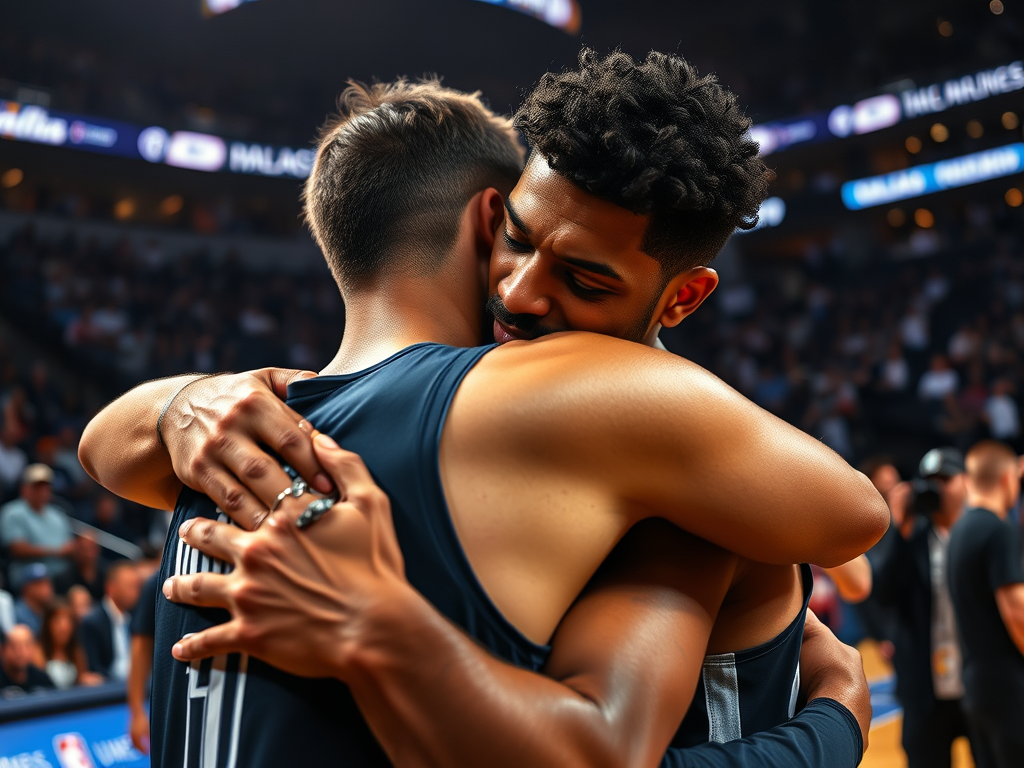
Morris, who played an integral role in shaping the Dallas Mavericks’ team spirit during their NBA Finals run the previous year, emerged from the background to greet his former teammate. With open arms and a warm smile, he pulled Dončić into a hug. Dončić leaned into him, resting his head on Morris’s shoulder while Morris gently patted his back—a quiet gesture of comfort and brotherhood.
Though Dončić usually keeps his emotions well-guarded, on this night, he couldn’t mask the emotional weight of his return to Dallas. It wasn’t just another game. It was personal.
“So many feelings… I don’t even know how to describe it,” Dončić confessed to ESPN’s Lisa Salters after scoring an impressive 45 points in his first game back in Dallas—this time, as a Los Angeles Laker. “I don’t even know how I managed to play. When I saw that tribute video, I thought to myself, ‘There’s no way I can go out there.’ But my teammates were there for me.”

The emotion written on Dončić’s face—his glistening eyes, the trembling of his lips—reminded everyone watching that professional athletes are human beings first. Beneath the stats and highlight reels is a community built on connection, identity, and shared memories. While the NBA often highlights glitz, drama, and debate, moments like this pierce through the noise, offering a glimpse of the league’s heart.
For the past two months, Mavericks fans had been holding onto hope. Wednesday night brought an emotional reckoning. Luka Dončić reminded everyone just how deep the connection between a city and its star player can run. In the NBA, where fans often follow players as loyally as they follow teams, who wins can sometimes matter just as much as what is won. The path to a championship is filled with moments like these—emotionally resonant experiences that give meaning to the trophy at the end.
For Dallas, Luka wasn’t just a player. He was family. And when it comes to family, the flaws don’t matter as much as the bond. Somewhere along the line, the Mavericks’ front office, led by general manager Nico Harrison, lost sight of that. A championship with Dončić leading the way would’ve meant more than just a title—it would’ve been a storybook ending to a love story between a city and its star.
Luka arrived in Dallas as a teenager, just 19 years old, leaving behind Real Madrid and stepping into a new world in Texas. He came of age in a city that knows how to treat its stars. Texas does everything big—especially its sports legends. Dončić was crowned early as the heir to Dirk Nowitzki, and for six and a half years, he gave the fans everything: joy, hope, electricity, and a belief in what could be.
Watching that tribute video, Dončić saw his own journey play out in fast-forward: the people who welcomed him, the charity events he supported, the local hangouts that became familiar, the backroads he learned like he learned a playbook. Dallas wasn’t just a stop in his career. It was home.

But sports are a business. Trades happen. Sometimes, they’re necessary. Relationships fade. Fans call for change. And most of the time, there’s some warning—a slow unraveling that gives everyone involved a chance to process the transition. Klay Thompson’s departure from Golden State was a long time coming, with signs pointing to the inevitable even years before he left. When he signed with Dallas, Warriors fans had already had time to prepare themselves.
But Luka’s exit was different. Sudden. Shocking. Painful. No one expected the Mavericks to let him go—not when he represented their best chance at future glory. Players of Luka’s caliber usually decide their own fate in the modern NBA. For someone else to decide it for him must’ve felt like a betrayal.
That’s what made Wednesday night feel less like a homecoming and more like a farewell. A memorial, even. Yes, it sounds dramatic—but the grief was real. Watching Dončić play through tears, hearing the crowd roar with unconditional love, you could feel it in your chest: something beautiful had ended before its time.
And while Harrison’s vision for the team might make strategic sense—bolstering defense with Anthony Davis, adding shooting power with Klay Thompson and P.J. Washington, surrounding Kyrie Irving with capable big men—on that particular night, none of it mattered. Not to the fans packed into American Airlines Center.
They didn’t care about roster logic. They cared about Luka.
And they made it clear: even if he’s wearing purple and gold, they’ll still wear his jersey proudly. Once a Maverick, always a Maverick. That kind of loyalty is rare. Remember, Dallas fans once viewed the Lakers as rivals, the enemy. The fierce battles between Nowitzki and Kobe Bryant had cemented that rivalry in their hearts. But when it comes to Luka, the rules are different.
What many in Dallas rejected was the idea that Dončić couldn’t bring them a championship. The fans sent a clear message to the basketball world: they would rather chase glory for the next decade with Luka, win or lose, than celebrate a single title without him.
In truth, most franchises in the NBA don’t win titles often. Of the 30 teams in the league, 18 have one championship or none at all. For most fan bases, what matters more are the unforgettable memories, the emotional highs and lows, the growth of a player they love. It’s about challenging the powerhouse teams. It’s about witnessing a talent evolve and knowing you were there from the beginning. And when that player is the face of the franchise—the one orchestrating the moments that make fans cheer, cry, and believe—he becomes more than a player. He becomes the heart of the team.
That’s why losing Luka to a superteam stings so deeply.
Sure, Dončić has the charisma and skill to win over L.A. fans. He’ll create new memories there, forge a new legacy. In time, he might feel at home in Los Angeles just as he once did in Dallas. The Lakers have long been a landing place for the league’s brightest stars, and Luka certainly fits that mold.
But before any of that could happen, he needed closure. He needed to say goodbye—to the fans, to the memories, to the part of himself that grew up in that city. And the world was fortunate enough to witness it.
When the hugs with teammates ended, another familiar figure was waiting: LeBron James. Another embrace. Another sign that Dončić wasn’t alone in this moment of transition.
Because even amid heartbreak, the beauty of sports is this: the emotions are real, the connections are deep, and sometimes, the tears say more than words ever could.




Leave a Reply