
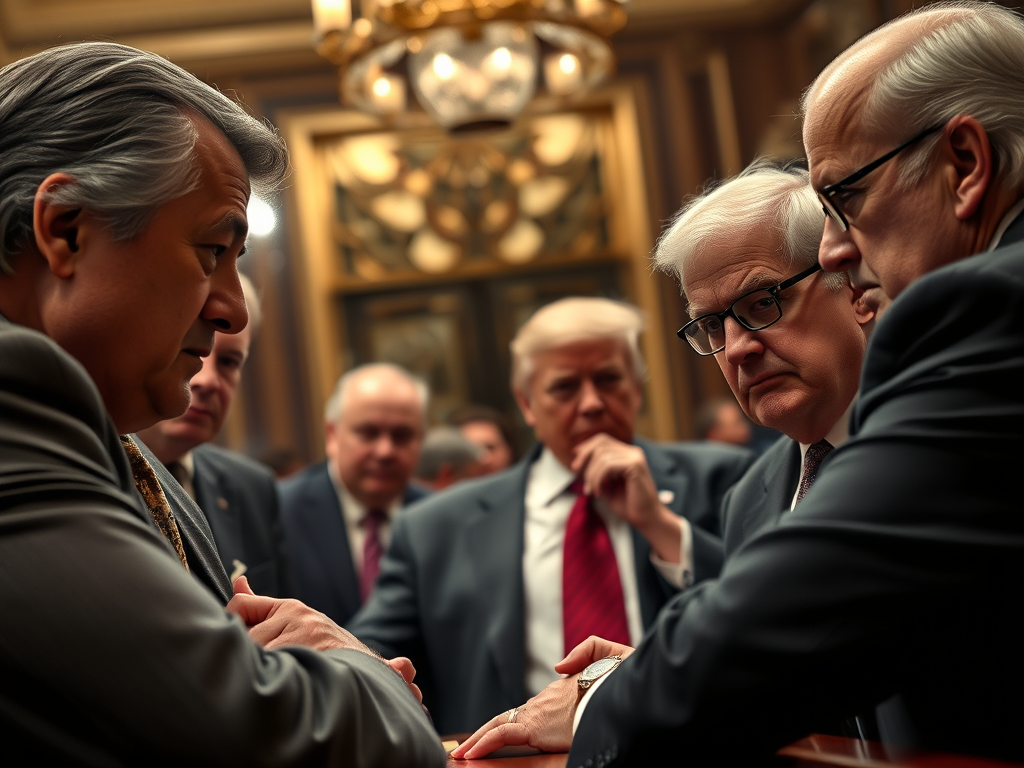

Wall Street Bursts With Anger Over Tariff ‘Stupidity’

Wall Street’s elite are rarely accustomed to being sidelined, especially when it comes to economic policymaking. Yet now, some of the most powerful figures in finance find themselves watching from the margins as President Trump pushes forward with a tariff strategy they strongly oppose—one they believe poses significant risks to the economy.
Against the backdrop of steep market declines, top business leaders have attempted nearly every method available—private meetings, public commentary, and even traditionally conservative investor letters—in hopes of convincing the administration to reverse course. But thus far, their appeals have gone unheeded.
Shortly after the president revealed his most aggressive round of tariffs last week, high-level executives from several leading financial institutions, including JPMorgan Chase CEO Jamie Dimon, met privately with Commerce Secretary Howard Lutnick. The gathering, coordinated by a major lobbying group in Washington, was meant to convey the urgent concerns of the financial world. Yet, according to three individuals familiar with the meeting, Lutnick remained unmoved.

Over the weekend, the effort took a new turn. Major donors to Trump’s re-election campaign personally contacted key administration figures—among them White House Chief of Staff Susie Wiles and Treasury Secretary Scott Bessent—to lobby against the tariffs. But these behind-the-scenes entreaties were also unsuccessful.
By Monday morning, the pressure campaign spilled into the public arena, with prominent hedge fund managers—many of whom had been enthusiastic supporters of Trump’s economic agenda—now voicing their alarm openly.
One such figure was hedge fund billionaire William A. Ackman, who took to X (formerly Twitter) to voice his disapproval. “The global economy is being dismantled due to faulty reasoning,” he wrote. “The President’s advisors must admit their miscalculation and adjust the strategy before April 9th to avoid a major blunder.”
Others joined the chorus. Andrew Hall, a wealthy oil trader and longtime critic of Trump, praised Ackman for having the courage to speak out. “At least he has the integrity to change his stance and challenge this nonsense,” Hall wrote in an Instagram post. “Where are the other so-called financial titans? Why are they remaining silent?”
Some executives have broken their silence, although more cautiously. Jamie Dimon addressed the matter in his annual letter to shareholders, warning that the imposition of tariffs could suppress consumer confidence and dampen economic momentum. While he stopped short of forecasting a full-scale recession, Dimon noted that the instability was prompting many to brace for a downturn.

Laurence D. Fink, CEO of the investment giant BlackRock, took a more direct tone during a midday address at the Economic Club of New York. He warned that the economy was already showing signs of softening. For the first time publicly commenting on the new tariff policy, Fink emphasized that the fallout would be felt broadly, even citing Barbie dolls as an example of everyday items that could see price hikes.
“Most of the CEOs I’m speaking with believe we’re already in a recession,” he said, painting a sobering picture of the current economic landscape.
For many in finance, the situation is bewildering. They’ve long had the ear of presidents from both parties and are stunned to find themselves without influence over an administration that once measured its success by the stock market’s performance. Trump’s previous habit of citing market gains as validation for his economic leadership now stands in stark contrast to his apparent disregard for Wall Street’s current distress.
“I’m not sure Wall Street has any sway with this president anymore,” said Robert Wolf, a former chairman of UBS Americas. “Maybe his donors and friends at Mar-a-Lago can get through to him about how misguided this policy really is.”
There was a fleeting moment on Monday when investors thought their efforts had borne fruit. News reports suggested that the administration was considering a pause in the tariff rollout. Markets immediately responded, reversing early losses and climbing into positive territory. But the optimism was short-lived. The White House quickly denied the reports, and Trump reaffirmed his commitment to the tariffs. By the end of the day, the S&P 500 had dropped another 0.2%, bringing it nearly 18% below its mid-February high—a decline bordering on bear market territory.
In response to mounting criticism, White House spokesperson Kush Desai issued a statement emphasizing that the administration remained in regular contact with business leaders, industry representatives, and ordinary Americans when formulating significant policies like the tariff plan. “President Trump’s only allegiance is to the American people,” Desai said. “His decisions are guided by what is best for the country, including addressing the serious challenge posed by our persistent trade imbalances.”
What particularly worries Wall Street is the possibility that prolonged market instability could stall corporate deals, discourage lending, and ultimately impact the broader economy. Financial executives are now closely examining their portfolios and client relationships for signs of vulnerability, as the rapid decline recalls the early days of the COVID-19 pandemic when the markets—and daily life—ground to a halt.
One leading investment bank, according to a person familiar with internal discussions, is now assessing whether it needs to write down the value of sizable loans it issued to blue-chip companies. These businesses, traditionally considered low-risk, could soon be viewed as vulnerable if market turbulence continues. Banks are set to report their quarterly earnings starting Friday, and such disclosures could spook investors further.
The private lending market, which has grown significantly since the 2008 financial crisis, is also under scrutiny. These lenders often deal with higher-risk borrowers and have long claimed their operations are insulated from broader economic shocks. But a slowdown of this magnitude has never truly tested their resilience.
Although the concerns of financial executives may appear distant from everyday American issues, their arguments to the administration have largely focused on the broader economic fallout. Many American companies depend heavily on exports, and retaliatory tariffs from other countries could disrupt critical revenue streams, leading to layoffs and reduced business investment.

In recent discussions with administration officials, financiers were told that the tariffs are part of a long-term strategy aimed at revitalizing domestic industries like manufacturing, which have declined due to offshoring. Short-term volatility, they were told, may be a necessary trade-off for long-term economic restructuring.
According to a senior executive who has been serving as a go-between for Wall Street and Trump’s team, the prevailing sentiment is shifting. Rather than trying to convince the president to abandon the tariffs altogether, he has begun urging fellow executives to focus on negotiating carve-outs for specific industries that are especially reliant on imports and cannot easily adapt to the new rules.
There are signs that even Wall Street’s most confident players are rethinking their strategies.
Last week, after meeting with Secretary Lutnick, a group of top banking executives reconvened by phone three days later. Rather than discussing how to influence Trump, the conversation centered on mitigating the risks to their institutions and clients stemming from what now appears to be an unshakable presidential directive.
Even Ackman, who had fiercely criticized the tariffs just a day earlier, seemed to soften his stance. In a follow-up post on X Tuesday morning, he wrote that he supported the administration’s goal of using tariffs to end unfair trade practices—but warned that moving forward without sufficient time for adjustment would create avoidable damage.
As Wall Street recalibrates its expectations and strategies, one thing has become clear: its once-commanding influence in the White House has diminished—at least when it comes to tariffs.




Leave a Reply