

How Florida drew from back-to-back champs to stop Houston, start new reign over college hoops

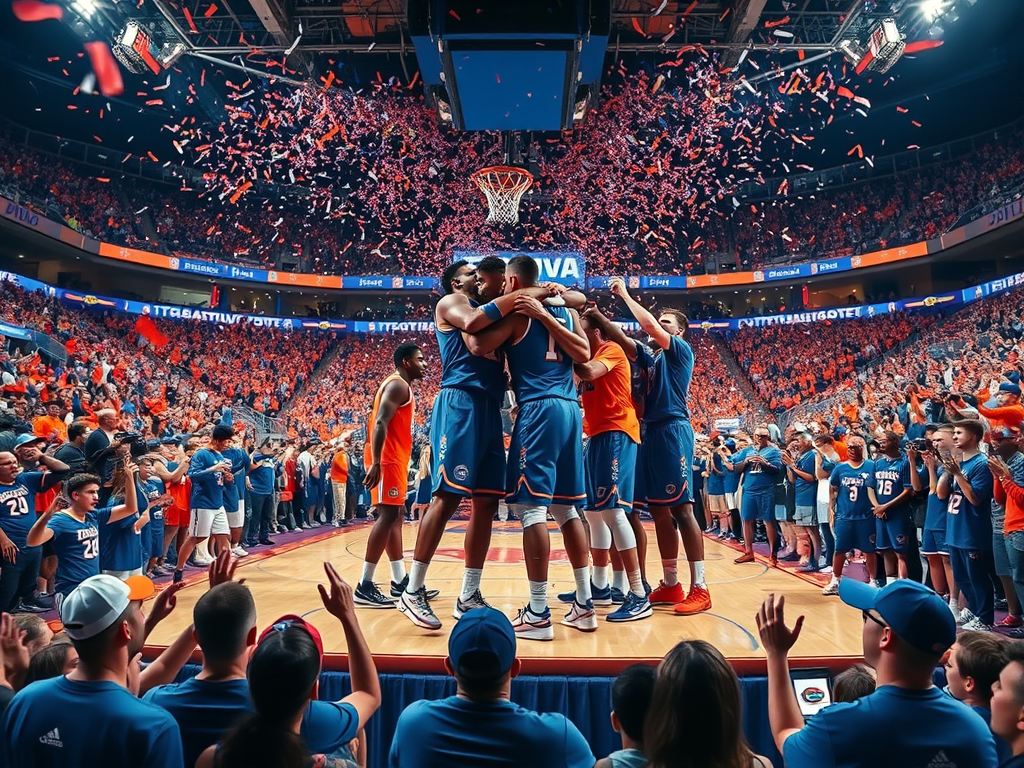
The scene was a flashback wrapped in new fabric: shorter shorts, a sea of blue flooding the Alamodome, and emotions spilling over the hardwood. Players leapt into each other’s arms, ran toward the sidelines to share joy with their fans, and fell into long embraces with coaches as confetti rained from the ceiling. It was a picture Florida basketball fans of a certain age would recognize—a revival of the glory years, only this time with a modern twist.
At center court, a temporary stage stood waiting, just as it had in 2006 and 2007, when Florida last sat atop the college basketball world. This time, after a hard-fought 65-63 victory over Houston, the Gators climbed up once more, taking in the view reserved only for champions. A long wait ended with a crowning moment that echoed the past but also blazed a trail forward.
After years of searching for a return to prominence, the Gators have done it again. Led by head coach Todd Golden, Florida pieced together a balanced, deep, and data-driven team that clawed its way to the top. A comeback win sealed by tenacity, unity, and an unwavering belief has brought Florida its third national championship in school history.
“It puts us back on the map as a basketball school,” said Al Horford, who played a key role in the 2006 and 2007 title runs and has since enjoyed an 18-year NBA career. “We’ve been taking steps, but never quite made it. This team, and Coach Golden, they brought us all the way back.”
Unlike their dominant predecessors, this Florida squad didn’t cruise to the finish line—they fought tooth and nail. Down 12 early in the second half and shaken by a pair of technical fouls, they did not rely on their offensive prowess to turn things around. Instead, they clamped down defensively, forcing Houston into four critical turnovers in the final two minutes. The game ended, fittingly, with a scramble for a loose ball and the clock running out.

Their largest lead of the night? Just two points—the final margin. And in a game where they scored their second-lowest total all season, the Gators’ comeback was tied for the third-largest in NCAA men’s title game history. Yet again, Florida rose when it mattered most.
“We always find a way when it counts,” said guard Alijah Martin, whose clutch free throws in the final minute gave the Gators the lead. “This team was built for these moments.”
Golden’s version of Florida is not a carbon copy of Billy Donovan’s championship squads from the 2000s, but the DNA is similar: resilience, chemistry, and unselfish play. Golden, a self-proclaimed analytics junkie, has implemented a system inspired by Ivy League precision into the heart of the ultra-competitive SEC. His roster? Filled with overlooked and underrated talent that coalesced into something far greater than the sum of its parts.
Walter Clayton Jr. exemplified this transformation. Once a four-star football recruit who started at Iona, Clayton became Florida’s first-ever first-team All-American in basketball and was named Most Outstanding Player of the Final Four. His journey—from “a little bit heavy,” as former coach Rick Pitino described, to national champion—mirrors Florida’s own resurgence.
And their road to the top wasn’t easy. This Final Four may have been the most loaded in tournament history. Yet Florida emerged from the chaos united, strong, and victorious.
Current big man Micah Handlogten described the process as following a well-worn blueprint. “That’s the exact roadmap we wanted to follow,” he said before the title game. “Togetherness. That’s what made those old teams so special. And it’s what got us here.”
Indeed, past champions have often spoken about camaraderie as their secret weapon. Will Richard, one of this year’s Gators, echoed that sentiment: “They played for each other, they worked hard, and they had fun doing it. That’s exactly what we’re about.”
The numbers add further credibility to the idea that this Florida team wasn’t just equal to its predecessors—it may have surpassed them.

The 2006 and 2007 champions ranked third and first nationally in offensive efficiency, respectively. This Florida team entered the championship game ranked second in that category, but its output was six points per 100 possessions better than even the 2007 team. They played faster and smarter, turning the ball over five percent less than their forerunners.
On defense, the comparison is close. While the previous champs had a slight edge in efficiency, this year’s squad faced a tougher schedule, ranked in the top 15 nationally. The result? More wins than any Florida team before them.
Still, this team also faced adversity that those earlier squads did not. Mid-season, the program found itself embroiled in a Title IX investigation involving multiple coaches. Allegations of misconduct were brought forward, including a complaint of sexual assault against assistant coach Taurean Green, a former player from the ’06 and ’07 championship teams.
In January, the university cleared Golden of any wrongdoing. Green’s case remains open. Yet through it all, the team stayed focused.
“We’ve stayed the course and kept our heads down,” Golden said during the West Region press conference in March. “There will be time to address things after the season. Right now, we’re focused on winning basketball games.”
When the Gators reached the Final Four, the pressure lifted slightly. “It felt like a release,” Golden admitted. “We made it. Now, we just hoop.”
And hoop they did—despite a slow start in the final. Florida missed its first six three-point attempts and committed six turnovers in the opening 10 minutes. Still, they trailed by just three at halftime, thanks in part to a surge from Richard, who knocked down four threes on his way to 14 first-half points.
Early in the second half, five fouls and a technical on the bench gave Houston a burst of momentum. L.J. Cryer’s free throw and a three-pointer off the technical pushed the deficit to 10, then 12. But Florida didn’t panic.
“We didn’t point fingers. We didn’t try to play hero ball,” said Golden. “We stayed together and got rewarded for our toughness.”
An 8-0 run brought them back. By the 12-minute mark, it was a one-possession game. By 7:54, Clayton had tied it with an and-one play—his first bucket after a rough shooting night.
The final stretch was a test of nerves and grit. A pair of Martin free throws with 46.5 seconds left gave Florida a 64-63 lead. Then came a defensive stand, a Houston turnover, and one more free throw from Denzel Aberdeen. Houston had a final chance but coughed it up. Alex Condon dove on the ball as time expired, cementing Florida’s victory.
“My elbow’s a little sore from diving on that last play,” Condon said. “But it was worth it.”
For Houston, it was heartbreak. “We held them under 70—that should’ve been enough,” said coach Kelvin Sampson. “But we just couldn’t get a clean look at the end.”
Florida’s improved defense—ranked 94th last season—was now top-10. “We committed to it,” said Condon. “We knew we couldn’t win a title without defense. By the end, we felt like they couldn’t score on us unless they got to the line.”
With stars like Clayton and Martin likely moving on and assistant coaches also on the way out, change is inevitable. But the legacy of this team is secure.
This was not just a championship. It was a statement. A return to relevance. And perhaps, the beginning of yet another era of Gator dominance.




Leave a Reply