
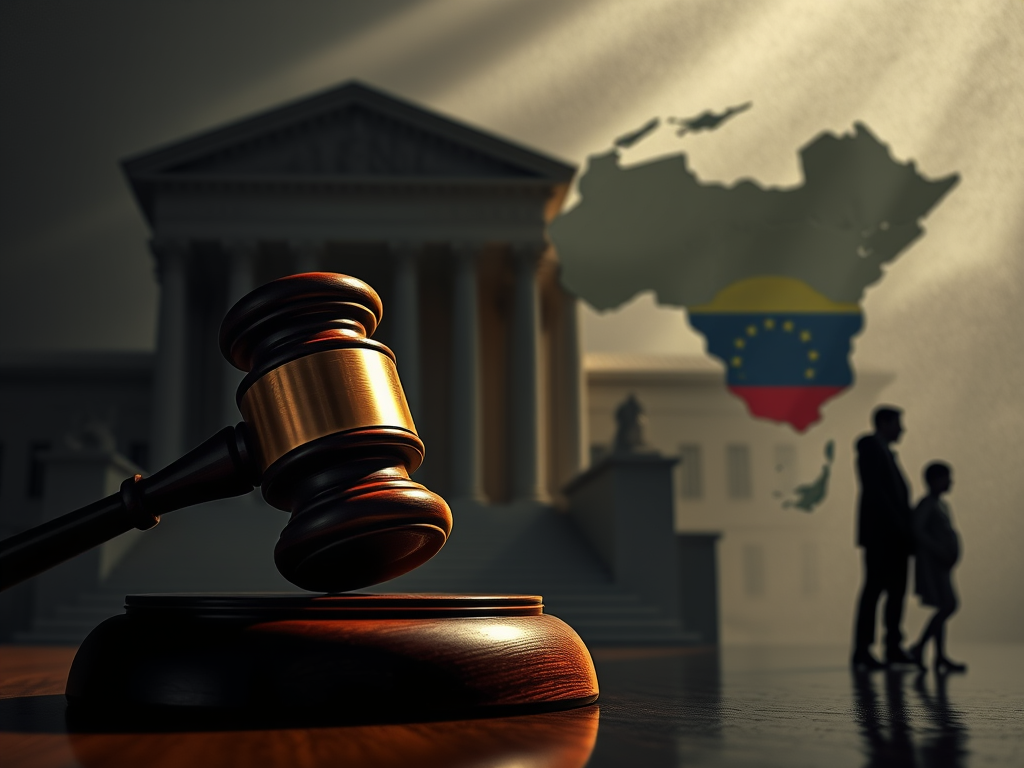

Supreme Court Clears Way for Venezuelan Deportations to Resume, for Now

In a ruling handed down Monday night, the U.S. Supreme Court cleared the way for the Trump administration to resume deportations of Venezuelan migrants under the Alien Enemies Act, temporarily lifting a lower court’s block on the removals. While the decision represents a win for the administration, it was made on procedural grounds and did not address the deeper constitutional issues surrounding the use of a wartime-era statute to justify the deportations.
The justices concluded that the legal team representing the migrants had filed their case in the incorrect jurisdiction. Rather than bringing the lawsuit in a federal court in Washington, D.C., the lawyers should have filed it in Texas, where the migrants are currently detained, the court said.
The ruling was concise and unsigned, which is customary for emergency orders. However, it clarified that although the deportations could proceed for now, the Venezuelan nationals must be given adequate notice and the opportunity to challenge their removal before they are sent out of the United States. Justice Brett M. Kavanaugh emphasized this point in a concurring opinion, noting that all nine justices agreed on the necessity of giving the migrants a chance to contest their removal.
Still, there was disagreement on where and how these legal challenges should unfold.
“The detainees are being held in Texas, therefore filing the case in the District of Columbia was not appropriate,” the court stated in its order.
As part of the decision, the court mandated that the government must notify the migrants that they are being deported under the Alien Enemies Act within a reasonable period. This is to ensure they have a fair opportunity to raise legal objections before they are deported. Although this procedural ruling allows the deportations to continue for now, it may limit the scope of how the Trump administration can use the 1798 law in future immigration enforcement efforts.

Following the announcement, former President Trump celebrated the outcome on his social media platform, Truth Social.
“The Supreme Court has reinforced the Rule of Law in this country by upholding a President’s right to protect our borders and defend the American people,” he wrote. “This is a tremendous day for justice in America!”
However, not all justices were in agreement. Justice Sonia Sotomayor, writing in a dissenting opinion, voiced concern over the legal basis of the decision. She argued that the court had given the administration an unusual and undue benefit without fully acknowledging the serious risks that deported migrants might face.
“The court is enabling the government to undermine legal norms,” Justice Sotomayor wrote. “By granting this emergency relief, the court overlooks the severe consequences these individuals might suffer if wrongly sent to El Salvador.”
Joining her in dissent were Justices Elena Kagan and Ketanji Brown Jackson. Justice Amy Coney Barrett partially agreed with their reasoning.
In a separate dissent, Justice Jackson criticized the court’s increasing reliance on the so-called “shadow docket”—a mechanism through which the court makes significant decisions without full briefings or oral arguments.

“In the past, even our most misguided decisions at least left behind a record for future generations to scrutinize,” Justice Jackson wrote. She drew a comparison to the court’s infamous Korematsu decision from 1944, which upheld the internment of Japanese Americans during World War II.
“With more of our major decisions now happening behind closed doors through emergency orders, there is less accountability,” she warned. “Make no mistake: we are once again making a profound mistake with serious consequences.”
Despite the setback, the legal team representing the Venezuelan migrants expressed a degree of optimism. Lee Gelernt, an attorney with the American Civil Liberties Union (ACLU), acknowledged that they would now need to restart their legal battle in a different jurisdiction, but emphasized that the court had still delivered an important victory.
“The key takeaway here is that the Supreme Court rejected the government’s argument that it could deport individuals without giving them any meaningful notice or opportunity to contest their removal,” Gelernt said. “That’s a significant legal victory.”
The case is one of the most closely watched among the nine emergency appeals filed by the Trump administration with the Supreme Court. It highlights an ongoing conflict between the judiciary and the executive branch over how far presidential authority can extend when invoking national security.
The administration invoked the Alien Enemies Act—a law from 1798—to justify deporting over 100 Venezuelan migrants, whom officials claim are associated with a notorious Venezuelan street gang known as Tren de Aragua. According to the administration, these individuals pose a national security threat, and their deportation is justified under the law, which allows for the detention or removal of citizens from nations considered hostile during times of war or invasion.
On March 14, Trump issued a presidential proclamation alleging that members of Tren de Aragua were actively participating in a hostile “invasion” orchestrated by the Venezuelan government. He described the gang’s actions as aggressive and covertly directed by the Venezuelan regime.
Lawyers representing some of the targeted individuals filed a legal challenge in federal court in Washington, D.C., on the same day the deportation flights began transporting migrants to El Salvador. The Central American country had reached an agreement with the Trump administration to detain the deportees.
Shortly after the flights commenced, U.S. District Judge James E. Boasberg ordered a halt to the deportations, issuing a temporary restraining order while the case was reviewed. He later formalized his decision in a written opinion that blocked the administration’s plan from moving forward.
The government appealed Boasberg’s decision, but a divided three-judge panel of the Court of Appeals in Washington upheld the block. One judge wrote that the migrants had been denied even the “barest thread of due process.”
In response, the Trump administration escalated the case to the Supreme Court, arguing that the judiciary was interfering with decisions that rightly belong to the executive branch, especially in matters of national security.
“This case involves essential questions about who controls national security operations,” the administration stated in its petition to the high court.
In contrast, lawyers for the migrants said the restraining order was the only safeguard preventing the government from carrying out deportations without any procedural protections or oversight.
The ACLU and Democracy Forward, organizations representing the migrants, accused the administration of misusing the Alien Enemies Act by forcibly fitting a criminal gang into the statute’s wartime framework. They argued that Congress never intended for the law to be used this way.

According to court filings, the migrants deported to El Salvador have been confined without communication in one of the harshest prisons in the world, where they face the risk of torture and other serious human rights violations.
The Justice Department responded to these concerns in a filing submitted on Wednesday. Acting Solicitor General Sarah M. Harris stated that the government does not dispute that the migrants are entitled to judicial review of their cases.
“The real issue at stake is procedural—where and how these individuals should raise legal challenges to their classification as enemy aliens,” Harris wrote. She maintained that the appropriate venue for the case was in Texas, not Washington, because that is where the migrants were initially detained.
She urged the justices to lift the existing block on the deportations, calling the delay “an excessively long interference in the President’s ability to manage foreign affairs and national security.”
Harris dismissed the depiction of the situation by the migrants’ lawyers as exaggerated and emphasized that the U.S. government does not condone torture.
“Our position is clear: we denounce torture,” she wrote. “The idea that the United States would knowingly subject individuals to brutality is simply false.”
Though Monday’s decision allows the Trump administration to resume deportations for now, the legal battle is far from over. With the court signaling that constitutional protections must still be observed, the case may continue to shape immigration law and presidential authority in the months ahead.




Leave a Reply